
Duress Button vs. Panic Button: What's the Difference and Which Does Your Hospital Need?
Imagine this for a moment…..
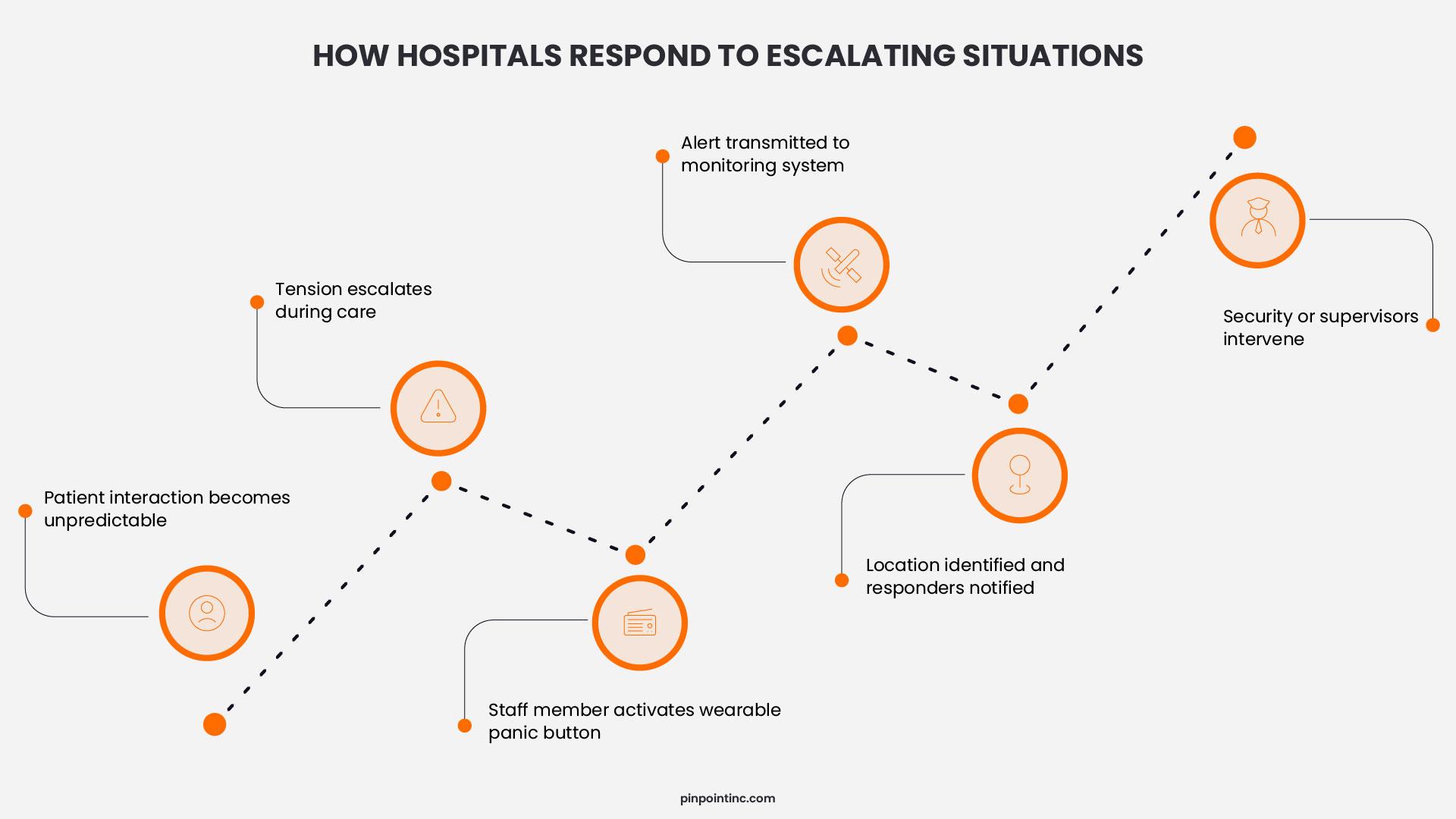
A nurse approaches a patient room to complete a usual standard check. The discussion begins quietly, but the patient’s mood changes abruptly, creating tension that could escalate without warning.
In moments like this, healthcare staff often have only seconds to decide how to signal for help. Should they trigger a panic button, drawing immediate attention to the emergency? Or would activating a duress button be the safer option, quietly alerting security without escalating the situation furthe or some other methods?
At first glance, the difference between these two tools may seem small or ideal…..but in real healthcare environments it can completely change how an incident unfolds.
Hospitals today are placing much greater emphasis on staff safety infrastructure. As organizations evaluate or upgrade their staff duress system, one question often comes up: duress button vs panic button…..what’s the real difference?
Both tools are designed to request assistance, but they serve very different purposes depending on the situation. Understanding when each should be used is essential for building a safety system that truly supports healthcare staff.
Before making that decision, let’s try to understand what a duress button is, how it differs from a panic button, and why both exist in modern workplace safety systems.
What Is a Duress Button vs a Panic Button?
A duress button is designed for situations where drawing attention could make the situation worse. Instead of triggering a loud alarm, it sends a silent alert to security teams or response staff, allowing them to intervene without escalating the threat.
This type of alert is commonly used in environments where staff interact closely with the public or with individuals who may become unpredictable. In healthcare settings, for example, staff may face situations involving aggressive patients, emotionally distressed individuals, or tense interactions that require discreet support.
A staff duress system allows employees to request assistance without making it obvious that an alert has been triggered. From the outside, the interaction may appear normal, while responders are quietly notified behind the scenes.
Now compare that with a PANIC BUTTON.
It’s a safety device designed to trigger an immediate and noticeable alert during an emergency. Panic buttons are meant to draw attention quickly, often activating alarms, notifications, or security responses that signal something urgent is happening.
These alerts are typically used when the situation is already clearly dangerous or when immediate intervention is required.
So while both tools are designed to request help, the difference between a duress button vs panic button comes down to one critical factor…..visibility of the alert.
Browse more expert insights and safety resources designed for hospitals and healthcare organizations.
Duress Button vs Panic Button: Key Differences
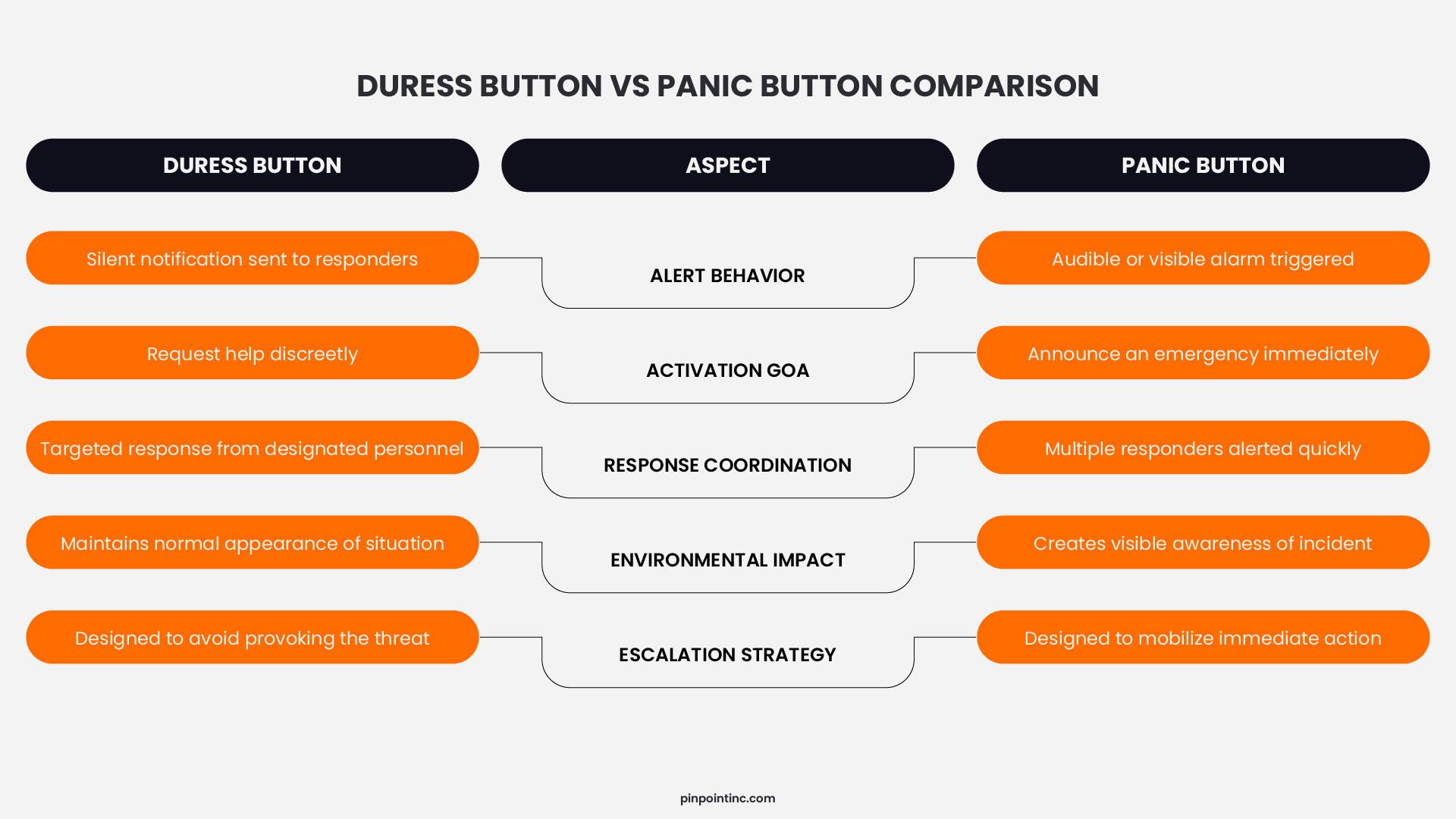
Once the basic definitions are clear, the real difference between a duress button vs panic button becomes easier to understand when we examine how each system behaves when activated. Both tools are designed to request assistance, but the way alerts are triggered and how response teams are notified can be very different.
Below are the key functional differences between the two systems.
Duress Button
It’s designed for situations where the person requesting help cannot openly signal distress.
Key characteristics include:
- Silent alert activation – the alert is transmitted without drawing attention
- Discreet request for assistance – responders are notified quietly
- Designed for escalating interactions – useful when open alarms may worsen the situation
- Targeted response notification – alerts typically go directly to security or designated responders
- Controlled response approach – responders can intervene without alarming everyone nearby
- Often integrated into staff duress systems for workplace safety environments
Panic Button
A wearable panic button is designed to create immediate awareness that an emergency is happening.
Key characteristics include:
- Audible or visible alarm – the alert is designed to attract attention
- Immediate emergency signaling – indicates an urgent situation requiring fast respons
- Wide notification reach – alarms or alerts may be broadcast across a facility
- Rapid escalation response – multiple responders may be alerted simultaneously
- Designed for clear emergencies where immediate attention is required
Why Hospitals Often Prefer Duress Alerts for Staff Safety
Because many safety incidents in healthcare do not begin as clear emergencies.
In hospitals, situations often develop gradually. A patient may become frustrated, confused, or emotionally distressed before the interaction escalates further. During these moments, staff may need assistance quickly, but triggering a loud alarm could draw unnecessary attention and potentially worsen the situation. A duress button allows healthcare workers to quietly signal for help while continuing to manage the interaction.
This challenge is reflected in real workplace data. Alone in New York, reports connected to the New York State Nurses Association show that more than 80% of nurses experienced workplace violence in a single year, highlighting how frequently frontline staff encounter aggressive situations during routine care.
Because of these realities, many healthcare facilities are adopting wearable panic button devices that allow staff to request help wherever they are working. These systems allow alerts to be triggered discreetly while responders are notified and move toward the location.
The Shift Toward Wearable Panic Buttons for Employees
Now an important question comes up, if hospitals already have security teams and emergency protocols, why rely a wearable panic button at all?
The answer becomes clearer when looking at the safety tools many facilities have traditionally used.
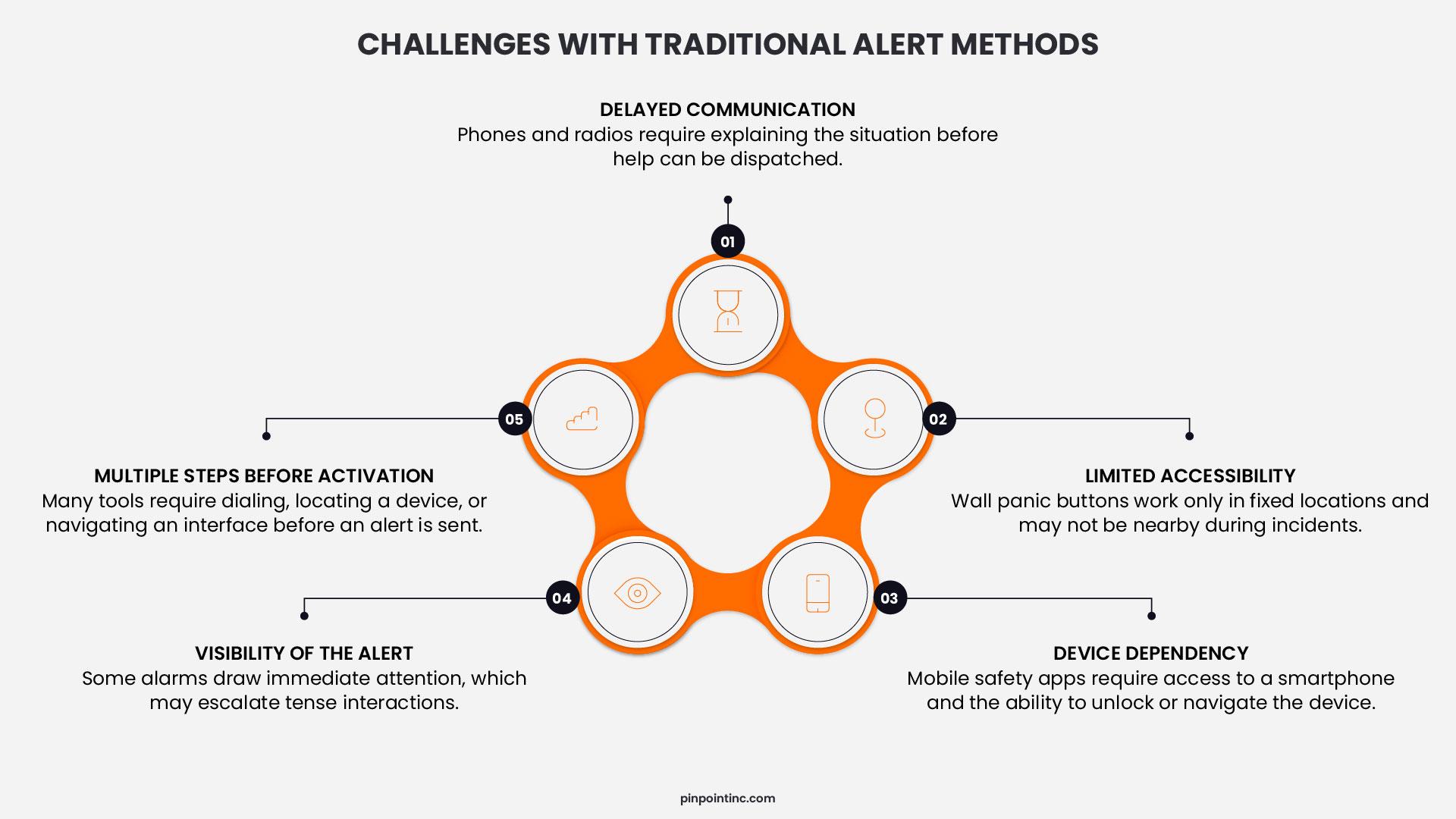
Common Tools Used in Safety Situations
Phone or Desk Communication
- Staff may call security or supervisors during an incident
- Requires reaching for a phone or stepping away from the patient
- Not always practical when a situation is escalating quickly
Two-Way Radios
- Often used by security personnel or supervisors
- Healthcare staff may not always carry radios during routine care
- Communication can be difficult during tense or unpredictable interactions
Wall-Mounted Panic Buttons
- Installed at fixed locations such as reception desks or nursing stations
- Effective only when staff are close to the button
- Staff working inside patient rooms may not be able to reach them quickly
Mobile Safety Applications
- Smartphone apps designed to send emergency alerts
- Require unlocking the phone and opening an application
- Depend on device availability and network reliability during stressful moments
So, unlike fixed alarms or communication tools, wearable devices are designed to trigger alerts immediately with minimal effort from the employee.
When activated, the system can notify designated responders and identify where assistance is needed inside the facility. This allows security teams or supervisors to respond quickly without relying on phone calls or manual communication during a tense or vulnerable situation.
Talking about the healthcare environments where interactions can change rapidly, this type of instant alert capability helps ensure that staff can request support the moment a situation begins to escalate.
How Pinpoint Approaches Staff Safety
As hospitals move away from fixed alarms and manual communication tools, the next question becomes practical: what does a modern wearable safety system actually provide in real healthcare situations?
Pinpoint approaches staff protection by combining duress alerts and panic alerts into a single wearable panic button for employees. The system is designed for situations where staff may need to request assistance while still standing in front of a patient or continuing a clinical interaction.
The wearable device itself is built as a badge-style unit that can be worn alongside a standard staff ID. Instead of relying on a visible alarm, the device includes two discreet buttons on the back, allowing staff to trigger an alert without drawing attention during a tense moment.
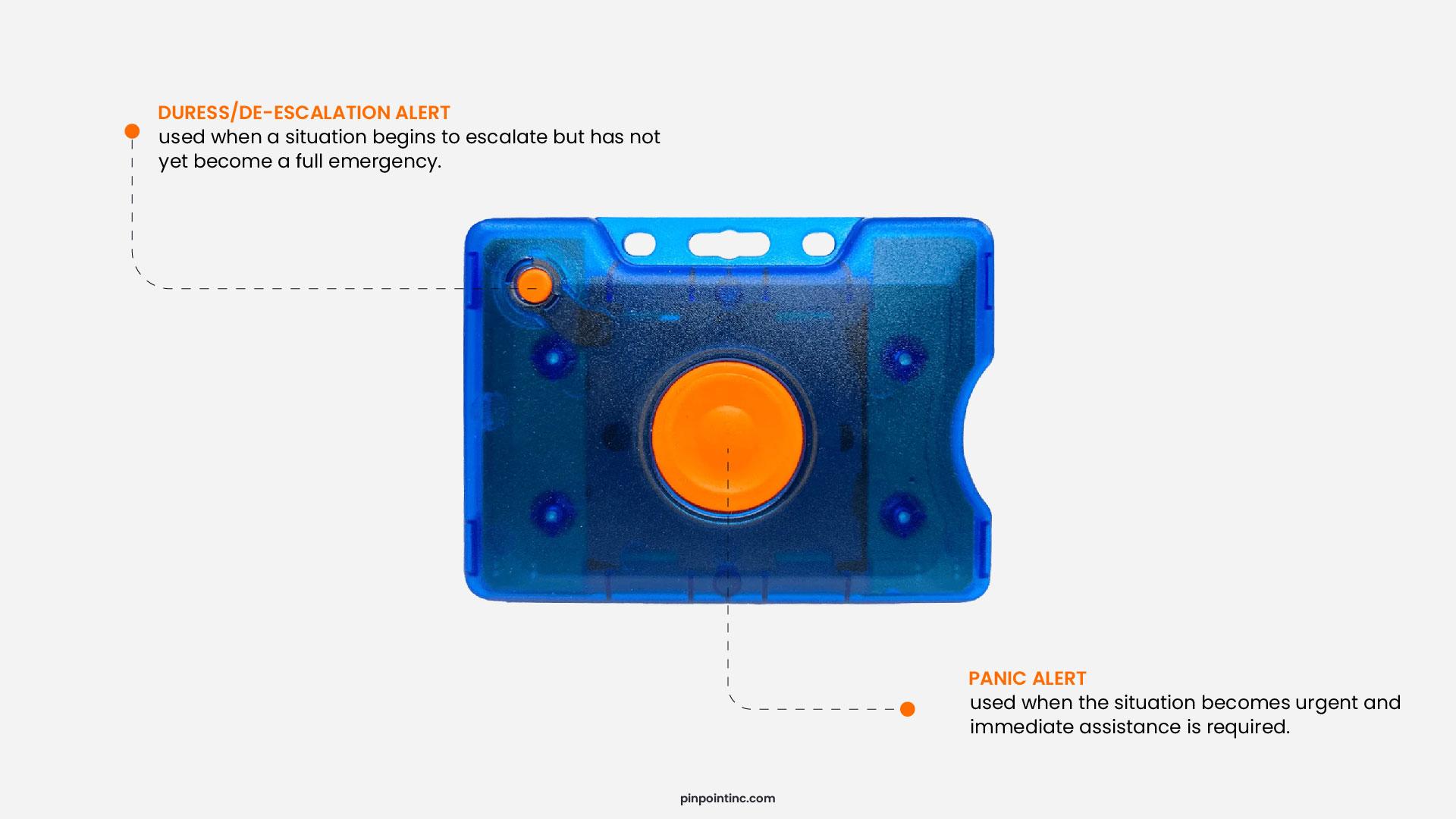
This distinction is important in healthcare environments where many incidents begin gradually. Staff often recognize warning signs before a situation becomes dangerous, and the ability to signal for help early can prevent further escalation. Even when the panic button is activated, the alert is transmitted discreetly through the system rather than triggering a loud alarm, allowing responders to assist without drawing attention in front of patients or others nearby.
Another design difference is how the system handles location information. Pinpoint uses a non-tracking architecture, meaning staff are not continuously monitored during their shift. Instead of tracking movement throughout the day, the system determines the location only when the button is pressed, allowing responders to identify the exact room where assistance is needed.
Once an alert is triggered, notifications are routed to security teams or designated responders through monitoring dashboards and mobile devices, allowing them to reach the location quickly.
Choosing the Right Safety System for Your Hospital
Selecting a staff safety system in healthcare is rarely just a technology decision. In many hospitals, the discussion quickly moves beyond alarms and devices to deeper questions about usability, privacy, and operational complexity.
Healthcare leaders often evaluate safety infrastructure by asking a few practical questions.
→ Will the system escalate or de-escalate tense situations?
In many patient interactions, openly triggering an alarm may worsen the situation. This is why understanding the difference between a duress button vs panic button is important, as discreet alerts can allow staff to request assistance without drawing attention.
→ How dependent is the system on IT infrastructure?
Some safety solutions require complex integrations, mobile device management, or heavy network dependencies. If the system relies on multiple layers of technology before an alert can be sent, it may become difficult to deploy and maintain across a large hospital environment.
→ Will staff feel comfortable using the system every day?
Adoption is a critical factor. If the safety tool feels intrusive or complicated, staff may hesitate to use it during real situations.
→ Does the system track employees continuously?
This concern often surfaces during implementation discussions. Continuous tracking systems can raise privacy concerns among healthcare workers and may create what some staff describe as ambient stress, where employees feel constantly monitored during their shift.
→ Can staff request help instantly without leaving the situation?
During patient care, staff may not have time to step away, make a call, or locate a fixed alarm. The safety system should allow assistance to be requested immediately when a situation begins to escalate.
These considerations help hospitals evaluate whether a duress button system, a panic alert system, or a combination of both best supports their environment.
Ultimately, the goal is not just to install a safety tool but to implement a system that staff trust, are comfortable wearing, and can rely on when situations become unpredictable.
If you’re reviewing staff safety technology, schedule a demo to see how Pinpoint’s wearable alert system supports healthcare teams.
FAQ’s
What is a duress button?
A duress button is a safety device used to request help discreetly during a threatening or escalating situation. When activated, it silently notifies designated responders without triggering a loud alarm. This allows security or supervisors to intervene without drawing attention to the alert.
What is the difference between a duress button and a panic button?
The main difference between a duress button vs panic button lies in how the alert is triggered and handled. A duress button sends a discreet alert to responders, while a panic button signals a more urgent situation that requires immediate attention.
Do wearable panic buttons track employees?
Not all systems track employees continuously. Our safety solutions use non-tracking technology that identifies location only when the button is activated. This allows responders to find the correct location while avoiding constant monitoring of staff during their shift.
Are wearable panic buttons only used in healthcare?
No. Wearable panic buttons are used across many industries including healthcare, hospitality, banking, and education. However, they are particularly valuable in hospitals where staff frequently interact with patients one-on-one.
Page Navigation
Author:
Jordan Belous
Chief Marketing Officer of Pinpoint North America, where she leads marketing strategy, brand development, and digital growth initiatives. She earned a Bachelor of Science in Allied Health with a concentration in physical therapy sciences from the University of Tampa, bringing a unique interdisciplinary perspective that blends healthcare knowledge with modern marketing strategy.
Jordan writes about workplace violence prevention in healthcare, nurse safety, staff wellbeing, and emerging healthcare technologies that support frontline teams. Her work explores how hospitals and behavioral health facilities can build safer environments, reduce burnout and turnover, and implement safety systems that protect staff while preserving trust and dignity.
She is also the Chief Executive Officer of Whip Pediatric Cancer, a nonprofit dedicated to supporting children battling cancer and raising awareness and funds for pediatric cancer. Through her work with Whip, Jordan regularly visits pediatric cancer patients in hospitals and spends time alongside patients, families, and the clinicians who care for them. These experiences place her directly beside nurses and healthcare teams every day and reinforce her belief that the people providing care deserve to feel just as safe as the patients they serve.
Her experiences with Whip and her work at Pinpoint are closely connected, both driven by her deep respect for nurses and frontline healthcare workers. Seeing firsthand the compassion, resilience, and critical role nurses play has strengthened her commitment to advocating for safer healthcare environments and ensuring that those who dedicate their lives to caring for others have the protection and support they deserve.