
Wearable Panic Button System Designed for All Healthcare Settings
Pinpoint’s wearable panic button is a non-tracking safety solution that helps healthcare workers and employees discreetly request help before situations escalate. Designed for high-risk environments like hospitals, it ensures staff can get immediate assistance without compromising privacy.
Why Is a Wearable Panic Button Becoming Essential in Healthcare?
Without a reliable way to call for help in real time, situations like patient aggression, verbal threats, or unexpected behavioral escalations can quickly turn into serious safety risks. Delayed response not only affects staff safety but also creates long-term operational and workforce challenges across the organization.
- Higher staff turnover and retention issues
- Increased absenteeism and unplanned leave
- Burnout and disengagement among staff
- Greater risk of workplace injuries and incidents
- Rising mental health and stress-related claims
- Reduced trust in workplace safety

Two Alert Levels. Two Buttons.
One Responsive Wearable Non-Tracking Panic Button System For Employees
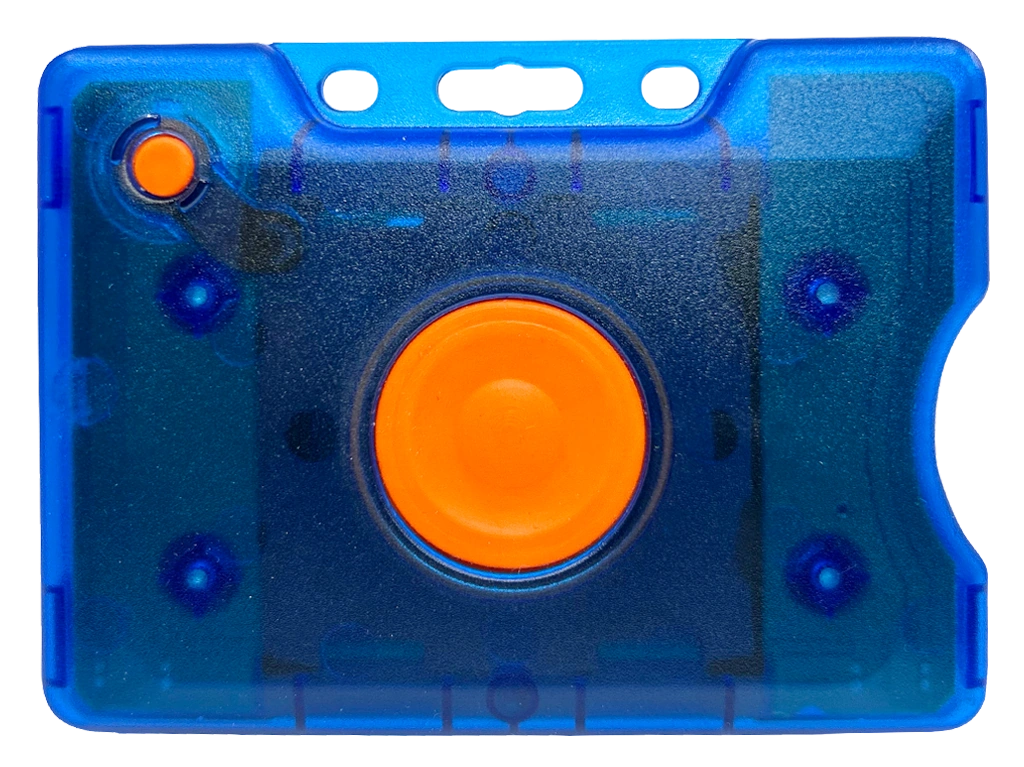
Clear, situation-based response system built into one wearable panic button system for nurses and staff in high-risk environments.


De-Escalation Button
What it is
The de-escalation alert is used when a situation begins to escalate but has not yet become an emergency.
When it’s used
Nurses and staff often recognize early warning signs such as agitation, pacing, raised voices, or verbal aggression.
Common scenarios
- Patient becoming verbally aggressive
- Family member refusing to comply
- Behavioral health patient showing agitation
- Patient pacing or displaying escalating behavior
- Visitor becoming disruptive in a care area
Outcome
By activating this button, employees can discreetly request nearby support, enabling early intervention and preventing situations from escalating into violence.

Panic Button
What it is
The panic alert is used when there is an immediate threat or dangerous situation requiring urgent response.
When it’s used
This includes moments where staff face physical harm, are unable to disengage, or require immediate assistance.
Common scenarios
- Physical assault
- Weapon presence
- A staff member being trapped or unable to disengage
- Patient attempting to cause immediate harm
- Staff member requiring urgent assistance
Outcome
This employee panic button triggers a high-priority alert, ensuring rapid response from security and emergency teams when every second matters.
Comparing Healthcare Panic Button Systems -
We're Not Like The Others
Healthcare environments require safety systems that work reliably in unpredictable situations. Different wearable panic button systems vary in how they deliver alerts, locate staff, and support response teams. Understanding these differences helps healthcare organizations choose a solution that performs consistently when it matters most.

Wearable Panic Button (Non-Tracking)
- Identifies the exact room only when an alert is triggered
- No continuous tracking, preserving staff privacy and trust
- Operates independently of Wi-Fi, avoiding network congestion risks
- Uses installed receivers to ensure consistent coverage across facility
- One-touch activation allows immediate response without device handling
- Designed for fast, reliable use during real-world healthcare incidents
Fixed-point panic button
- Provides exact location, but only at installed button locations
- Staff must physically reach a wall or desk-mounted button to activate
- Works reliably within installed zones, not across the full facility
- Provides exact location, but only at installed button locations
- Staff must physically reach a wall or desk-mounted button to activate
- Works reliably within installed zones, not across the full facility
Smartphone panic button
- Location accuracy varies and is often unreliable inside buildings
- Requires staff to carry, unlock, and access a mobile device
- Dependent on Wi-Fi, cellular signal, and battery availability
- Performance can degrade in critical or high-traffic environments
- Alerts may fail or delay due to connectivity or device issues
- Adds dependency on personal devices during high-stress situations
Wearable RTLS Panic Button (Continuous-Tracking)
- Continuously tracks staff location across the entire facility
- Requires complex RTLS infrastructure with ongoing calibration
- Higher setup, maintenance, and operational overhead
- May introduce privacy concerns and reduce staff adoption
- Dependent on multiple technologies working simultaneously
- Accuracy and performance require continuous system management
Built for Every Healthcare Environment
This wearable panic button system supports nurses and staff across different care settings, adapting to the unique safety challenges of each environment.
Hospitals
Enable rapid response across departments with a wearable panic button for nurses and staff safety.
Behavioral Health
Support early intervention with a wearable employee panic button designed for escalating situations.
Residential Rehab Centers
Provide discreet access to help with a wearable employee panic button that fits daily care routines.
Simple to Use, Simple to Install

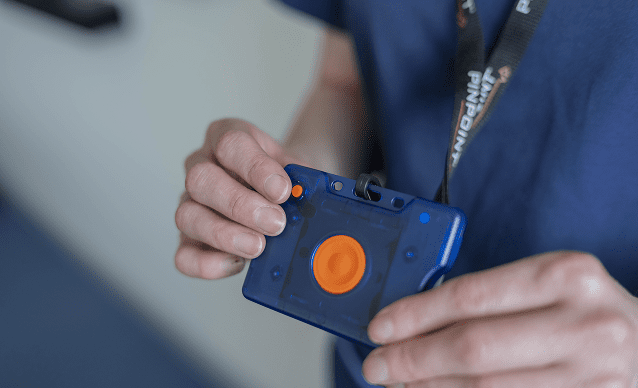
Trigger via Wearable ID Badge
Pinpoint offers two wearable options for triggering an alert: a Wearable ID Badge or a Perpetual Pit. Both options activate the same Pinpoint system and follow the same alerting logic. Neither option requires programming or individual assignment. They work in any facility equipped with Pinpoint and can be passed between staff without administrative setup. Both triggering options are wearable and designed for all-day use. Staff can choose the option that best fits their role or preference.

Pinpoint Room-Level Location Awareness
Tamper-resistant and ligature-resistant receivers are installed throughout the hospital, including patient rooms, hallways, treatment areas, and common spaces, to precisely pinpoint staff location when help is needed.

When a panic button is pressed:
- The system determines the staff member’s location in real time
- Location accuracy is provided at the room or zone level
- Responders immediately know exactly where to go
This level of precision is critical in hospital environments, where “third floor” or “east wing” is not enough. Seconds matter, and responders need exact location information to act quickly and effectively.
Receive via a Ceiling Mounted Device in Each Room
True room-level accuracy you can rely on.
Pinpoint uses supervised, hardwired infrared receivers installed throughout the facility, wherever you want coverage. This includes patient rooms, hallways, treatment areas, and common spaces. Because the system is hardwired and supervised, receiver status is continuously monitored. Connectivity issues or device failures are identified immediately, not during an emergency. When a button is pressed, the system determines the exact pinpointed room location at that moment, delivering consistent reliability and accuracy without dead zones or wireless interference.

Alerts Sent to Your Team 5 Ways
When a staff member triggers an alert, the system immediately notifies designated responders simultaneously across multiple channels. Organizations determine who is alerted and how alerts are delivered, ensuring the right people are notified without delay:
Core Features
Room-Level Precision
Identify the exact room instantly, so responders reach the right location without delay.
Zero IT Overhead
No complex setup or ongoing IT involvement required, reducing operational burden.
Hardwired Infrastructure
Reliable, interference-free system that works consistently across your entire facility.
5–7 Year Battery Life
Long-lasting performance reduces maintenance and ensures continuous staff protection.
Dual Alert System
Trigger early assistance or emergency response based on the situation.
Non-Tracking Privacy Design
Staff are not continuously monitored. Location is shared only when help is requested.
Instant Alert Delivery
Alerts are sent immediately across multiple channels within 85ms ensure faster response.
Seamless Staff Adoption
Works with existing badges and workflows, making it easy for nurses and staff to use daily.
Location Accuracy Without Invasive Staff Tracking
One of the most important aspects of Pinpoint’s system is privacy. The system does not continuously track staff:
Location is only captured when a button is pressed
No movement monitoring
No productivity tracking
No “big brother” surveillance
This design is intentional. Staff adoption depends on trust, and hospitals consistently see higher acceptance when staff understand the system exists solely for their protection.

Where the Pinpoint System Is Most Valuable
Hospitals deploy Pinpoint’s panic button system across a wide range of departments and care settings, including:
The system scales easily from single departments to entire hospital campuses.
Built for Facilities that Refuse to
Compromise on Life Safety.
Click every criteria that matters to your team.
16 fit factors. See how many Pinpoint delivers.
You don't want alerts to fail because of interference, dead zones, or network congestion.
You care about a supervised system that tells you when something isn't working.
You want a system with little to no IT overhead.
You want a solution with no per-device, per-month fees.
You want a panic button that doesn't track staff location.
You want something safe to wear for long shifts, including near vital organs with no RF concerns.
You want a discreet, lightweight, wearable badge that's always with you.
You want a device that doesn't need to be charged and has long, reliable battery life.
You want a badge that's anti-ligature, tamper-resistant, and antimicrobial.
You want a system that doesn't interfere with medical equipment or devices.
You want two-tiered buttons that support de-escalation and true panic alerts.
You want to reduce alarm fatigue so security responds only when needed.
You want to reduce hesitation when someone truly needs help.
You want true room-level accuracy at the moment help is requested.
You want a system that's scalable and modular as your facility grows.
You want a management portal that supports oversight and compliance.
Frequently Asked Questions
A wearable panic button works by allowing nurses and employees to instantly send an alert when they need help. When the button is pressed, the system transmits a signal to nearby receivers, identifying the exact location of the user. This triggers real-time alerts to security or response teams through multiple channels, enabling immediate assistance. Our system also include dual alert levels, allowing staff to request early support or activate emergency response depending on the situation.
A wearable panic button enables nurses and staff to call for help immediately when facing aggression, threats, or emergencies. With features like room-level accuracy and dual alert levels, it allows early intervention before situations escalate, reducing workplace violence, injuries, and response delays.
Traditional panic buttons only trigger alerts during emergencies. This system includes dual alert levels, allowing staff to request help early through de-escalation alerts or activate emergency response when needed. It also provides room-level precision and does not continuously track staff location, ensuring both safety and privacy.
No. This wearable panic button is designed with a privacy-first approach. Employee location is only shared when an alert is triggered, not continuously tracked. This ensures staff safety without compromising privacy or creating monitoring concerns.
No. The system is built with minimal IT overhead. It uses a reliable infrastructure that does not depend on congested networks and requires little ongoing maintenance, making it easy to deploy and manage across facilities.
Yes. The wearable panic button system is designed to support workplace violence prevention initiatives aligned with OSHA guidelines and Joint Commission expectations. By enabling staff to quickly request help, improving response times, and documenting incidents through a centralized system, it helps healthcare organizations strengthen safety protocols, enhance reporting, and demonstrate a proactive approach to staff protection and compliance.
In many panic button systems, alerts rely on Wi-Fi or cellular networks, which can fail during outages, congestion, or infrastructure issues. Pinpoint operates independently of these networks, using a dedicated in-building system to deliver alerts reliably. This ensures staff can request help and responders receive alerts even when traditional networks are unavailable or unstable.