
What Is a Wearable Panic Button? (And Why Healthcare Needs One That Doesn't Track)

Let me ask you something.
Have you ever spoken with a nurse about the moment a routine interaction with a patient suddenly turns tense?
Not the dramatic scenes you see in movies, but the real situations that unfold quietly inside patient rooms or in a hallway where no one else happens to be nearby.
We hear these stories often when speaking with healthcare teams.
A nurse walks into a room for a normal check, expecting a quick conversation about medication or vitals, and within seconds the situation shifts. The patient becomes agitated, voices start rising, and now the nurse needs support, but the nearest phone is outside the room and security has no idea that something is happening.
Another scenario comes up frequently during night shifts. A staff member might be covering several rooms across a floor, moving between patients and sometimes working alone for stretches of time. If something escalates in that moment, the only options may be reaching for a phone or calling through a radio, both of which take time and often require stepping away from the situation.
And in healthcare, those few SECONDS matter more than people realize.
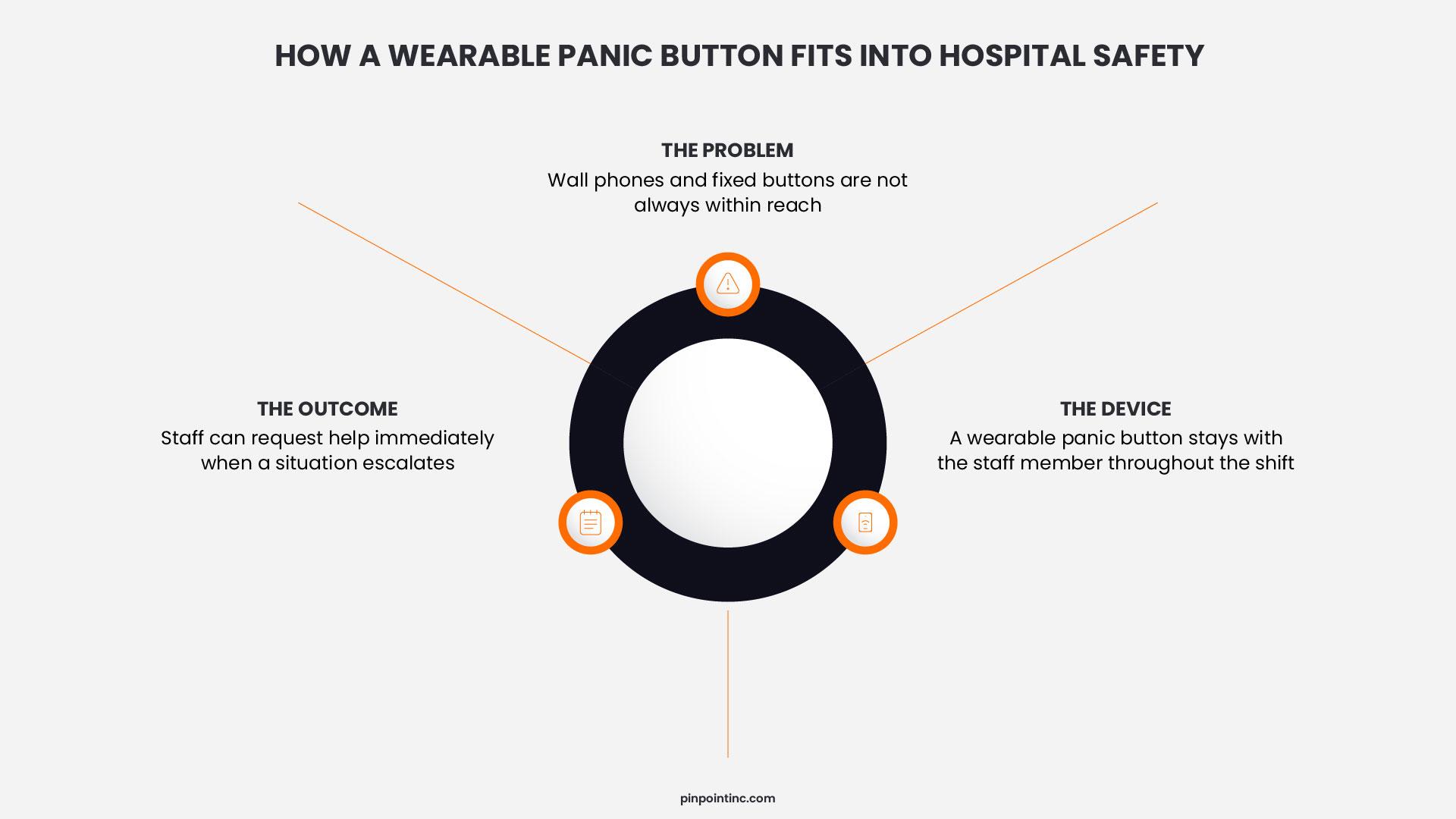
Most hospitals were originally built around fixed communication points like wall phones, nurse stations, and intercom systems. Those tools still serve an important purpose, but they only work when someone is close enough to reach them at the exact moment help is needed.
This is exactly where the idea of a wearable panic button began gaining attention in healthcare environments.
Instead of searching for a wall device or stepping away from a situation to make a call, a staff member can trigger an alert immediately with a small device worn during their shift, sending a signal that help is needed without drawing attention or losing valuable time.
But before looking at how hospitals use this tool, let’s answer a simple question.
What is wearable panic button technology, and how does it actually work inside a hospital environment?
What Is Wearable Panic Button?
A wearable panic button is a small emergency alert device that healthcare staff can carry or wear, allowing them to request help instantly with a single press. (you cab also define how it works like things right?)
At its core, the idea is simple. When a situation begins to escalate, the person in the room should not have to search for a phone, walk to a nurse station, or step away from the patient just to call security.
Instead of relying on fixed alert points around the hospital, the safety device moves with the staff member. A nurse can press the button discreetly while staying with the patient, and the system immediately sends an alert to the hospital’s response or security team.
This mobility is what separates it from traditional panic systems.
For years, hospitals relied on wall-mounted panic buttons placed in certain rooms or corridors. Those systems still exist, but they only work if someone is close enough to reach them at the moment help is needed. In a hospital environment where staff move constantly between rooms, hallways, and wards, that limitation becomes obvious.
These devices are intentionally small and easy to carry during a shift. Depending on the system, they can appear in several formats, including:
- Badge-style buttons worn with staff IDs
- Pendant devices on a lanyard
- Wrist-based safety buttons
- Clip-on devices attached to uniforms
Regardless of the format, the purpose remains the same. When someone presses the button, the wearable panic button sends an emergency signal through the hospital’s safety system, allowing help to reach the right location much faster.
How Wearable Panic Buttons Work
Once someone understands what a wearable panic button is, the next question is simple: what actually happens when a staff member presses it?
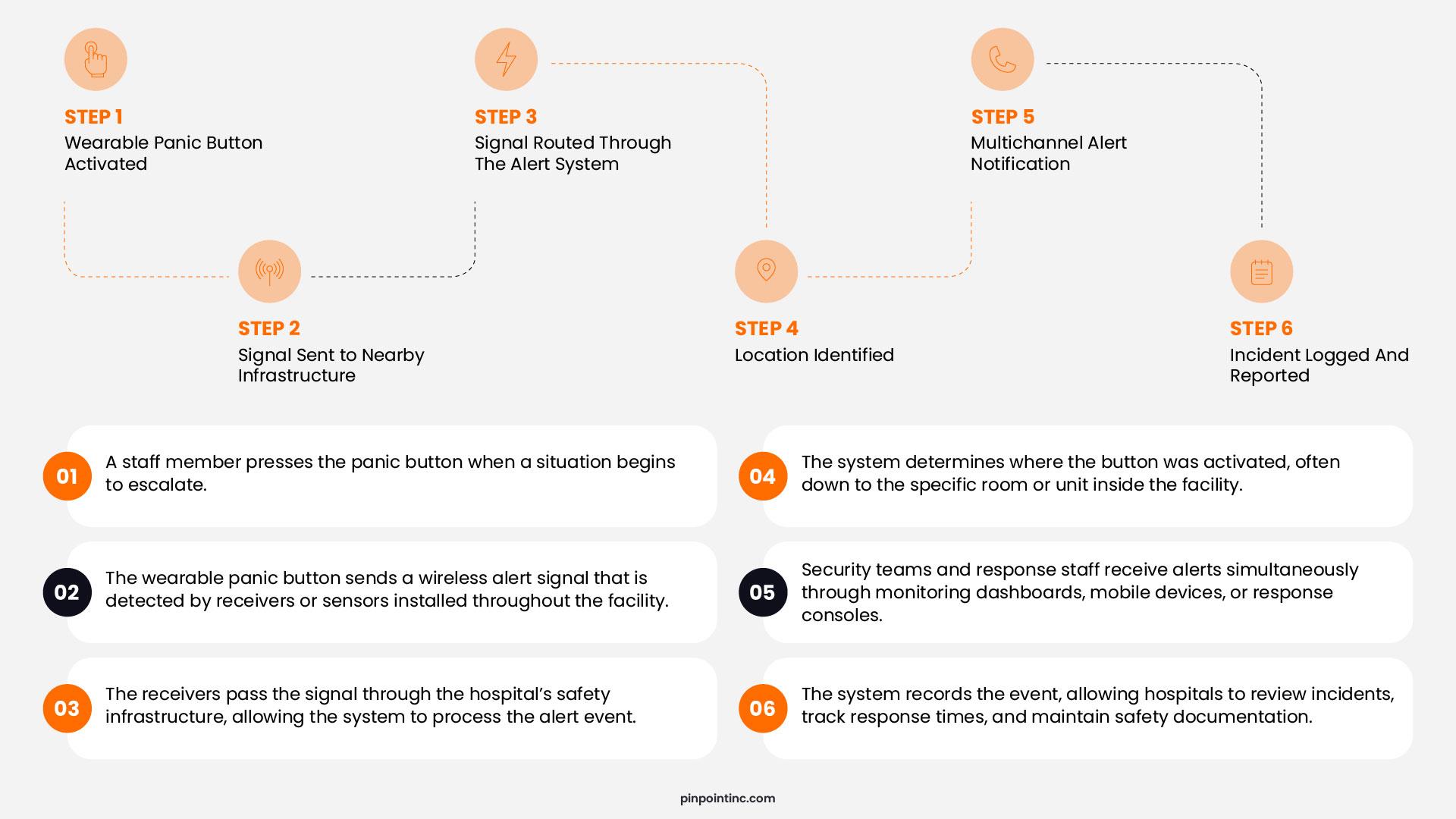
Inside a hospital, the system follows a clear sequence designed to trigger help quickly and accurately.
Button Activation
A wearable panic button is typically integrated into a badge-style device that can be clipped to a uniform or worn with an ID holder.
Many panic buttons for nurses include two or more activation options. One button signals a critical emergency, while another can request assistance when a situation is escalating. This gives response teams context before arriving and allows staff to ask for help earlier.
Signal Transmission
When the button is pressed, the wearable panic button sends a signal that is picked up by receivers installed throughout the hospital.
Those receivers pass the alert through the facility’s safety infrastructure so the system can process the event and route it to the correct response team. In many hospitals, panic button systems rely on technologies such as WiFi, Bluetooth, or RTLS to transmit alerts and estimate where the signal originated.
Room-Level Location Identification
As the alert moves through the system, the infrastructure determines where the button was activated.
Advanced wearable panic button solutions for hospitals can identify the exact room where the alert originated. Instead of sending responders to a general area or floor, the system directs them straight to the correct location.
Multichannel Alerts and System Monitoring
Once the location is confirmed, the alert is sent to the designated response team through multiple notification channels at the same time. Security personnel or supervisors receive the alert immediately so they can respond without delay.
Modern systems also monitor their own infrastructure. If a receiver or device loses connectivity, the platform flags the issue and notifies the central system so the problem can be addressed quickly, reducing the chance of unnoticed failures.
Why Healthcare Workers Face Unique Safety Risks
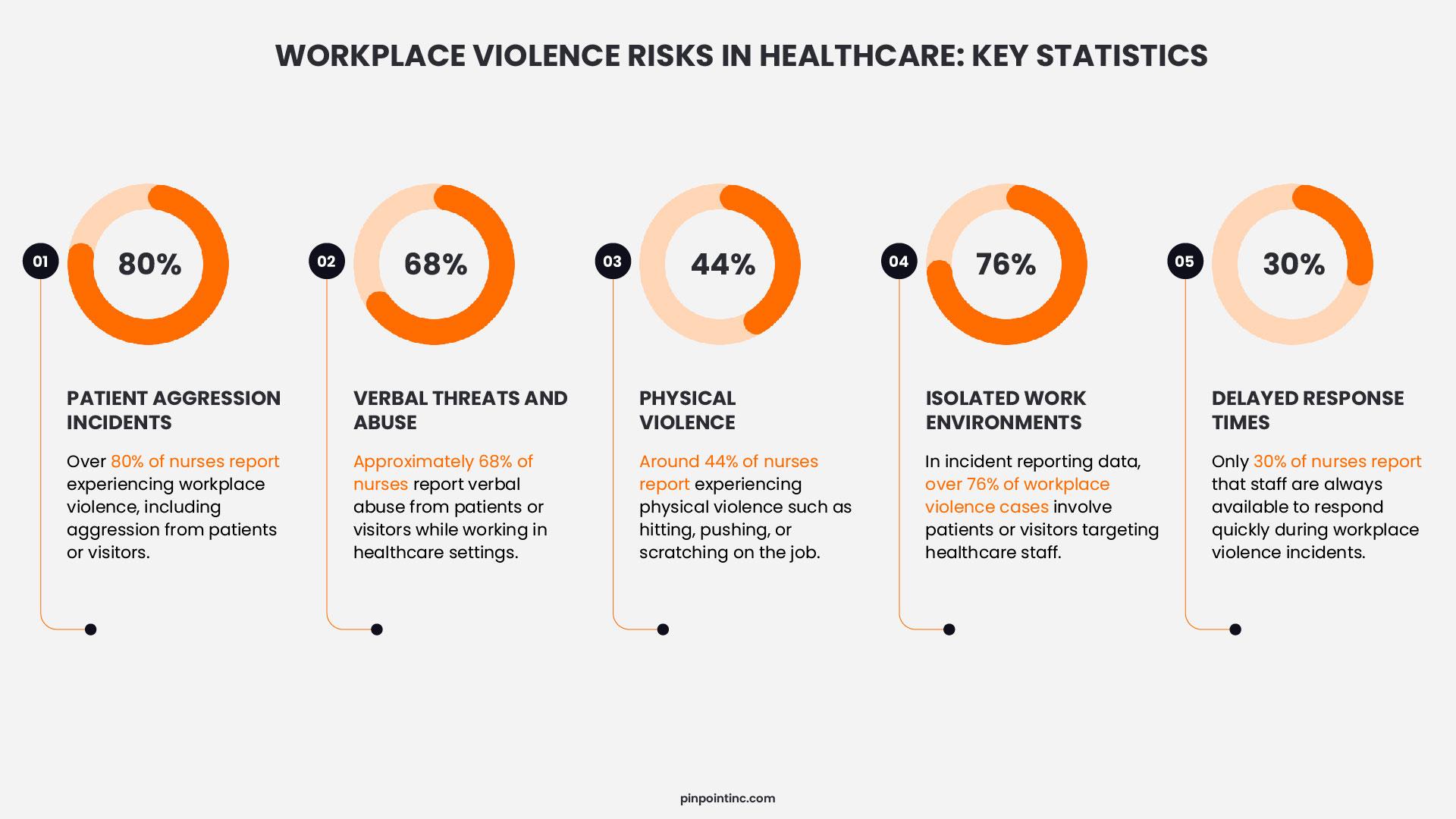
Let’s have a stats first, according to a recent healthcare workforce survey, 54% of healthcare workers say they have felt threatened by patients or visitors while on the job.
And that is only part of the picture. Data from labor statistics shows that healthcare workers are about five times more likely to experience workplace violence than workers in other industries.
When you start speaking with nurses, emergency staff, or hospital administrators, those numbers begin to make sense.
Emergency Departments Are Highly Unpredictable
Emergency rooms deal with patients who are often in distress, under the influence of substances, or facing severe mental health crises. In these environments, emotions run high and situations can shift quickly. Studies show that a significant portion of violence against healthcare staff occurs in emergency departments where tension and uncertainty are common.
For nurses working in these units, the risk is not theoretical, but can happen during routine patient care.
Many Hospital Spaces Are Isolated
Hospitals are large, complex environments. Nurses regularly move between patient rooms, treatment areas, medication rooms, and quiet corridors where they may be working alone.
In these moments, even a minor incident can escalate before anyone nearby realizes something is wrong. Without a quick way to signal for help, staff can find themselves managing situations without immediate support.
Psychiatric and Behavioral Health Units
Behavioral health units face some of the highest rates of workplace violence in healthcare. Patients may be experiencing severe psychological distress, confusion, or agitation, which increases the likelihood of sudden escalation.
These units require staff to remain calm and supportive while also maintaining personal safety.
Night Shifts and Staffing Challenges
Safety risks also increase during overnight shifts. Fewer staff members are present, security coverage may be limited, and healthcare workers often move across multiple rooms or units alone.
This combination of unpredictable patient behavior and reduced staffing is one reason healthcare are investing in wearable panic button solutions, particulalry the hospitals.
Benefits of Wearable Panic Button Solutions for Hospitals
Hospitals typically evaluate safety infrastructure based on how well it protects staff, reduces operational risk, and supports regulatory expectations. Wearable panic button solutions for hospitals address several challenges that healthcare facilities face when managing workplace violence and emergency escalation.
Faster Intervention During Escalating Situations
Many safety incidents do not begin as emergencies. They often start with verbal aggression, agitation, or behavioral escalation.
When staff have a discreet way to request assistance early, response teams can intervene before situations become physical confrontations. A wearable panic button gives nurses the ability to escalate concerns at the first sign of risk rather than waiting until an incident becomes dangerous.
Early intervention is one of the most effective ways hospitals reduce workplace violence incidents.
Precise Response Coordination
Hospitals are large environments where response teams may cover multiple units, floors, or buildings. During a critical event, uncertainty about the incident location can slow response efforts.
Talking about hospitals, the wearable panic button solutions allow response teams to identify exactly where assistance is needed, enabling more coordinated and targeted intervention. This reduces confusion during incidents and allows security teams to focus immediately on the correct location.
Higher Staff Adoption and Trust
Safety technology only works if staff actually use it, YES.
Some systems rely on continuous tracking or complex applications, which can create hesitation among healthcare workers. When safety tools are simple and privacy-respecting, staff are more likely to activate them early.
A wearable panic button designed specifically for healthcare environments tends to see higher adoption because it allows staff to request assistance without feeling monitored during their shift.
Data-Driven Safety Improvements
Another advantage of wearable panic button solutions for hospitals is the ability to generate structured incident data.
Hospitals can analyze where incidents occur most frequently, how quickly teams respond, and which units face the highest safety risks. This information allows leadership to refine staffing strategies, security coverage, and workplace violence prevention programs.
Over time, these insights help healthcare organizations improve safety policies based on real operational data.
Regulatory and Compliance Readiness
Workplace violence prevention is receiving increased attention from regulators!
OSHA guidance encourages healthcare facilities to implement workplace violence prevention programs that include risk assessment, incident reporting, and staff protection measures. Similarly, the Joint Commission expects hospitals to demonstrate that staff safety risks are actively addressed.
Because of these expectations, many healthcare systems are implementing wearable panic button solutions as part of their broader safety infrastructure. These systems provide documented incident records and operational transparency that support compliance efforts.
Non-Tracking RTLS Safety Systems
Most wearable safety tools in healthcare rely on continuous tracking systems that monitor staff locations throughout their entire shift. While these systems provide visibility, constant tracking can raise concerns among healthcare workers about privacy and workplace monitoring.
Some wearable panic button solutions use a different approach through a non-tracking RTLS (Real-Time Location System). In this model, the wearable panic button does not track staff movements during routine work. The system activates only when the button is pressed, identifying the location of the alert and notifying the appropriate response team.
Why Panic Buttons for Nurses Are Becoming Essential
Nurses spend more time in direct patient interaction than most roles inside a hospital.
That constant proximity means they are often the first to encounter situations that begin to escalate, whether it is agitation, confusion, or unexpected aggression. Over time, repeated exposure to these tense situations can create ambient trauma, where staff remain in a constant state of vigilance during their shifts. In many of these moments, leaving the room to seek help is not practical, which is why panic buttons for nurses are becoming an important part of workplace safety.
- Working alone in patient rooms
Routine care often happens one-on-one. Nurses enter rooms for assessments or monitoring, and if a situation becomes tense, stepping away may not be possible. A panic button allows them to request support while remaining with the patient.
- Medication rounds in unpredictable situations
Medication administration requires nurses to move across multiple rooms and interact with patients experiencing pain, stress, or confusion. In these moments, panic buttons for nurses provide a discreet way to signal for assistance.
- Managing aggressive or distressed patients
Healthcare workers regularly support patients experiencing mental health crises or emotional distress. A wearable panic button allows nurses to alert response teams without escalating tension in the room.
- Limited backup during critical moments
During busy units or late shifts, immediate support may not always be visible. Panic buttons for nurses allow responders to be notified quickly when situations escalate, helping ensure assistance arrives without unnecessary delays during critical moments.
Additional risk situations nurses face
- Behavioral health patient escalation
- Verbal threats during patient interactions
- Security teams covering multiple units
- High-risk emergency department encounters
- Late-night staffing limitations
Closing Words
Time to wind things up, but before we do that, let’s bring everything together.
Healthcare environments are built around care, but they also carry moments of unpredictability, nurses step into patient rooms every day not knowing exactly how an interaction might unfold. Most shifts pass without incident, yet when situations do escalate, the difference between control and chaos often comes down to one simple factor: how quickly help can arrive.
That is why many healthcare leaders are paying closer attention to tools like a wearable panic button. It is not about replacing training or security teams. It is about giving frontline staff a reliable way to signal for assistance during those few moments when a situation begins to shift.
For nurses in particular, access to panic buttons can change how safe they feel walking into a room alone. Knowing that support can be requested instantly reduces hesitation, helps teams respond earlier, and ultimately protects both staff and patients.
Pinpoint develops safety infrastructure designed specifically for healthcare environments, helping response teams identify the exact location of an incident and act quickly when assistance is needed.
If you’re exploring ways to strengthen workplace safety inside your facility, the best way to understand the difference is to see how the system works in practice.
Schedule a short demo with the Pinpoint team to explore how wearable panic button solutions can strengthen safety and response coordination inside your facility.
FAQ’s
What is a wearable panic button in healthcare?
A wearable panic button is a small device that healthcare staff can carry or wear during their shift, giving them a quick way to call for help if a situation starts to escalate. With a simple press, the system alerts the appropriate response team and identifies where assistance is needed inside the facility. These devices are commonly used to support staff safety, especially in situations where nurses or clinicians may be working alone with patients.
Why are panic buttons important for nurses?
Nurses often spend long periods interacting directly with patients, sometimes in isolated rooms or high-stress environments. Panic buttons for nurses allow staff to discreetly request help if a situation begins to escalate, ensuring support can arrive quickly without leaving the patient or interrupting care.
What situations might require a nurse to use a panic button?
Nurses may use a panic button when a patient becomes aggressive, when verbal threats escalate, or when they feel unsafe during an interaction. These situations can happen unexpectedly during routine care, medication rounds, or in high-stress areas like emergency departments and behavioral health units.
Where are wearable panic buttons most useful in hospitals?
These devices are particularly valuable in areas where staff may encounter unpredictable situations, including:
- Emergency departments
- Behavioral health units
- Patient rooms
- Long corridors or isolated care areas
- Overnight shifts with limited staff coverage
In these environments, quick access to help can significantly reduce response delays.