
Why Nurses Refuse RTLS Hospital Tracking Badges

Imagine a med-surg unit during evening shift change. The charge nurse hands an RTLS badge to the incoming shift lead. The nurse accepts it, then clips it to the workstation instead of her uniform.
“You’re supposed to wear it,” the charge nurse says.
“I’ll be near the workstation all night,” the nurse replies before starting the huddle.
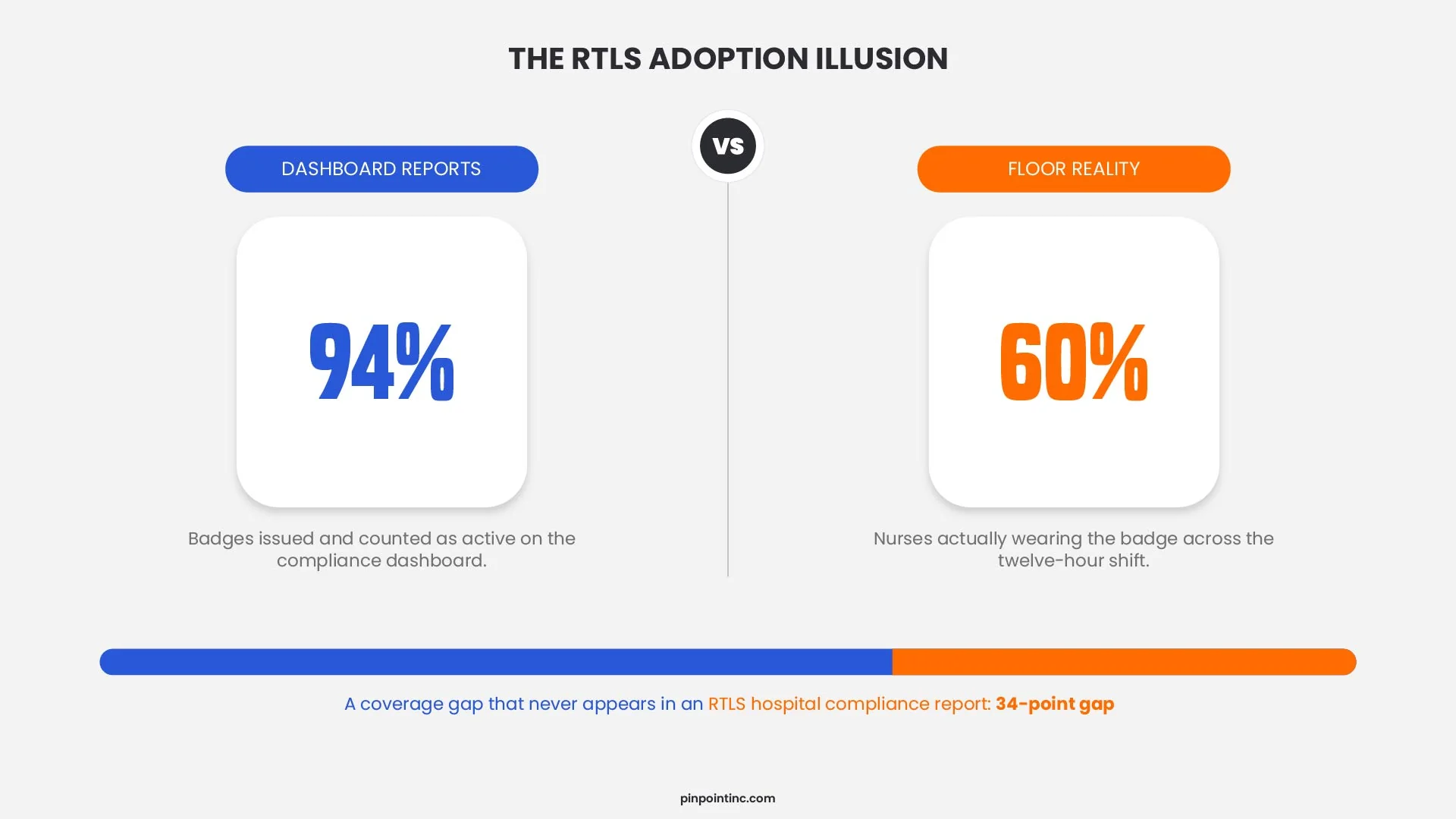
Over the next several shifts, other badges remain in lockers or beside computers. Suppose the RTLS hospital dashboard shows 94% adoption because almost every nurse has been issued a badge. A floor check, however, finds that only about 60% are actually wearing one.
The figures are illustrative, but the measurement gap is worth considering. Issuing wearable tracking devices does not necessarily show whether staff wear them consistently during their shifts.
If this happened after a hospital RTLS rollout, calling it carelessness or noncompliance could miss the underlying concern. Leaders should first ask what nurses understand about the badge. Does it record location continuously? Who can view that information? How long is it retained? Can it be used outside its stated safety purpose?
Nurses may support stronger workplace protections while still questioning a device they believe monitors routine movement, breaks, or time with patients. Without clear answers, a safety badge can feel more like surveillance than protection.
Hospitals facing this tension should examine how their technology collects location data, how clearly those practices are explained, and whether event-triggered alternatives to RTLS could meet their staff safety needs without recording routine movement.
Tracking Assets and Staff Requires Different Rules
RTLS is used across logistics, manufacturing, and healthcare, but its purpose changes with the subject. Hospitals use RTLS to find IV pumps, wheelchairs, and beds. Other deployments identify patients or staff.
A 2026 Veterans Health Administration privacy assessment describes its RTLS as applications used mainly to locate medical equipment, while noting that it may also track staff and patients. An AHRQ case study documented an emergency department using infrared badges for patients, staff, and equipment in 2004.
The central issue is not whether RTLS started with forklifts. It is how responsibilities change when location data relates to a person. Asset data raises operational questions. Staff data raises questions about purpose, access, retention, and acceptable use.
Hospitals should therefore consider why asset tracking and staff safety require different approaches. Nurses can support stronger safety measures while asking what a badge records, when it records, who can view the information, and how it may be used.
The Five Concerns I Hear From Nurses
When I speak with nurses about tracking badges, these five concerns come up repeatedly. They do not always appear in the same order, and not every nurse raises all five. What remains consistent is the need for clear answers. Dismissing these concerns as resistance makes trust harder to establish.
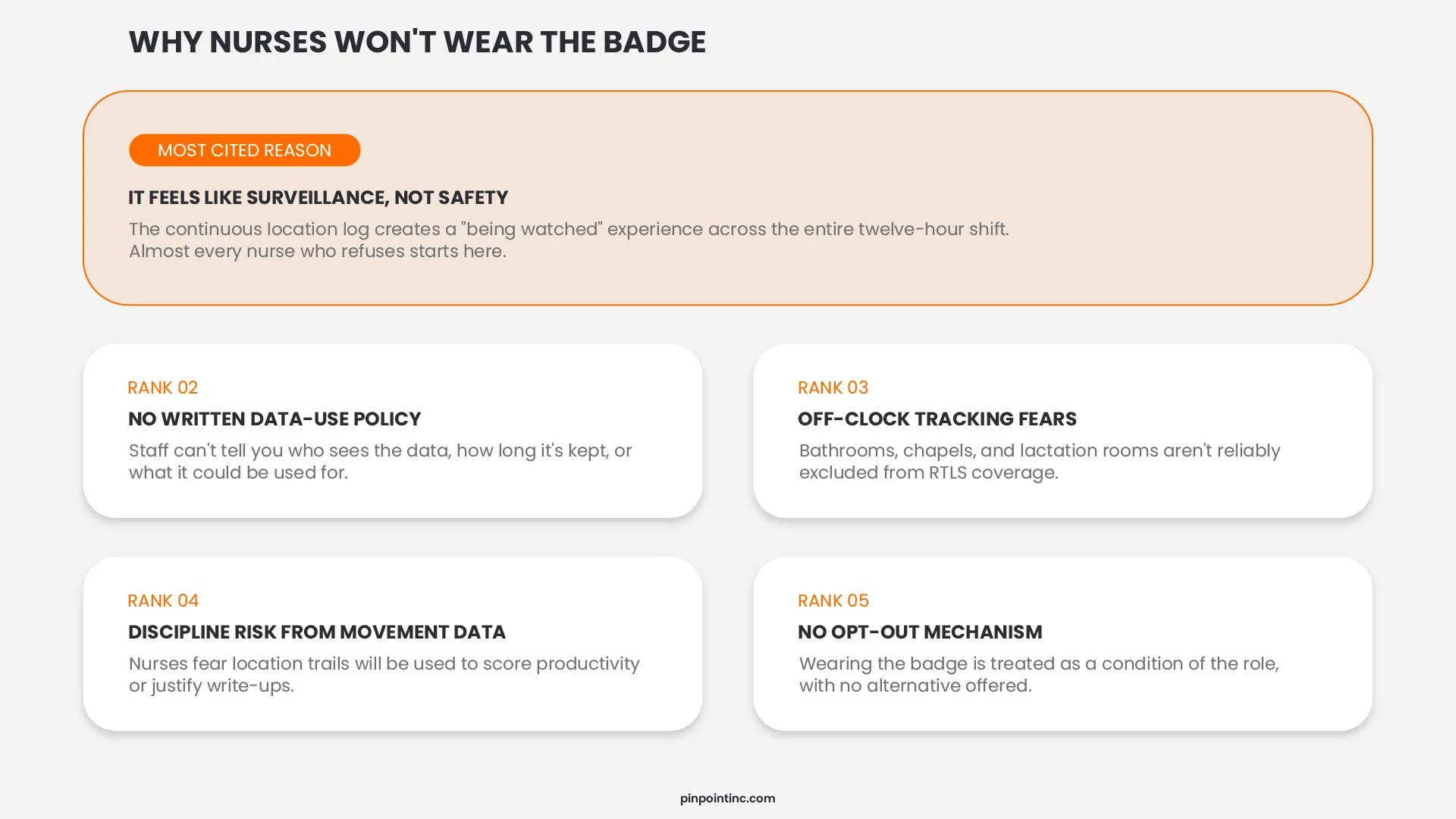
1. It Feels Like Surveillance, Not Safety
A wearable tracking device may record a nurse’s location periodically, depending on its configuration. That can create a movement history that authorized users may review or export. When nurses aren’t told what is recorded, I understand why safety technology can feel like surveillance. That uncertainty may contribute to the ambient stress created by continuous monitoring. It isn’t the acute pressure of a code or a crash. It’s a lower-grade concern present throughout a twelve-hour shift.
2. No Transparent Policy on Data Use
During a hospital RTLS rollout, I ask the same questions nurses ask: who can see the location data, how long is it retained, and can it inform investigations? A written nurse badge tracking policy should define the system’s purpose, permitted uses, access controls, retention period, and review process. When those rules are unclear, nurses may assume the data could be used beyond safety. In my view, clear disclosure allows staff to judge the system based on policy rather than assumption.
3. Off-Clock and Break-Time Concerns
Some wearable tracking devices continue transmitting until removed, disabled, or outside the coverage area. Configurations vary, so nurses need clear answers about break rooms, lactation rooms, chapels, bathrooms, and the end of a shift. Privacy concerns in healthcare often focus on patients, HIPAA, and protected health information, but staff location data deserves governance. I believe a nurse privacy policy should explain where tracking occurs, when it stops, and how staff can raise concerns. Protecting nurse privacy starts with boundaries nurses can understand and verify.
4. Burnout Amplification
Nurses already carry clinical, documentation, and interpersonal demands. I don’t present continuous monitoring as a proven independent cause of burnout. Still, unclear or intrusive tracking can add pressure to a demanding shift. That is why I examine how constant location monitoring may contribute to nurse burnout without overstating the evidence. The practical question is simple: does the technology reduce strain, or does it give nurses another concern to manage each day?
5. Erosion of Trust in the Alarm Itself
This is the concern I take seriously. A safety badge only works when staff feel comfortable activating it. If nurses believe an alert could expose their movement history to scrutiny, some may become less confident in the process. That does not mean tracking automatically causes staff to hesitate to trigger alerts. It does explain why hospitals should address the concern before deployment. Training should clarify what happens after activation, who reviews the event, and what information becomes available. A hospital RTLS program should make clear that requesting help initiates a safety response, not an unrelated review of routine behavior.
What Badge Refusal Can Cost a Hospital
Nurse badge refusal doesn’t stop with one employee. In my experience, it can affect safety coverage, staff trust, and how a hospital explains its workplace violence plan.
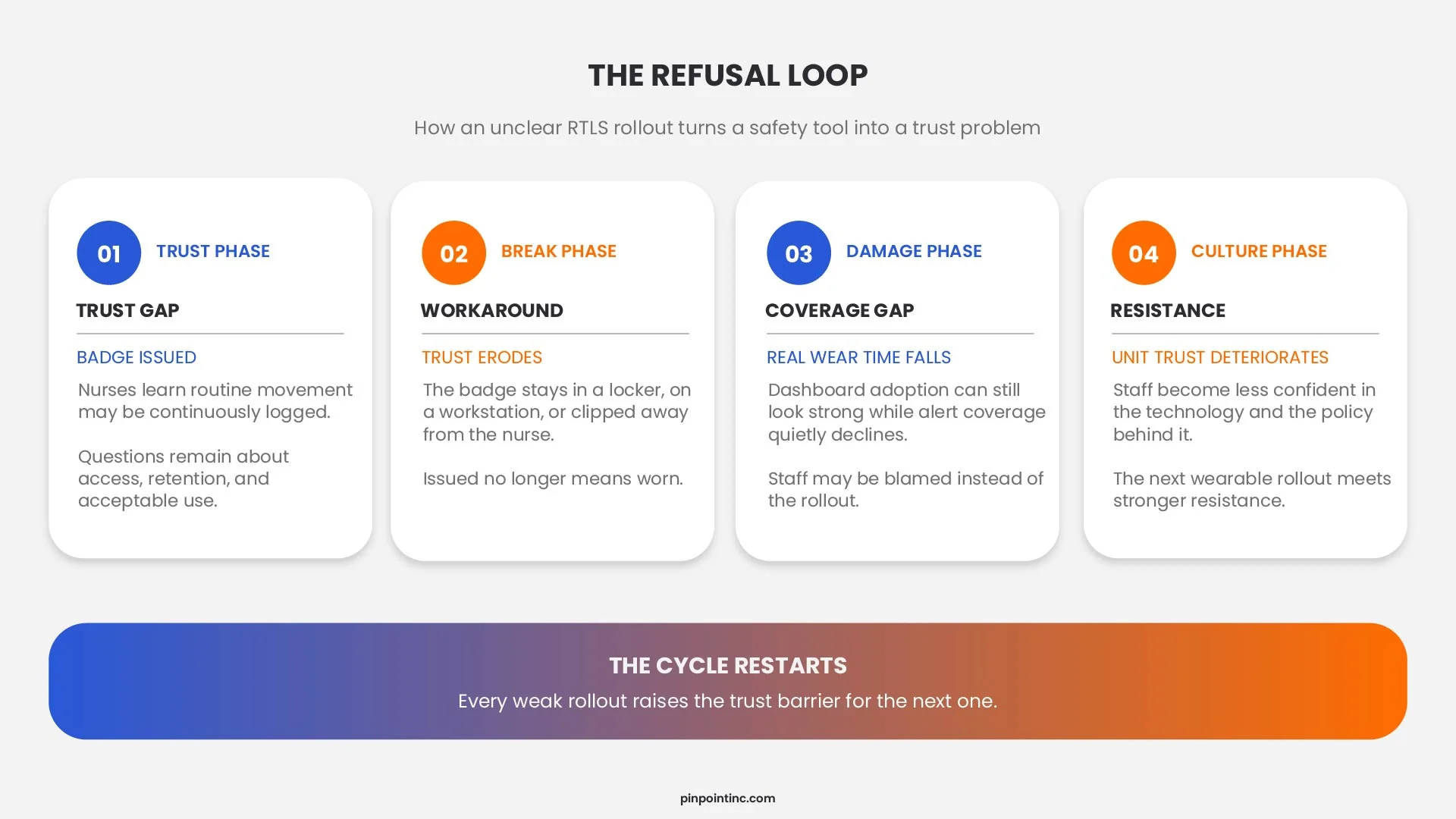
Adoption can look stronger on paper than on the floor. From what I’ve seen, issued badges can appear adopted. But issued, worn, and tested aren’t interchangeable. If leadership measures distribution alone, a hospital RTLS dashboard can overstate coverage. A badge left in a locker cannot send an alert, yet reports may miss that gap.
Turnover costs can compound. Recent NSI retention reports put RN replacement near $60,000, not six figures. I wouldn’t blame tracking for a resignation without evidence. Still, unclear monitoring can damage workplace culture, and one additional departure carries meaningful cost. Hospitals should consider how safety technology may influence resignations tied to workplace culture alongside other causes.
Labor and policy questions can grow. In unionized settings, location tracking may raise bargaining questions, depending on law and contract. I haven’t found reliable evidence that such grievances or OSHA complaints are increasing. A clear nurse badge tracking policy should instead define access, retention, permitted use, and how concerns are reviewed.
Joint Commission expectations go beyond installing badges. The Joint Commission workplace violence standards take a broader view, covering clear policies, staff training, incident reporting, leadership accountability, and regular worksite analysis. They don’t prescribe RTLS or a specific badge. In practice, the real test is whether the whole safety program works when staff need it.
I watch for the gap between deployment and dependable use. An aggressive hospital RTLS rollout can’t close it alone. Policy, staff involvement, training, testing, and usage measures matter more than badges issued.
A Different Approach: Location Only When Help Is Needed
The problem isn’t location technology itself. It’s using continuous RTLS tracking for hospital staff when their location is only needed during an emergency. From what I’ve seen, a better approach gives nurses control over when that information is shared.
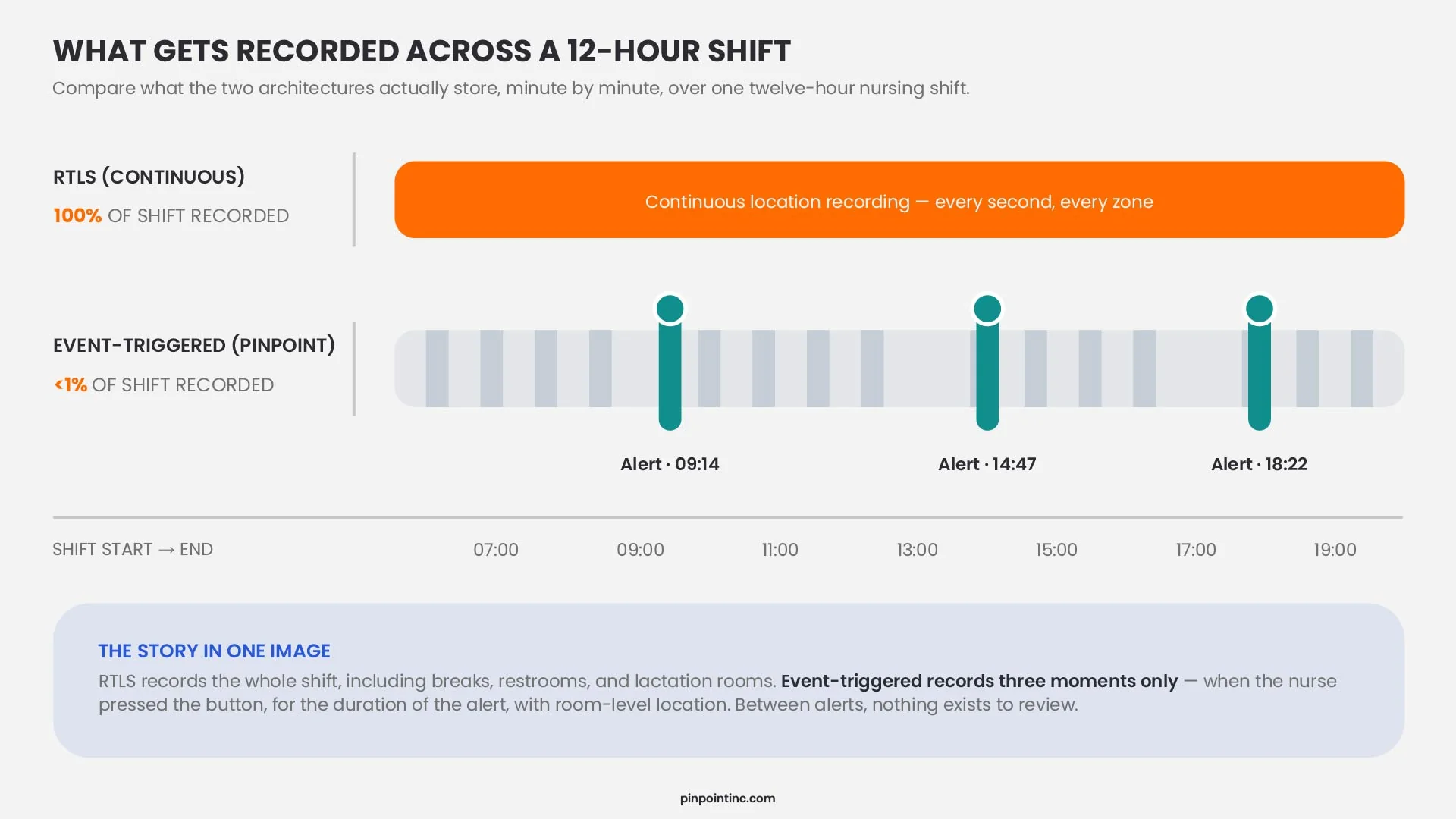
Event-triggered wearables work differently. By design, the badge does not continuously transmit a staff member’s location. When a nurse presses the assistance or panic button, an infrared signal identifies the room or zone so responders know where to go. The system can record the alert event, but it doesn’t create a routine movement log or historical replay of the entire shift.
That distinction matters.
Unlike wearable tracking devices that continuously report location, an event-triggered badge functions as a safety tool the nurse controls. This design can better support nurse privacy, while clear policies define how information from an activated alert may be accessed, retained, and reviewed.
The infrastructure also matters. A supervised, hardwired infrared design can operate independently of Wi-Fi and cellular networks. It does not require a dedicated radiofrequency location mesh. When the badge is idle, the system isn’t producing a continuous location trail. Alert records may still be retained under hospital policy, but routine location history does not exist because it isn’t collected.
Six Ways to Strengthen Your Nurse Badge Tracking Policy
Whether a hospital uses continuous RTLS or an event-triggered system, I recommend reviewing the nurse badge tracking policy before rollout. It should reflect the technology, data practices, and workplace requirements. These six changes belong in the review.
- Provide a plain-language data-use notice. At badge issue, explain what the device records, when it records, who can access the data, and its permitted and prohibited uses. Document receipt without treating acknowledgment as consent. Framing the wearable honestly, not as another asset tag starts here.
- Define a purpose-based retention schedule. Base retention on collection purpose, investigation needs, and applicable requirements. Avoid arbitrary deadlines and indefinite storage. For continuous RTLS used with hospital staff, publish the retention period and deletion rules.
- Set limits on performance and disciplinary use. A blanket ban may not fit every investigation. Define when data may be reviewed, required approvals, and prohibited uses. A nurse badge tracking policy loses credibility when exceptions are vague.
- Align the policy with the workplace violence program. Explain how badge alerts are reported, escalated, investigated, and documented. This reflects OSHA guidance and Joint Commission expectations without suggesting that the badge itself creates compliance.
- Create a concerns and exception process. An opt-out may not always be available. Explain alternatives, accommodations, or non-tracking coverage options and who approves them.
- Explain event-triggered design plainly. Nurses may assume every hospital-issued wearable tracking device works like RTLS. Show what the badge transmits while idle, what activation creates, and how long alert information is retained.
How Pinpoint Approaches Nurse Safety Differently
Pinpoint uses an event-triggered approach to nurse safety. Its wearable has two physical buttons, typically configured for assistance and emergency alerts, without continuously transmitting staff location. Pressing either button sends an infrared signal to installed receivers, allowing the system to identify the room or zone and notify designated responders.
Between alerts, the system does not create a minute-by-minute location history or replay a nurse’s shift. It can retain activated-alert information, so data-use and retention policies remain necessary. This gives hospitals a way to address privacy concerns in healthcare without describing the technology as data-free.
The model can support hospital deployments, behavioral health and residential rehab settings, where staff may need a discreet way to request help. Continuous tracking isn’t automatically unethical or unsuitable for every use. The difference is that this design shares location when an alert occurs, not throughout the shift.
Next Step
See a Nurse Safety System That Doesn't Track
If nurse badge refusal is showing up on your unit, or you're evaluating a safety wearable before deployment, start with a 15-minute conversation.
See how an event-triggered system works, when room-level location is shared, and what happens between alerts, without committing to a full product review.
Watch room-level location activate only when the nurse presses the button.
FAQ’s
Can a nurse legally refuse to wear a hospital-issued tracking badge?
It depends on employer policy, law, a collective bargaining agreement, and accommodations. Hospitals may require safety equipment, but no single U.S. rule governs every tracking badge. A missing nurse badge tracking policy does not automatically create a right to refuse. Before refusing wearable tracking devices, nurses should review the policy and seek union, HR, or legal guidance.
Does RTLS record nurse location during breaks or in restrooms?
Not always. Some RTLS tags transmit while powered on, but location capture depends on receiver coverage, configuration, and storage settings. Sensitive areas may lack receivers or be excluded. Staff should know what areas are covered, what information is retained, and whether filtering prevents collection or only limits display. These distinctions matter when addressing privacy concerns in healthcare workplaces.
What's the difference between RTLS and an event-triggered panic badge?
RTLS in hospital settings may provide ongoing updates and retain location history, depending on configuration. An event-triggered panic badge is designed to share location when a nurse activates an alert. It may still store the alert time, location, and response record. Between alerts, a non-tracking design does not create a routine movement trail.
How long is nurse location data typically retained?
There is no universal retention period. Periods from 30 days to several years cannot be generalized across hospitals. Retention depends on hospital policy, vendor configuration, contracts, investigation needs, and applicable requirements. The policy should state the retention period, deletion process, exceptions, and whether alert records follow a different schedule.
Can RTLS data be used in disciplinary action?
Potentially. It depends on hospital policy, law, a collective bargaining agreement, the collection purpose, and data reliability. A missing prohibition does not make every use lawful or appropriate. Protecting nurse privacy requires written rules explaining when data may be reviewed, who approves access, and how nurses can challenge inaccurate interpretations.
Do event-triggered systems satisfy Joint Commission workplace violence standards?
No technology satisfies the standards alone. Joint Commission requirements cover leadership, policies, training, incident reporting and analysis, victim support, and worksite analysis. An event-triggered system may support response and documentation, but wear time alone does not prove Joint Commission workplace violence compliance or outperform every RTLS hospital deployment.
Author:
Jordan Belous
Chief Marketing Officer of Pinpoint North America, where she leads marketing strategy, brand development, and digital growth initiatives. She earned a Bachelor of Science in Allied Health with a concentration in physical therapy sciences from the University of Tampa, bringing a unique interdisciplinary perspective that blends healthcare knowledge with modern marketing strategy.
Jordan writes about workplace violence prevention in healthcare, nurse safety, staff wellbeing, and emerging healthcare technologies that support frontline teams. Her work explores how hospitals and behavioral health facilities can build safer environments, reduce burnout and turnover, and implement safety systems that protect staff while preserving trust and dignity.
She is also the Chief Executive Officer of Whip Pediatric Cancer, a nonprofit dedicated to supporting children battling cancer and raising awareness and funds for pediatric cancer. Through her work with Whip, Jordan regularly visits pediatric cancer patients in hospitals and spends time alongside patients, families, and the clinicians who care for them. These experiences place her directly beside nurses and healthcare teams every day and reinforce her belief that the people providing care deserve to feel just as safe as the patients they serve.
Her experiences with Whip and her work at Pinpoint are closely connected, both driven by her deep respect for nurses and frontline healthcare workers. Seeing firsthand the compassion, resilience, and critical role nurses play has strengthened her commitment to advocating for safer healthcare environments and ensuring that those who dedicate their lives to caring for others have the protection and support they deserve.