
The Hidden Costs of Constant Surveillance: How Nurse Tracking Can Fuel Nurse Burnout
What if the badge a nurse wears to feel safer is quietly making her more exhausted?
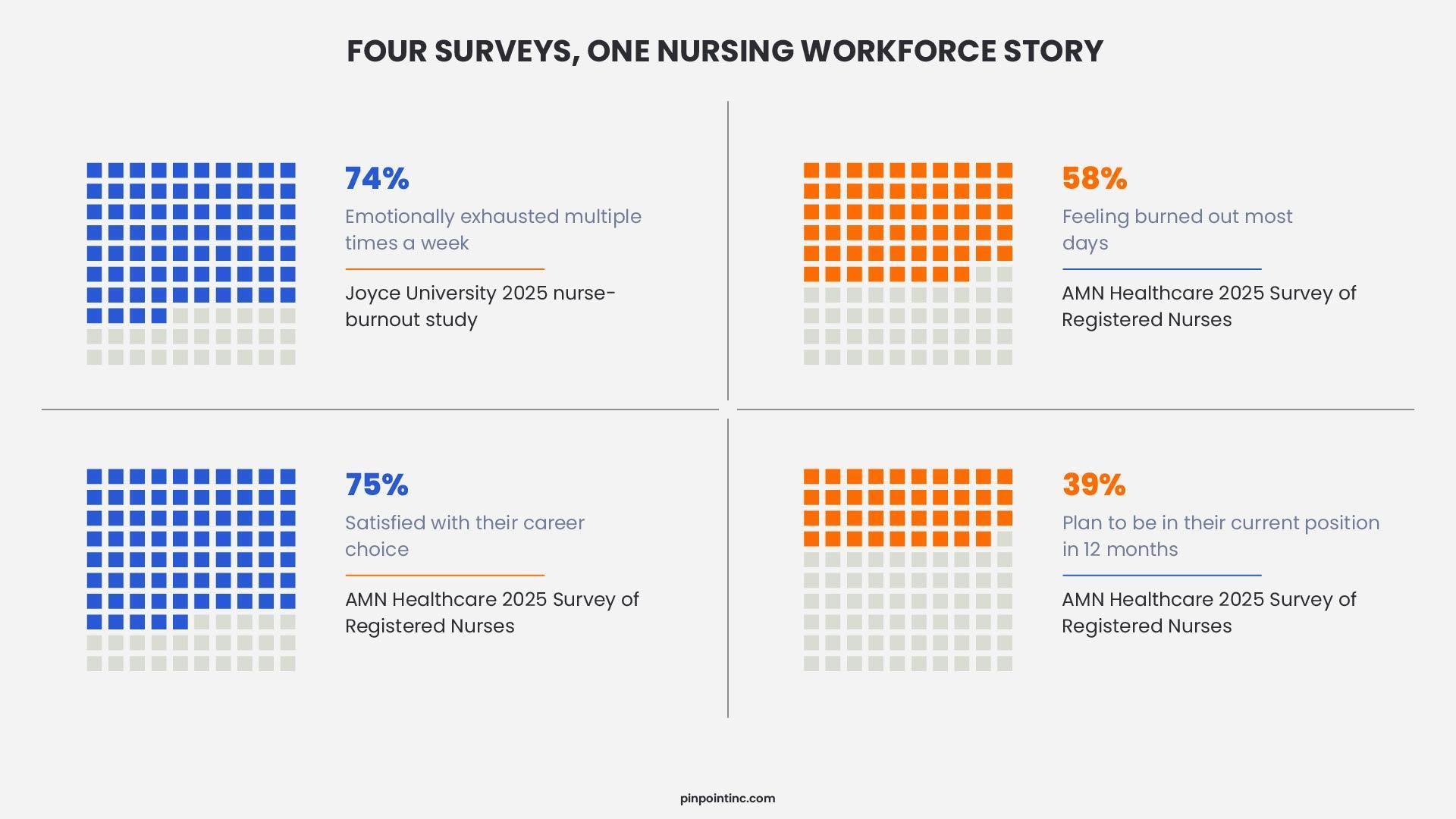
More than half of nurses in the United States report burnout in the past two years, according to the 2026 Nurse Salary and Work-Life Report. A separate 2025 Joyce University survey found that 74% of nurses felt emotionally exhausted from work multiple times a week, and 28% of Gen Z nurses said they felt burned out every single day. These findings point to a workforce under sustained strain, where daily pressures continue to shape nurse well-being. What gets far less attention is a specific, measurable piece of that strain: the technology hospitals use to keep nurses safe.
Hospitals rarely set out to make nurses feel watched. Location tracking technology, wearable badges, and BYOD apps are usually introduced with good intentions, faster response times, better asset visibility, stronger safety coverage. But good intentions don’t cancel out a bad daily experience. Nurses don’t accumulate burnout the way they accumulate shift hours, on a visible counter, it builds quietly, and a badge that logs every movement is one of the quieter contributors nobody puts on the whiteboard.
This piece goes beyond the burnout statistics everyone already knows and asks a narrower question: what specifically happens, psychologically and organizationally, when constant tracking is layered onto an already exhausted workforce, and what a hospital can do differently if it treats tracking fatigue as seriously as it treats short staffing.
What Nurse Burnout Actually Looks Like Right Now
The World Health Organization defines burnout as a syndrome from chronic workplace stress that has not been successfully managed, marked by exhaustion, cynicism, and reduced professional effectiveness. That clinical definition matters, because burnout is not simply "having a hard week." It is a slow accumulation of unmanaged pressure that eventually changes how a person shows up to work.
The current data paints a consistent picture across multiple independent surveys, one where the gap between "overwhelmed" and "burned out" keeps narrowing:
Burnout has plenty of well-documented drivers already: unsafe staffing ratios, documentation overload, moral injury, and simply not feeling heard by leadership. What’s less discussed is a subtler contributor sitting underneath all of it, the low-grade, ongoing stress of knowing you are being tracked. That contributor follows a pattern worth naming, because once hospital leaders can see the pattern, they can interrupt it.
The Ambient Surveillance Cycle: A Framework for Seeing the Problem
Most conversations about workplace monitoring jump straight from “we installed a tracking system” to “nurses don’t like it,” skipping the part in between. That middle stage is where burnout actually takes root, and it tends to move through three predictable phases:
- Awareness. A nurse learns her badge, wearable, or app logs her location throughout the shift. She doesn’t necessarily object yet, but she now knows a movement record exists somewhere.
- Hypervigilance. Awareness turns into low-grade self-monitoring, noticing how long she lingers in the break room, whether a slow response to a call light looks bad on a dashboard, whether her movement pattern will raise questions she can’t easily answer.
- Disengagement. Over weeks and months, that self-monitoring becomes exhausting on its own, on top of the clinical workload. Nurses stop trusting the system, stop trusting the intent behind it, and start looking for a job where they don’t have to think about it.
None of these stages shows up on an incident report. That’s exactly why they’re worth naming: a hospital can measure staffing ratios and turnover, but it rarely measures whether its own safety technology is quietly pushing nurses through this cycle.
The Quiet Trigger Nobody Talks About: Constant Tracking
Not all workplace stress announces itself. Some of it builds silently in the background, in what’s known as ambient stress, the accumulation of small, ongoing environmental pressures that never register as a single crisis but add up over a shift, a week, a career. Nearly half of U.S. health care workers, 46%, reported feeling burned out often or very often, according to CDC data. About four in 10 also said they were likely to change jobs, underscoring ongoing strain across the workforce.
Constant location tracking fits squarely into that category of ambient pressure. It’s the Awareness and Hypervigilance stages described above, playing out in real time. It rarely triggers an acute reaction the way a violent incident does. Instead, it sits quietly in the background of every shift: the awareness that a badge is logging your location, that a dashboard somewhere is showing your movement patterns, that a supervisor could pull up exactly how long you spent in a break room or a supply closet. Over months and years, that low hum of being watched contributes to the same chronic stress response tied to nurse burnout, even though it rarely shows up as a line item on an incident report.
How Real Time Location System Tools and RTLS Tracking Add to the Load
A real time location system, often shortened to RTLS, is designed to track the position of people or assets continuously throughout a facility. In hospitals, RTLS tracking is frequently deployed for legitimate operational reasons: locating equipment faster, understanding patient flow, or supporting safety response.
What gets less attention is the cognitive cost of that continuous layer. Research on workplace monitoring consistently finds that the mere knowledge of being watched, even when nothing is actively wrong, raises baseline stress and self-censoring behavior. Nurses aren’t unusual for feeling this; it’s a well-documented human response to being observed, and a twelve-hour shift gives it a lot of time to compound.
That’s a different problem from the legal or compliance risk hospitals usually worry about. It’s a human factors problem: the system doesn’t need to misuse the data for it to cost something. Simply existing in always-on mode is enough to add a layer of self-monitoring on top of an already demanding job. For hospitals comparing RTLS vs non-RTLS safety systems, the key question isn’t only whether the technology tracks staff continuously or only during an emergency, it’s whether nurses can feel the difference in how safe or watched they feel on shift.
The distinction matters because staff notice. A badge that only activates during a genuine emergency feels like protection. A badge that quietly logs your position all day, every day, starts to feel like surveillance, and that distinction shapes whether nurses trust the system or resent it.
BYOD Policy: When "Bring Your Own Device" Becomes "Bring Your Own Surveillance"
Bring your own device, or BYOD, policies let clinical staff use personal smartphones for work tasks like secure messaging, scheduling, and clinical documentation.Adoption has accelerated in healthcare. Recent 2025 research shows that clinicians are increasingly using personal devices for work in hospital settings, and BYOD policy adoption is being actively studied as organizations try to balance productivity with security.
The convenience is real. So is the risk. A poorly scoped BYOD program can blur the line between "using your phone for work messages" and "your employer having visibility into where your phone, and therefore you, are at any given moment." If location services or mobile device management tools are not carefully configured to stop tracking the moment a shift ends, nurses can end up carrying an always-on surveillance device in their pocket, one that follows them home, to appointments, and into their personal lives.
This is where a well-designed BYOD policy needs to do more than protect patient data under HIPAA. It needs to explicitly define what location data, if any, gets collected, when tracking starts and stops, and who has access to that information. Nurses who don’t know the answer to those questions reasonably assume the worst, and that uncertainty itself becomes another source of chronic workplace stress layered on top of an already demanding job. That uncertainty is often where the Awareness stage of the surveillance cycle starts for a lot of nurses, not with the hospital’s official RTLS system, but with their own phone.
Employee Privacy Rights Nurses Deserve to Understand
Nurses are employees first, and employee privacy rights don’t disappear the moment someone clocks in for a shift. Yet many hospital tracking programs are rolled out with minimal disclosure, buried in onboarding paperwork rather than explained clearly and separately from other policies.
Nurses have a right to plain-language disclosure about what gets collected, clear limits once a shift ends, and defined retention periods, and a growing set of state laws are starting to spell that out directly. The legal detail behind those protections is covered in our companion piece on hospital tracking and digital privacy. What matters here is simpler: not knowing the answer to any of it is its own low-grade stressor, layered on top of everything else a shift already asks of a nurse.
None of this means tracking technology is inherently wrong. It means hospitals that want nurses to trust a system need to be transparent about what it does, plain and simple.
The Turnover Connection: Why Tracked Nurses Leave
Burnout and nurse turnover move together, and hospitals rarely think to measure whether their own safety technology is part of that equation. Units that lean hardest on always-on tracking tend to show up in exit interviews the same way: nurses citing feeling unsupported and watched, not just short-staffed. Turnover shows up on a spreadsheet months after the actual decision to disengage, which is exactly why the underlying cause is easy to miss.
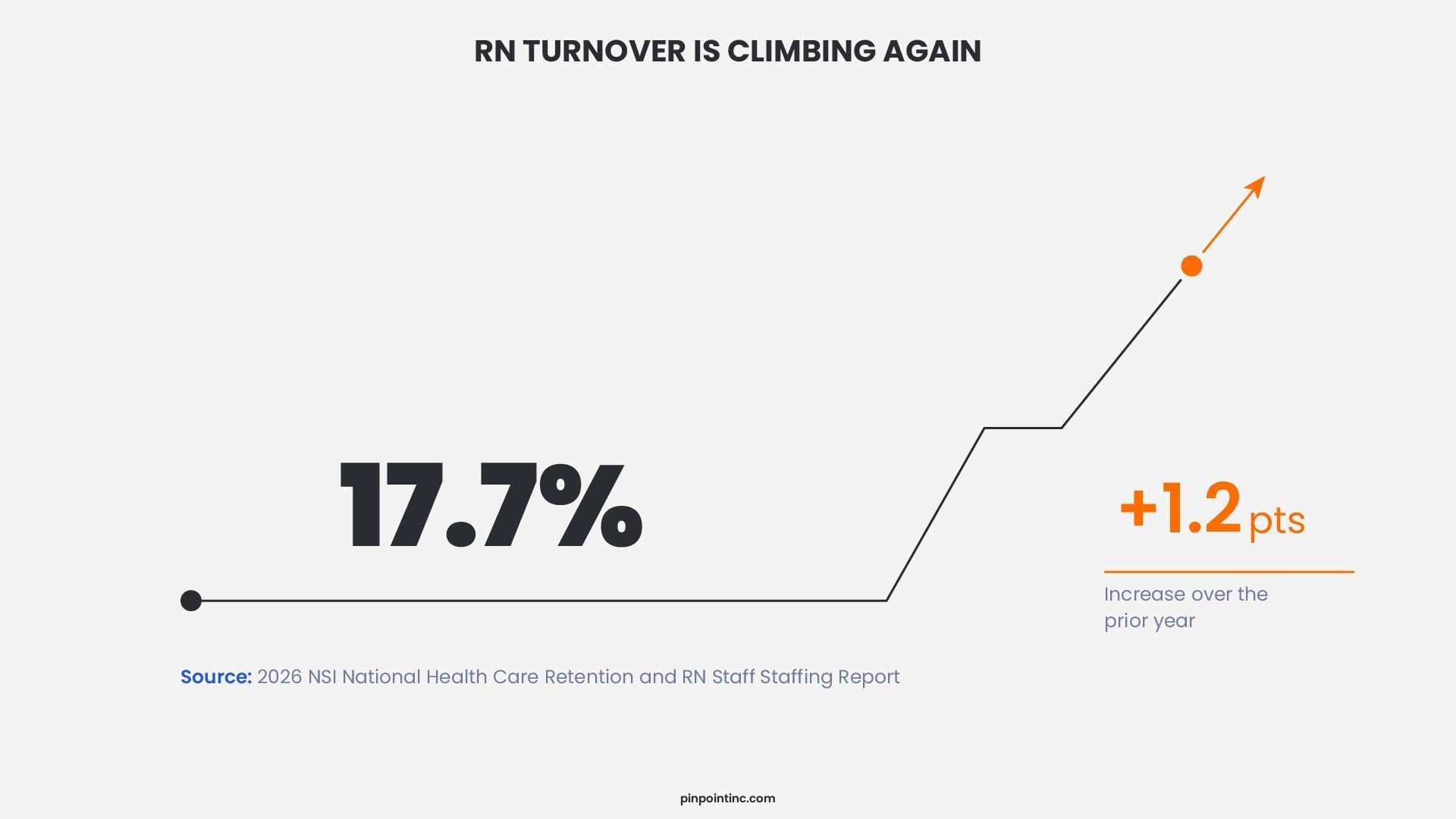
Surveillance is rarely the single reason a nurse leaves a job. But it consistently shows up as part of a broader pattern nurses describe when they talk about feeling unsupported, alongside unmanageable ratios and unresponsive leadership. Nurses have increasingly made clear they are done treating unsafe, high-pressure conditions as simply "part of the job," a sentiment that became impossible to ignore when 15,000 New York nurses said as much during recent contract negotiations. That same "enough is enough" energy extends to how nurses feel about being constantly monitored, not just about safety incidents themselves.
Framed through the Ambient Surveillance Cycle, turnover is often the Disengagement stage finally becoming visible on a spreadsheet, months after the Awareness and Hypervigilance stages started quietly doing their damage.
A Different Model: Wearable Panic Button Technology
The good news is that protecting nurses and respecting their privacy are not competing goals. The distinction comes down to design. A wearable panic button that activates only when a nurse presses it, generating a location signal solely at the moment help is needed, delivers the same safety benefit without asking a nurse to spend twelve hours managing how her movements might look on a dashboard.
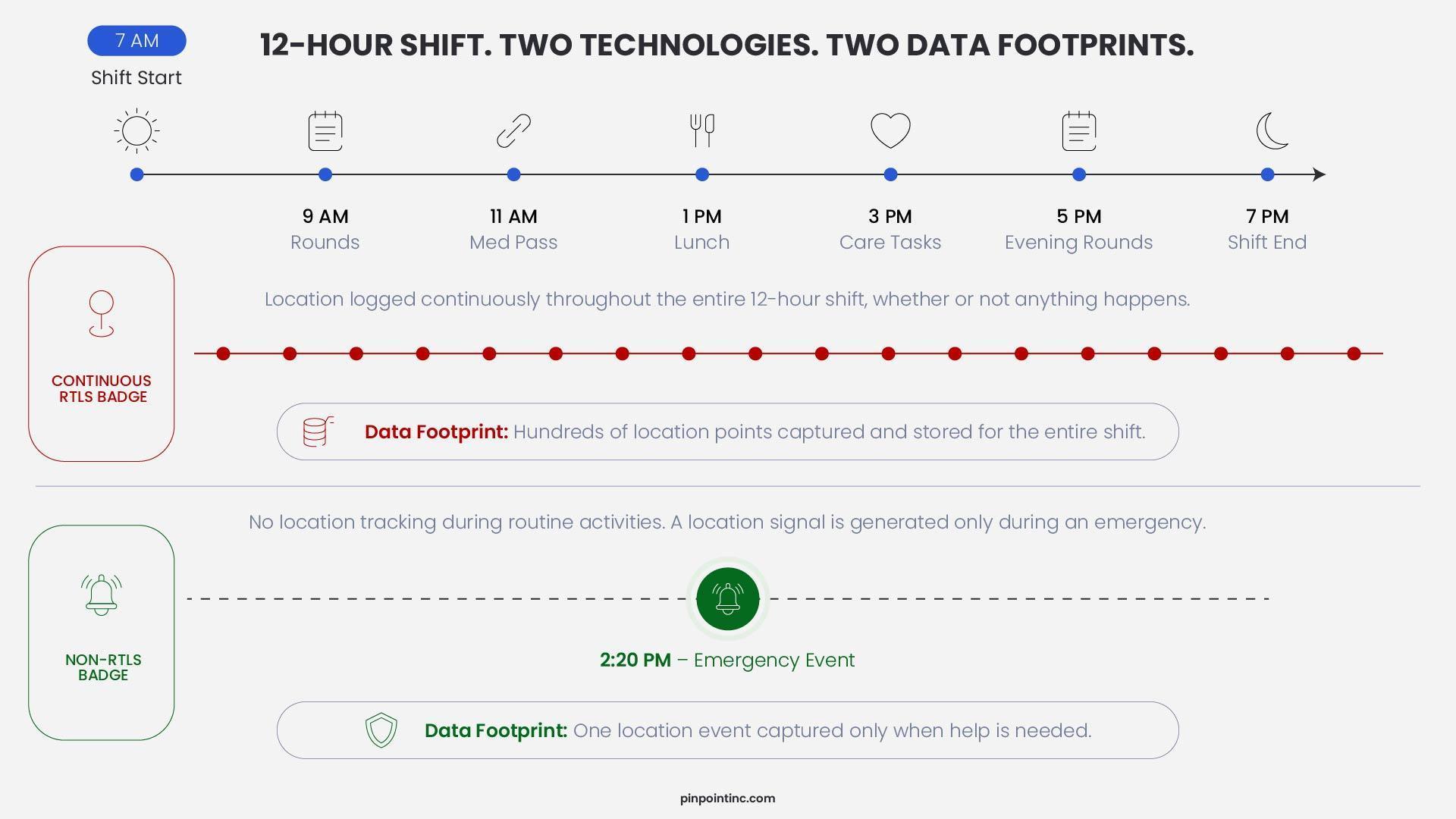
- Collects location data only during an actual emergency activation, so there’s no full-shift record for a nurse to feel self-conscious about.
- Interrupts the Ambient Surveillance Cycle at the Awareness stage, since there’s simply nothing continuous to become aware of.
- Staff tend to trust and actually wear a wearable panic button consistently, precisely because it isn’t watching them when nothing is wrong, which is a meaningfully different day-to-day experience than knowing a dashboard is always on.
This is where an event-triggered wearable panic button becomes a stronger fit for hospital staff safety. Instead of logging routine movement throughout a shift, the system creates a location signal only when a nurse needs help. Pinpoint’s wearable panic button is built around that model, and the broader 2026 hospital panic button systems comparison shows how different vendors approach tracking, retention, and deployment complexity.
Building a Culture That Protects Without Surveilling
Reducing nurse burnout is not a single fix. It requires addressing staffing ratios, workload, leadership responsiveness, and yes, the technology choices hospitals make around safety and tracking. Rather than repeat a generic compliance checklist, here’s what actually moves the needle on the trust side of burnout:
- Ask nurses directly, before rollout, what would make a safety system feel protective rather than invasive, and build the disclosure plan around their answers, not a vendor’s default settings.
- Run a short pilot with a small group of nurses and gather feedback specifically on how the technology feels during a shift, not just whether it technically works.
- Write BYOD guidelines that explicitly address off-duty tracking boundaries, not just data security.
- Publish a plain-language one-pager on what the system collects and doesn’t collect, and post it somewhere nurses actually see it, not just in the onboarding folder.
- Run a short, anonymous pulse survey each quarter asking nurses whether current safety tech feels protective or invasive, and track the trend the same way you’d track a staffing ratio.
- Prioritize supervised safety systems that verify device readiness, signal health, battery status, and alert pathways without turning staff movement into a continuous tracking record.
The common thread across all of these is treating nurse trust as something to design for upfront, not something to repair after a tracking rollout goes badly.
Closing Words
Nurse burnout doesn’t have one cause, and it won’t have one fix. But hospitals do have direct control over one piece of it: whether their safety technology asks nurses to hand over their entire shift, or only the moment they actually need help. The Ambient Surveillance Cycle described above isn’t inevitable. It starts with Awareness, and awareness is exactly the stage a well-designed, event-triggered system removes.
Interrupting the Awareness stage doesn’t just close a compliance gap, it removes one more quiet reason a nurse decides this shift, or this job, isn’t worth it anymore.
If burnout is already showing up on your unit, the technology on nurses’ wrists is worth a second look, not because it’s the biggest driver, but because it’s one of the few drivers a hospital can change without waiting on a staffing budget.
Reevaluating your staff safety technology?
See what an event-triggered, privacy-respecting system looks like in practice. Book a 30 minute demo
Next Step
Protect Nurses Without Adding to the Load
Constant tracking asks already-exhausted nurses to carry one more layer of surveillance. Pinpoint takes the opposite approach: a wearable panic button that stays silent until a nurse needs help, then sends a fast, accurate alert.
See how an event-triggered model can strengthen trust, support retention, and give staff real protection without the burnout cost of always-on monitoring.
See event-triggered staff safety in action.
FAQ’s
How does an event-triggered panic button reduce privacy risk?
An event-triggered panic button reduces privacy risk, and burnout risk, by sending a location signal only when a nurse activates the device. Because there’s no continuous movement record, nurses don’t carry the background awareness of being watched that contributes to ambient stress, and hospitals avoid building a routine surveillance record they don’t need.
Do nurses have employee privacy rights around location tracking?
Yes. Nurses are entitled to clear disclosure about what location data is collected, reasonable limits on off-duty tracking, and defined data retention practices. State-level protections around employee location and biometric data are also expanding. Uncertainty about any of these is itself a low-grade stressor, so clarity here isn’t just a compliance matter, it’s a burnout-prevention one.
Does workplace tracking actually contribute to nurse burnout?
Constant location tracking functions as a form of ambient stress, a low-grade, ongoing pressure that builds over time even without a single triggering event. This maps to the Awareness and Hypervigilance stages of what we call the Ambient Surveillance Cycle above. While it is rarely the sole cause of nurse burnout, it consistently appears alongside other drivers like unsafe staffing and unresponsive leadership.
How can hospitals protect nurses without constant surveillance?
Hospitals can choose event-triggered safety tools, clearly define data retention policies, separate safety features from tracking features, and communicate employee privacy rights before rollout.
Can staff tracking affect nurse trust?
Yes. Staff tracking can affect nurse trust when nurses are unclear about what data is collected, who can view it, and how long it is stored. A safety tool feels supportive when it protects staff during emergencies, but it can feel invasive when it monitors routine movement across every shift.
- What Nurse Burnout Actually Looks Like Right Now
- The Ambient Surveillance Cycle: A Framework for Seeing the Problem
- The Quiet Trigger Nobody Talks About: Constant Tracking
- How Real Time Location System Tools and RTLS Tracking Add to the Load
- BYOD Policy: When "Bring Your Own Device" Becomes "Bring Your Own Surveillance"
- Employee Privacy Rights Nurses Deserve to Understand
- The Turnover Connection: Why Tracked Nurses Leave
- A Different Model: Wearable Panic Button Technology
- Building a Culture That Protects Without Surveilling
- Closing Words
- FAQ’s
Author:
Jordan Belous
Chief Marketing Officer of Pinpoint North America, where she leads marketing strategy, brand development, and digital growth initiatives. She earned a Bachelor of Science in Allied Health with a concentration in physical therapy sciences from the University of Tampa, bringing a unique interdisciplinary perspective that blends healthcare knowledge with modern marketing strategy.
Jordan writes about workplace violence prevention in healthcare, nurse safety, staff wellbeing, and emerging healthcare technologies that support frontline teams. Her work explores how hospitals and behavioral health facilities can build safer environments, reduce burnout and turnover, and implement safety systems that protect staff while preserving trust and dignity.
She is also the Chief Executive Officer of Whip Pediatric Cancer, a nonprofit dedicated to supporting children battling cancer and raising awareness and funds for pediatric cancer. Through her work with Whip, Jordan regularly visits pediatric cancer patients in hospitals and spends time alongside patients, families, and the clinicians who care for them. These experiences place her directly beside nurses and healthcare teams every day and reinforce her belief that the people providing care deserve to feel just as safe as the patients they serve.
Her experiences with Whip and her work at Pinpoint are closely connected, both driven by her deep respect for nurses and frontline healthcare workers. Seeing firsthand the compassion, resilience, and critical role nurses play has strengthened her commitment to advocating for safer healthcare environments and ensuring that those who dedicate their lives to caring for others have the protection and support they deserve.