
Why the Supreme Court’s Shift on Digital Privacy Should Make Hospitals Think Twice Before Tracking Nurses

On June 29, 2026, the Supreme Court handed down a 6-3 decision that quietly rewrote the rules for how much of your life a smartphone can give away without your consent. The case was Chatrie v. United States, and on paper it was about a bank robbery in Midlothian, Virginia. In practice, it settled a question that has been hanging over every organization that tracks people’s movements through technology: does the government need a warrant-level justification before pulling someone’s precise location history, even for a window as short as two hours?
If you run a hospital, that question should stop you in your tracks. Not because your facility is under criminal investigation, but because the reasoning behind this ruling applies just as forcefully to the real-time location systems, wearable badges, and mobile apps many hospitals now use to track nurses through every hour of their shift.
Ask yourself honestly: if a court now requires a judge-approved warrant before police can access two hours of someone’s location data, what does it say that your hospital collects that same kind of data on its nursing staff continuously, shift after shift, with a badge swipe and no warrant at all?
What Just Happened: Chatrie v. United States
Here’s the short version of a case that took seven years to reach the Court. In 2019, police investigating a Virginia credit union robbery obtained a geofence warrant, a warrant that names no suspect but instead asks a tech company to hand over data on every phone that passed through a defined area during a defined window. Google’s first pass returned anonymized location pings for phones inside a roughly 17.5-acre radius around the crime scene. Detectives then narrowed the pool until they had names, including Okello Chatrie, whose phone had entered the area shortly before the robbery.
Chatrie argued that pulling his location history this way was an unconstitutional search. The government argued he had no reasonable expectation of privacy in data he had voluntarily shared with Google, leaning on the old third-party doctrine, the idea that once you hand information to a company, the fourth amendment mostly stops caring about it.
Justice Kagan, writing for the majority, rejected that argument. The Court held that obtaining someone’s cell phone location data, even for a window as short as two hours, is a search under the fourth amendment, and that a valid warrant is required. The ruling didn’t strike down geofence warrants outright; it sent the case back to the Fourth Circuit to decide whether this particular warrant’s multi-step process met the probable cause and particularity requirements. But the core holding was unambiguous: location data deserves constitutional protection, regardless of how briefly it’s collected or which company happens to be holding it.
From Carpenter to Chatrie: How the Fourth Amendment Caught Up With Your Phone
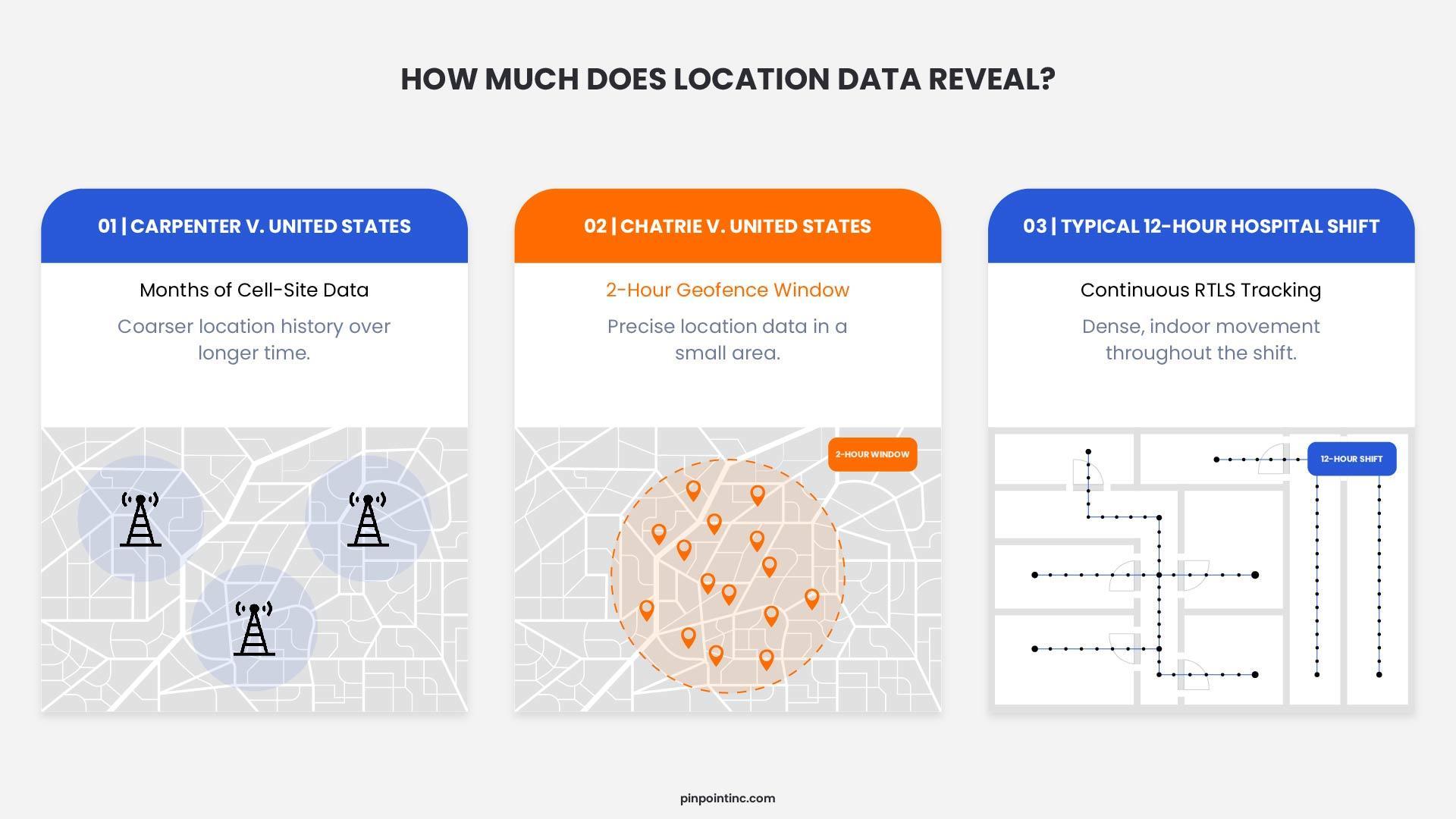
Chatrie v. United States didn’t come out of nowhere. It builds directly on Carpenter v. United States, the 2018 decision that first cracked open the third-party doctrine for location data. In that case, the government had obtained months of a suspect’s cell-site location records without a warrant. The Supreme Court ruled that this kind of comprehensive tracking violates a reasonable expectation of privacy, since it can reveal the intimate contours of a person’s associations and habits.
The government’s fallback argument in Chatrie was that the earlier precedent only applies to long-term surveillance, not a narrow two-hour slice. The Court didn’t buy it. The location data Google’s Location History service collects is far more precise than the cell tower records at issue in the earlier case, updating roughly every two minutes rather than only when a phone connects to a new tower. More precision over a shorter window, the Court found, is not meaningfully less invasive.
That’s the piece hospital administrators need to sit with. The old assumption that only long-term, months-long tracking counts as a serious digital privacy problem is gone. A single eight-hour shift’s worth of precise, continuous location data is exactly the kind of intimate record the Court now recognizes as constitutionally sensitive.
Why This Ruling Matters Inside Hospital Walls
To be clear about the legal boundary: the fourth amendment restrains government action, not private employers. A hospital tracking its own nurses through RTLS badges isn’t the government executing a search, and this ruling doesn’t create a new lawsuit against hospitals directly. But three things temper any sense of relief.
First, many hospitals are government entities or receive substantial public funding, and courts have applied constitutional scrutiny to public hospital employers before. Second, the reasoning doesn’t stay confined to criminal law; legislatures increasingly borrow it when defining reasonable digital privacy protection in employment settings. Third, employee privacy rights litigation doesn’t need a constitutional hook to succeed. State wiretapping statutes, biometric privacy laws, and common-law claims already give nurses real avenues to challenge tracking they never meaningfully consented to.
Put simply: the ruling shifts the cultural and legal center of gravity. A jury or regulator weighing whether a hospital’s tracking practices were reasonable now has a fresh, high-profile precedent establishing that even brief windows of precise location data deserve serious weight.
The Employee Privacy Rights Hospitals Can No Longer Ignore
Nurses didn’t sign up to be tracked the way Chatrie’s phone was tracked. Yet a growing share of RTLS and wearable badge deployments in hospitals do exactly that, logging a nurse’s location continuously across a shift, often without clear disclosure that the badge marketed as a safety tool is also generating a movement record retained indefinitely.
Employee privacy rights in healthcare sit at an uncomfortable intersection of frameworks. HIPAA governs patient information, not staff location data, so it offers nurses little direct protection here. Meanwhile, a growing patchwork of state law increasingly treats granular location and movement data as sensitive personal information requiring notice or consent, and more legislatures are watching this Supreme Court term closely as they draft the next round of digital privacy law.
The practical risk isn’t abstract. Employee privacy rights disputes over under-disclosed tracking have already produced real litigation across industries. Layer a nursing shortage and a workforce acutely sensitive to feeling surveilled on top of that exposure, and you have a compliance problem that compounds an operational one.
RTLS, Wearables, and Apps: Where Hospital Tracking Crosses the Line
Not all location technology in a hospital carries the same risk. The line that matters is the one between continuous tracking and event-triggered response.
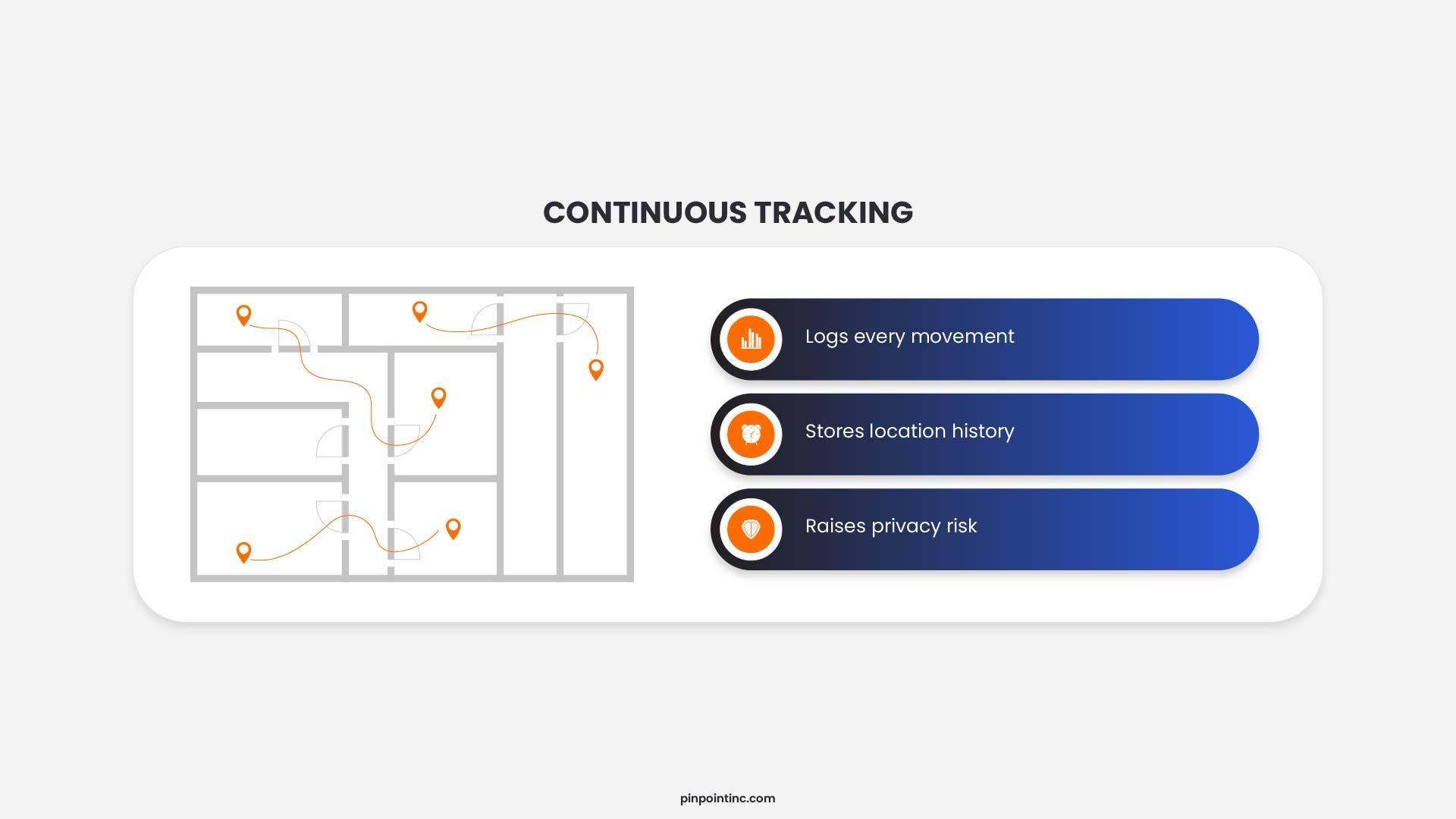
Real-Time Location System (RTLS) platforms typically log a badge’s location at regular intervals throughout a shift, building a persistent movement record whether or not anything eventful happens. Many wearable duress badges marketed for staff safety quietly include this same continuous layer, even though the safety use case only actually requires location data at the moment a nurse presses a button. This is where RTLS alternatives for hospital staff safety become important, especially when hospitals need safety coverage without creating unnecessary movement records.
Constant surveillance and genuine emergency response are not the same safety strategy, even though vendors often bundle them together. A nurse who presses a panic button during an assault needs immediate location data at that moment. A nurse walking to the supply closet at 2 a.m. does not need her employer logging that trip. The wearable panic button guide for 2026 covers systems built around this narrower, event-based model.
The Real Cost: Nurse Trust, Burnout, and Turnover
Hospital leaders evaluating tracking technology tend to focus on the safety upside and underweight the trust cost. The workforce data doesn’t support that trade.
According to the 2026 NSI National Health Care Retention and RN Staffing Report, national hospital RN turnover rose to 17.6% in 2025, a 1.2-point increase from the prior year, reversing the previous decline. The report also found first-year RN turnover at 22.3% and placed the average cost of turnover at $60,090 per RN departure. NSI’s summary cites personal issues, relocation, career advancement, retirement, and education among the main reasons nurses leave.

Culture and trust are not soft metrics when they show up in a nursing shortage that costs the average hospital millions annually in replacement and agency staffing. A workforce already stretched thin by mandatory overtime and unsafe ratios does not need one more reason to feel monitored rather than supported. Digital privacy, in this context, is not an abstract legal concept. It’s a retention lever hospital administrators can pull or ignore.
Legal and Compliance Risks Hospitals Are Sleeping On
Beyond turnover, hospitals deploying continuous location tracking on staff face a stacking set of exposures worth naming plainly.
Public and quasi-public hospitals face closer constitutional scrutiny than private facilities, and the Chatrie ruling strengthens the argument that continuous, unwarranted tracking of employees could face a genuine legal challenge. State digital privacy law is also moving fast, and multi-state health systems increasingly navigate a compliance patchwork where a tracking practice legal in one state requires explicit consent or retention limits in another.
There’s a HIPAA-adjacent wrinkle too. RTLS and wearable systems that combine staff location with patient proximity data can inadvertently create protected health information exposure, since location logs can sometimes be cross-referenced to infer which patients a nurse treated and when. And every high-profile ruling like this one shapes how plaintiffs’ attorneys frame future workplace surveillance claims, even in cases that never invoke constitutional law directly.

For a compliance framework specific to workplace violence obligations that intersect with these tracking decisions, the Joint Commission’s 2026 workplace violence prevention standard is worth reviewing alongside RTLS or wearable vendor contracts.
A Better Way: Safety Without Surveillance
None of this means hospitals should abandon technology that protects nursing staff from workplace violence, a documented and serious risk in high-pressure clinical environments. It means the technology should be built around the actual safety need, not a broader tracking capability that happens to include a safety feature.
The Joint Commission’s workplace violence prevention standard, effective January 2026, requires a formal program with trained leadership, annual risk assessments, and governing body reporting. Notably, it does not mandate RTLS or any specific continuous tracking technology. That gap gives hospitals real room to choose event-triggered systems over always-on location monitoring.
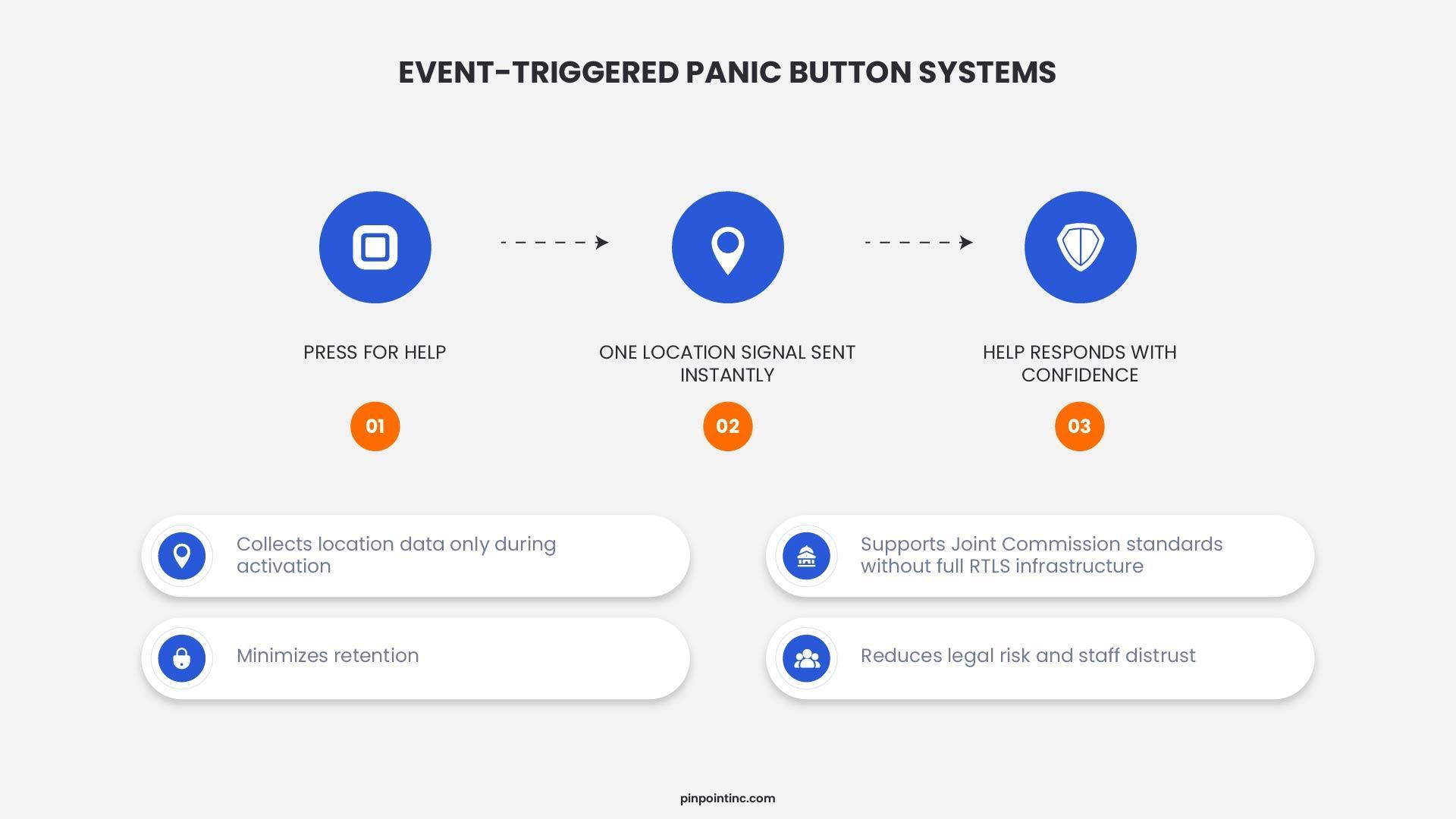
This is the design principle behind Pinpoint’s wearable panic button systems: a nurse presses a button when she needs help, and that action, not her entire shift, is what generates a location signal. There is no continuous movement log sitting in a database waiting to be subpoenaed, breached, or misused. For hospitals reviewing compliance alongside staff safety, the OSHA-focused workplace violence prevention approach helps show how this model satisfies Joint Commission requirements while sidestepping the exposure that continuous RTLS tracking creates.
Building a Privacy-Forward Safety Program: Practical Steps
Hospital leaders don’t need to choose between staff safety and digital privacy. A few concrete steps can close the gap fast. There are also real legal implications tied to staff tracking devices, especially when location data is collected continuously, retained too long, or used beyond the immediate safety purpose.
- Audit every system that touches staff location data, including badges, wearables, and mobile apps, and document exactly what’s collected, how long it’s retained, and who can access it.
- Separate safety features from tracking features in vendor contracts, and ask directly whether continuous location logging happens even when no emergency is triggered.
- Give nursing staff clear, written disclosure of what’s collected and why, rather than folding tracking consent into a general onboarding packet nobody reads closely.
- Set retention limits that match the actual safety purpose. There’s rarely a legitimate operational reason to keep months of routine movement logs on file.
- Review your program against your state’s current privacy statutes, one of the fastest-moving areas of state legislation right now.
- Revisit your workplace violence prevention program against the Joint Commission’s 2026 standard to confirm you’re meeting it without over-collecting data you don’t need.
- If the goal is to reduce legal exposure while still protecting staff, the better path is to choose a solution that is compliant, privacy-conscious, and built around regulated safety needs rather than unnecessary tracking.
If you want a second set of eyes on where your current systems fall on the tracking-versus-safety spectrum, schedule a demo with Pinpoint and we’ll walk through it with you.
The Bottom Line
Chatrie v. United States didn’t just settle a robbery case. It confirmed something hospital leaders should already suspect: location data, even a small slice of it, reveals more about a person than most tracking programs acknowledge. Nurses already carry enough weight during a shift. They shouldn’t have to wonder whether every step is being logged, stored, and potentially exposed.
The hospitals that get this right in the next few years won’t be the ones with the most sensors. They’ll be the ones that built safety programs nurses actually trust, ones that respond when help is needed instead of watching all the time. If you’re ready to see what that looks like in practice, talk to our team about a system designed for real emergencies, not constant surveillance.
Next Step
See Safety Without Surveillance in Action
Protecting nurses should not require logging every step they take. Pinpoint's wearable panic button generates a location signal only when a staff member presses for help, so there is no continuous movement record to breach, subpoena, or misuse.
If you are reviewing RTLS or wearable vendor contracts, we can walk through where your current systems fall on the tracking-versus-safety spectrum and how an event-triggered model supports Joint Commission requirements without the privacy exposure.
See how event-triggered alerting protects staff without tracking them.
FAQ’s
What did the Supreme Court decide in Chatrie v. United States?
The Court held 6-3 that obtaining someone’s cell phone location history through a geofence warrant is a search under the fourth amendment, even when the window is as short as two hours. It sent the case back to the Fourth Circuit to determine whether the specific warrant used met probable cause and particularity requirements.
What is a Carpenter v. United States summary, in plain terms?
Carpenter v. United States (2018) held that police need a warrant to obtain historical cell-site location records because that data can reveal deeply personal patterns in a person’s life. It also limited the third-party doctrine, the idea that sharing data with a company automatically strips away privacy protection. Chatrie builds directly on this foundation.
Does the fourth amendment apply to hospitals tracking their own employees?
Not directly in most cases, since it restrains government action rather than private employers. Public hospitals face closer scrutiny, and this ruling increasingly informs how courts and legislatures evaluate employee privacy rights even outside a strict constitutional context.
Is RTLS tracking of nurses illegal?
Not automatically, but it carries growing legal risk depending on your state’s digital privacy law, how clearly you disclose the tracking, how long you retain the data, and whether continuous tracking is even necessary for your stated safety purpose.
How is Pinpoint different from RTLS?
Pinpoint’s wearable panic button systems generate location data only when a staff member activates the device during an emergency, rather than logging movement continuously throughout a shift. This supports Joint Commission workplace violence prevention requirements without the surveillance footprint of full RTLS deployment.
How can hospitals protect employees without creating privacy risk?
Hospitals can protect employees by choosing safety systems that support emergency response without creating unnecessary legal exposure from continuous tracking. Location data can trigger privacy obligations when it is collected, stored, accessed, or retained beyond the immediate safety purpose. Pinpoint reduces that risk by using an event-triggered model: location information is generated only when an employee activates the panic button during an emergency. That gives hospitals a safer path to support workplace violence prevention, meet compliance expectations, and avoid building routine movement records they do not need.
- What Just Happened: Chatrie v. United States
- From Carpenter to Chatrie: How the Fourth Amendment Caught Up With Your Phone
- Why This Ruling Matters Inside Hospital Walls
- The Employee Privacy Rights Hospitals Can No Longer Ignore
- RTLS, Wearables, and Apps: Where Hospital Tracking Crosses the Line
- The Real Cost: Nurse Trust, Burnout, and Turnover
- Legal and Compliance Risks Hospitals Are Sleeping On
- A Better Way: Safety Without Surveillance
- Building a Privacy-Forward Safety Program: Practical Steps
- The Bottom Line
- FAQ’s
Author:
Jordan Belous
Chief Marketing Officer of Pinpoint North America, where she leads marketing strategy, brand development, and digital growth initiatives. She earned a Bachelor of Science in Allied Health with a concentration in physical therapy sciences from the University of Tampa, bringing a unique interdisciplinary perspective that blends healthcare knowledge with modern marketing strategy.
Jordan writes about workplace violence prevention in healthcare, nurse safety, staff wellbeing, and emerging healthcare technologies that support frontline teams. Her work explores how hospitals and behavioral health facilities can build safer environments, reduce burnout and turnover, and implement safety systems that protect staff while preserving trust and dignity.
She is also the Chief Executive Officer of Whip Pediatric Cancer, a nonprofit dedicated to supporting children battling cancer and raising awareness and funds for pediatric cancer. Through her work with Whip, Jordan regularly visits pediatric cancer patients in hospitals and spends time alongside patients, families, and the clinicians who care for them. These experiences place her directly beside nurses and healthcare teams every day and reinforce her belief that the people providing care deserve to feel just as safe as the patients they serve.
Her experiences with Whip and her work at Pinpoint are closely connected, both driven by her deep respect for nurses and frontline healthcare workers. Seeing firsthand the compassion, resilience, and critical role nurses play has strengthened her commitment to advocating for safer healthcare environments and ensuring that those who dedicate their lives to caring for others have the protection and support they deserve.