
q15 Patient Safety Check System
Simplify patient observation documentation
without changing clinical workflows.
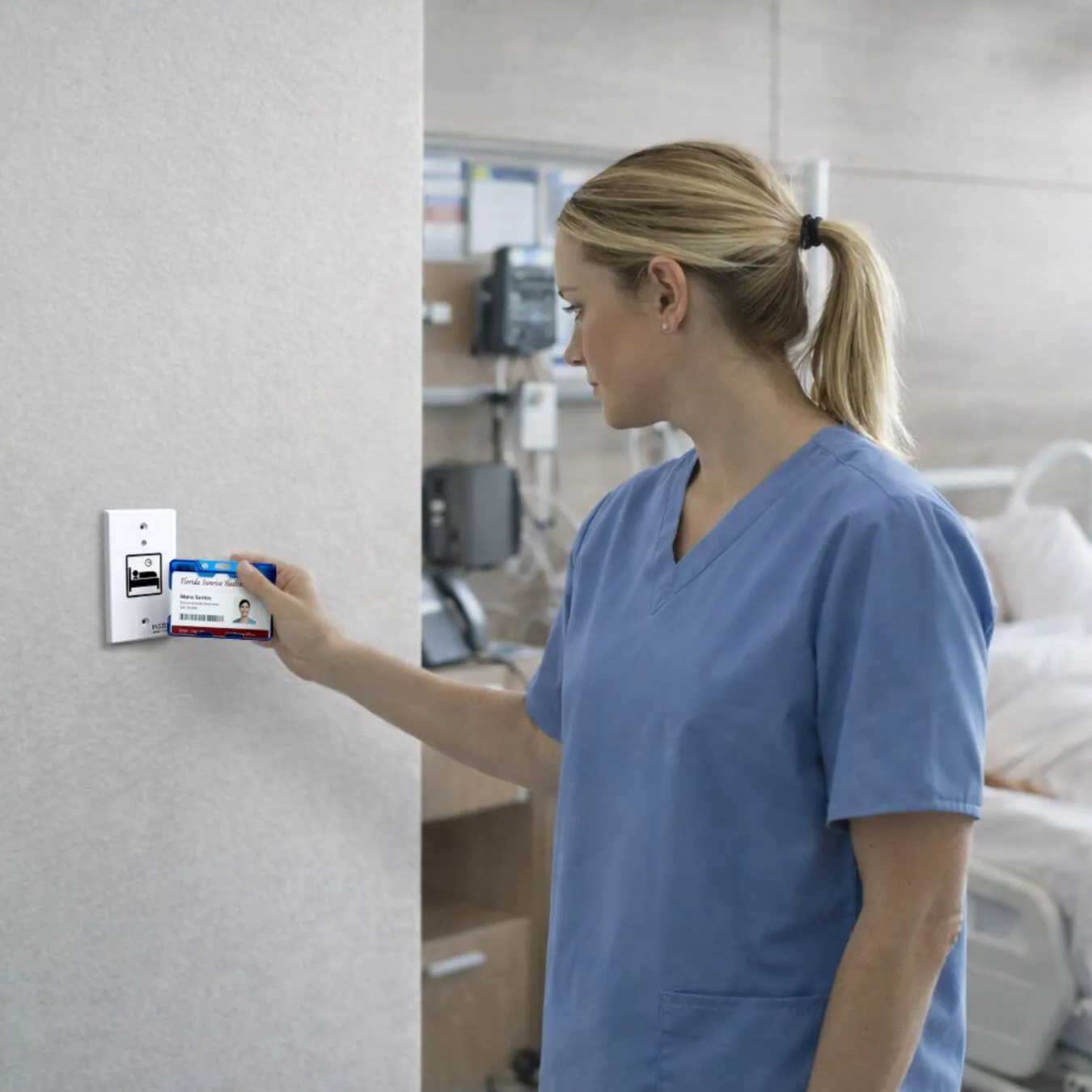
Pinpoint’s q15 Patient Safety Check System helps behavioral health and inpatient care teams document each patient safety check at the point of care. Staff simply tap their existing badge at the patient location, and the system records the clinician, date, time, and location in a secure digital log.
This creates a faster, clearer, and more consistent way to manage q15 checks while supporting compliance, oversight, and safer patient care.
Joint Commission Aligned
Works with existing staff badges
Automatic observation logging
Fast deployment across units
Built Around How Observation Actually Works
Patient observation policies vary by state, but the Joint Commission recommends periodic caregiver visits for high-risk patients. Hospitals and behavioral health facilities determine observation intervals as long as policies and procedures are documented and consistently followed.
The q15 check system is built specifically for behavioral health environments where observation rounds are a daily clinical requirement, not an occasional event. Whether you follow a strict 15-minute patient safety check protocol or a facility-specific interval, Pinpoint gives you a verifiable record of every round completed.

When Observation Records Depend On Manual Processes
Patient observation documentation is a critical part of maintaining safety, compliance, and accountability. But when records are managed on paper, missed entries, inaccurate timestamps, limited oversight, and time-consuming audits become difficult to avoid.
Staff carried paper rounding sheets
Physical forms were easy to lose, damage, or forget. A missed signature created a compliance gap with no way to recover it.
Manual time entries were unreliable
Rounding times were written after the fact, not recorded at the moment of observation. Documentation reflected memory, not reality.
Supervisors had no live visibility
Charge nurses and administrators had no way to know whether rounds were running on time unless they physically checked. Missed rounds went undetected until review.
Audits required manual document retrieval
Pulling records for a Joint Commission survey or an incident review meant sorting through paper logs, a slow and error-prone process under pressure.
Volume becomes unsustainable
On a 20‑bed unit, staff complete roughly 1,900 patient observation rounds per day. Pinpoint automates every single log, eliminating paperwork and returning that time to patient care.
rounds per day on a 20-bed unit

Patient Observation And Staff Safety On The Same Badge
The q15 Patient Safety Check System is a powerful add-on to the Pinpoint Panic Button System, giving facilities patient observation documentation and staff safety support through the same badge staff already wear.
That means no extra staff device, no separate platform to learn, no duplicate workflow, and no additional line item for a standalone q15 documentation tool. Staff continue working the way they already do, while Pinpoint captures each patient observation automatically at the point of care.
Timestamped entries
Every round is recorded at the exact moment of the visit.
Staff attributed
Each check is linked to the staff member who completed it.
Audit-ready records
Exportable logs available immediately for compliance review.
Built For High-Risk Clinical Environments
Our safety check system can be deployed as a stand-alone workflow or added to your existing panic button system. Staff use the same ID badge holder, which keeps observation checks and panic alerts in one simple, familiar process and reduces the need for extra devices, extra training, or a separate workflow.
Safety Check Annotations
Clinicians can add date, time, and room details from their mobile device or desktop, creating a clear record without extra paperwork. This helps teams capture accurate observations in real time, especially in fast-moving behavioral health and inpatient settings.
Ligature-Resistant Design
All patient safety check components are ligature-resistant and tamper-resistant, making them suitable for high-risk behavioral health environments. The hardware is designed to support safer observation workflows without introducing unnecessary risk into sensitive care areas.
Secure Safety Check Log
The system securely stores each check in a digital log, helping teams maintain accurate records for review, audits, and internal reporting. This gives supervisors a reliable source of truth when validating completed rounds and reviewing missed checks.
Reduces Clinician Workload
By replacing paper logs and manual tracking, Pinpoint helps reduce documentation burden and keeps staff focused on care. It also improves consistency by removing the delays and errors that often come with handwritten observation records.
Safety Check Analytics
Supervisors can view completed and overdue checks in one portal, making it easier to spot gaps and respond faster. The analytics also give leadership better visibility into unit activity, staffing patterns, and compliance performance.
Regulatory Compliance
UL certification through ETL and alignment with Joint Commission expectations help support compliance-focused workflows across the facility. This makes the system a strong fit for hospitals that need both operational accountability and documentation they can stand behind during surveys or audits.
A q15 Observation Round In Fours Steps
The Pinpoint q15 system turns a previously manual, error-prone process into a simple, verifiable workflow that takes the same amount of time as the round itself.
Staff enters the patient room
The staff member completes the observation visit as they normally would. No change to clinical behavior, no interruption to patient interaction.
Badge tap records the check
A quick tap of the wearable badge on the room reader captures the visit in real time. Timestamp, room number, and staff identity are logged automatically.
Supervisors see it immediately
The management portal updates instantly. Charge nurses and administrators can see which rooms have been checked, which are overdue, and who completed each round.
Missed rounds trigger instant alerts
If a check is overdue, supervisors don't have to guess or walk the unit. Pinpoint automatically flags the missed round in the portal and can send real-time alerts, so staff can intervene before a documentation lapse becomes a patient safety or compliance issue.
Built For Documentation That Stands Up To Surveys, Audits, And Reviews
When a Joint Commission survey, internal audit, incident review, or compliance assessment occurs, observation records need to be complete, accurate, and immediately accessible. The q15 Patient Safety Check System automatically creates timestamped, staff-attributed documentation that supports oversight, accountability, and regulatory readiness. Records are stored in a HIPAA-compliant cloud system with configurable retention to meet state laws (typically 6‑10 years).
Joint Commission Alignment
The Joint Commission expects observation policies to be followed consistently. The q15 system creates automatic point-of-care records, providing surveyors with clear, verifiable documentation without extra administrative work. To strengthen trust for compliance buyers, our physical system components are independently UL certified by ETL, ensuring your tracking infrastructure satisfies strict national regulatory standards during unexpected inspections.
State Mandate Readiness
Patient observation requirements vary by state, and many facilities operate under internally defined observation protocols. The q15 system can be configured to match your facility's required observation interval, whether every 15 minutes or another defined frequency. Documentation remains consistent, accurate, and audit-ready regardless of the schedule used.
HIPAA - compliant Cloud
Secure storage for observation records.
Configurable Retention
Support state-specific record retention needs.
ETL Certified Hardware
Independent trust signal for compliance buyers.
How Pinpoint Compares To Standalone q15 Documentation Tools
The workflow stays simple. Staff complete the observation round as normal, while Pinpoint creates the record automatically.
| What Matters to You | Standalone q15 Tool | Pinpoint q15 System |
|---|---|---|
| Primary use case | Digital documentation for observation checks and rounds | q15 patient safety check documentation built into a broader staff safety system |
| Staff device model | Typically requires a separate device or dedicated workflow for documentation | Uses the same wearable badge staff already carry for panic alerts and safety support |
| Separate device required | Often requires staff to use a separate documentation process or device | No additional staff device required when used with the Pinpoint Panic Button System |
| Staff safety integration | Primarily focused on documentation | Combines patient observation documentation and staff panic alerts on the same badge |
| q15 documentation | Supports digital logging of observation checks | Records clinician, date, time, and room location in a secure digital log |
| Point-of-care logging | Designed to reduce manual paper logs | Staff tap their badge at the patient location, and the system records the check instantly |
| Compliance support | Supports digital records for review | Creates timestamped, staff-attributed records for surveys, audits, and incident reviews |
| Behavioral health fit | Used in environments where frequent checks are required | Designed for high-risk behavioral health settings, with anti-ligature and tamper-resistant components |
| Supervisor visibility | Helps facilities review completed observation activity | Alerts supervisors to missed or overdue rounds in real time; management portal shows completed, pending, and overdue checks |
Are We A Good Fit For Your Healthcare Setting?
Pinpoint is built for facilities that have specific requirements around reliability, safety, and staff experience. If the following statements describe what your facility needs, the q15 system is worth a closer look.
You want q15 checks documented automatically at the moment of the visit, not filled in retroactively at the end of a shift.
You need 15-minute safety check records that are immediately available for Joint Commission surveys and incident reviews.
You want supervisors to have live visibility into which rounds are complete and which are overdue without physically checking.
You want patient safety observation and staff panic alerts running on a single badge without carrying additional devices.
You want no alerts failing because of dead zones, interference, or network congestion during a safety-critical event.
You want a system that requires little to no IT overhead to deploy, maintain, or scale as your facility grows.
You want no per-device, per-month fees that increase as you add staff or expand to additional units.
You want a supervised system that tells you when something is not working before it becomes a compliance gap.
You want a wearable badge that is anti-ligature, tamper-resistant, antimicrobial, and safe for use in clinical environments.
You want a management portal that supports oversight, reporting, and compliance documentation from one place.
Are We A Good Fit For Your Healthcare Setting?
Pinpoint is built for facilities that have specific requirements around reliability, safety, and staff experience. If the following statements describe what your facility needs, the q15 system is worth a closer look.
You want q15 checks documented automatically at the moment of the visit, not filled in retroactively at the end of a shift.
You need 15-minute safety check records that are immediately available for Joint Commission surveys and incident reviews.
You want supervisors to have live visibility into which rounds are complete and which are overdue without physically checking.
You want patient safety observation and staff panic alerts running on a single badge without carrying additional devices.
You want no alerts failing because of dead zones, interference, or network congestion during a safety-critical event.
You want a system that requires little to no IT overhead to deploy, maintain, or scale as your facility grows.
You want no per-device, per-month fees that increase as you add staff or expand to additional units.
You want a supervised system that tells you when something is not working before it becomes a compliance gap.
You want a wearable badge that is anti-ligature, tamper-resistant, antimicrobial, and safe for use in clinical environments.
You want a management portal that supports oversight, reporting, and compliance documentation from one place.
Common Questions About q15 Patient Safety Checks
Answers to the questions we hear most often from behavioral health and inpatient facility teams evaluating the q15 system.
A q15 patient safety check is a structured observation round where staff monitor high-risk patients at scheduled intervals, commonly every 15 minutes, to help support patient safety and wellbeing. q15 checks are widely used in behavioral health and certain inpatient settings for patients at risk of self-harm, elopement, behavioral escalation, or medical deterioration. Observation requirements vary by state regulations and facility policies, but healthcare organizations are expected to maintain documented observation procedures and follow them consistently as part of patient safety and compliance practices.
Staff tap their wearable badge on a wall-mounted reader when entering a patient room. The system records the timestamp, room location, and staff identity automatically. This replaces the paper rounding sheet with a live digital record that is immediately visible to supervisors and available for audit without any manual retrieval. There is no back-filling, no end-of-shift paperwork, and no opportunity for documentation gaps caused by a lost or damaged form.
No. The q15 patient safety check system is an add-on to the Pinpoint Panic Button System. Staff use the same wearable badge for both employee safety alerts and patient observation documentation. There is no additional device to carry, no new login to manage, and no separate workflow to learn. If your facility is already using Pinpoint for staff safety, adding q15 rounding documentation requires no change to how staff operate day to day.
Every observation round logged through the Pinpoint q15 system creates a timestamped, staff-attributed digital record that is stored and exportable from the management portal. When a Joint Commission survey or an internal incident review requires documentation of patient safety check rounds, that information is retrievable immediately, without sorting through paper logs or relying on staff recollection. Observation records are created at the time of care, making them accurate and defensible.
Yes. While q15 refers specifically to 15-minute patient safety checks, the Pinpoint system supports configurable observation intervals to match your facility's defined policy. Some facilities operate under state-mandated q15 protocols while others use internally defined frequencies. The documentation format and compliance records work the same way regardless of the interval, so your records remain consistent and audit-ready whatever schedule your policy requires.
The q15 system uses wall-mounted readers installed at patient room entry points. These readers communicate with the Pinpoint infrastructure already in place if your facility is running the Pinpoint Panic Button System. The system is designed with minimal IT overhead in mind and does not require complex network integration or dedicated servers. For facilities starting fresh, Pinpoint's implementation team handles the full installation and setup process.
No. Pinpoint does not track staff location on a continuous basis. The system records a location event only when a staff member actively taps their badge at a reader, which happens during a patient observation round or when a safety alert is triggered. There is no passive location monitoring between those events. This is an important distinction for facilities that have concerns about continuous staff surveillance, and it is one of the reasons the Pinpoint wearable badge model is preferred in many behavioral health environments.
Yes. The Pinpoint Q15 Patient Safety Check System replaces paper rounding sheets with real-time digital documentation. Each patient observation is recorded automatically at the point of care, creating a timestamped, staff-attributed record without relying on manual entries or end-of-shift paperwork.
Pinpoint runs independently of your EHR/EMR. There is no integration required, which means no IT tickets, no interface engines, no version compatibility issues, and no delay in deployment. Observation logs can be exported from the Pinpoint management portal and attached to patient records as needed. The separation also ensures that a network outage or EHR downtime never blocks Q15 documentation or staff safety alerts.
Replace Paper Observation Logs With A Real-Time, Audit-Ready Q15 Workflow
See how Pinpoint can support safer patient observation, staff accountability, and compliance documentation without adding extra devices or changing clinical workflows.