
Why RTLS Signals Fail in Dense Hospital Environments
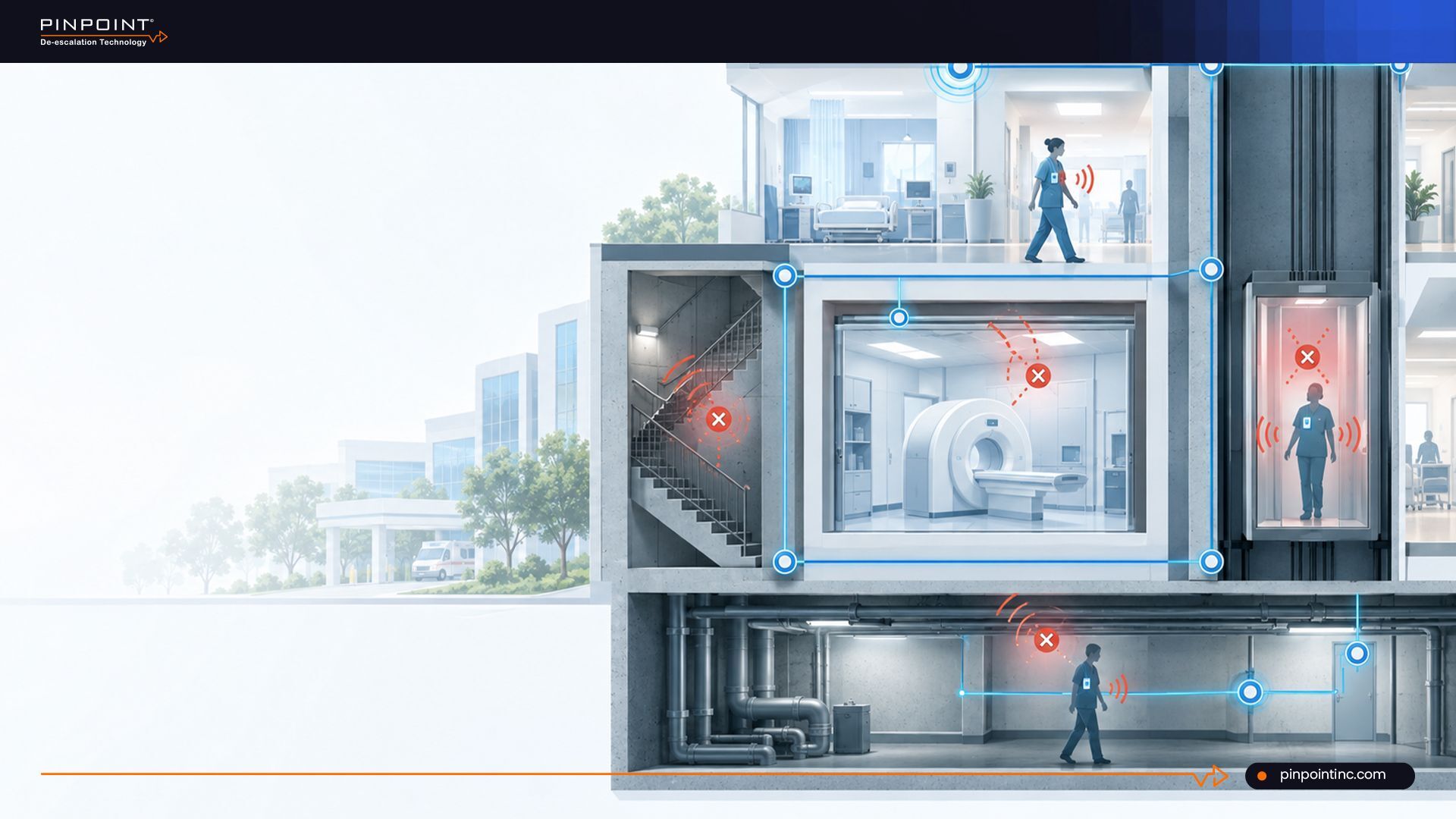
If a nurse presses a duress badge in a stairwell, imaging suite, or basement corridor, can the system identify the right room immediately?
Signal reliability in a hospital depends on more than the badge. Concrete, metal, shielded rooms, elevators, and constantly moving people can all disrupt how signals travel. That means a hospital duress alarm system has to be designed around the building itself, not just the device.
That is why Real Time Location System (RTLS) performance can look strong in a demo and become less predictable after deployment. Research on indoor positioning in hospitals consistently points to attenuation, multipath propagation, interference, and non-line-of-sight conditions as sources of location error. In one hospital study, BLE positioning accuracy dropped sharply under increased signal interference. Published hospital RTLS research shows why the building itself has to be part of the test plan.
RTLS is not one technology. Wi-Fi, BLE, UWB, infrared, and hybrid systems behave differently. The practical question is not whether “RTLS works,” but where a specific architecture becomes less reliable and whether the duress alert path still works when the location layer or enterprise network is under stress. Pinpoint approaches that problem with event-triggered room-level location on dedicated in-building infrastructure rather than continuous RTLS tracking. That distinction matters when comparing RTLS for staff protection with a network-independent staff safety system or other event-triggered approaches. It also keeps workplace duress RTLS discussions focused on how the alert behaves in the real facility.
Where RTLS Signals Struggle Most in Hospitals
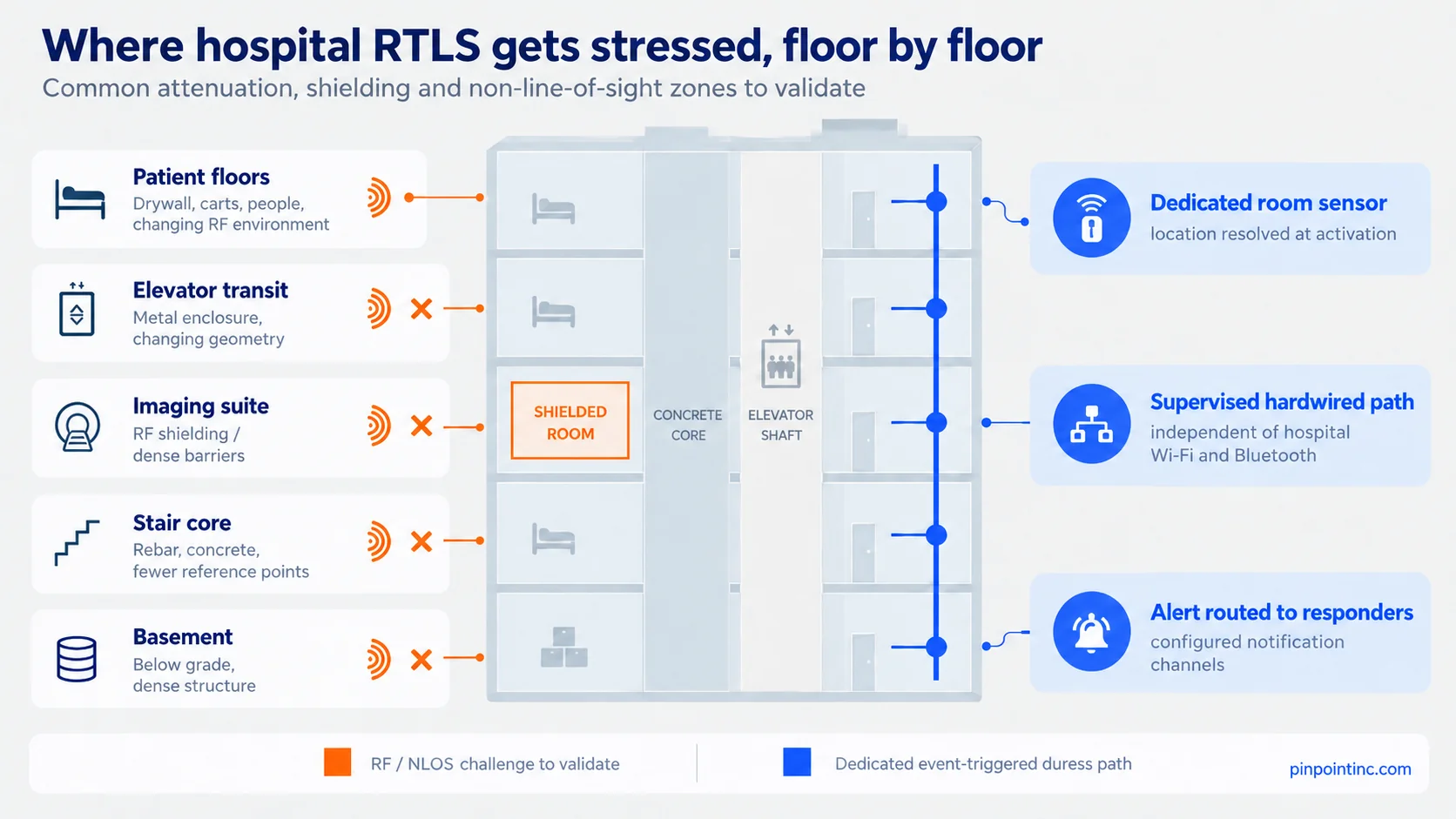
Four hospital zones deserve extra scrutiny because they combine shielding, dense materials, non-line-of-sight paths, or vertical movement. They should be validated in the actual building, not assumed from a standard coverage model. When evaluating RTLS for staff protection, each of these zones should have its own acceptance test.
1. Concrete cores and stairwells
Reinforced concrete and rebar attenuate and reflect RF signals. Depending on the RTLS technology, that can reduce signal strength, create multipath, or make floor-level positioning less stable. Stairwells are especially difficult because they sit inside structural cores and often have fewer reference points than occupied clinical areas. A room-level location duress alert should therefore be tested inside the stair core, not inferred from corridor coverage.
The risk is practical: a staff member can move from a well-covered corridor into a stair core while the system still has to resolve the correct floor and zone.
2. Shielded imaging and treatment rooms
Shielded rooms are not all built the same. MRI suites use RF shielding, commonly a conductive enclosure, to limit external radio-frequency interference. CT and radiation therapy spaces may use lead or dense concrete for radiation shielding. Those materials and enclosures can attenuate or block wireless signals, but the effect depends on frequency, doors, penetrations, antenna placement, and the location technology. The same validation applies to a wearable duress system for healthcare that must identify the correct room inside or beside shielded spaces.
For a duress system, the question is not simply whether a signal can reach the room from outside. It is whether the system has been designed and tested to identify the correct room from inside the shielded space.
3. Below-grade basements and service corridors
Below grade, foundation walls, slabs, earth, mechanical equipment, and long service corridors can all complicate RF propagation. Cellular coverage may be weak, and Wi-Fi or BLE coverage designed for connectivity may not provide the geometry or density needed for accurate location in every service space. These areas need direct validation. A hospital panic button system should be tested in these service areas under the same conditions staff will actually encounter.
4. Elevators and transit shafts
Elevator cars and shafts add metal, movement, changing geometry, and rapid transitions between floors. Wireless location systems may see non-line-of-sight conditions or changing reference points during the ride. The key test is whether the system can resolve the correct floor and destination zone as the staff member enters or exits the car. For RTLS for staff protection, floor transitions are especially important because a small vertical error can send responders to the wrong level.
What Actually Determines Whether the Alert Gets Through
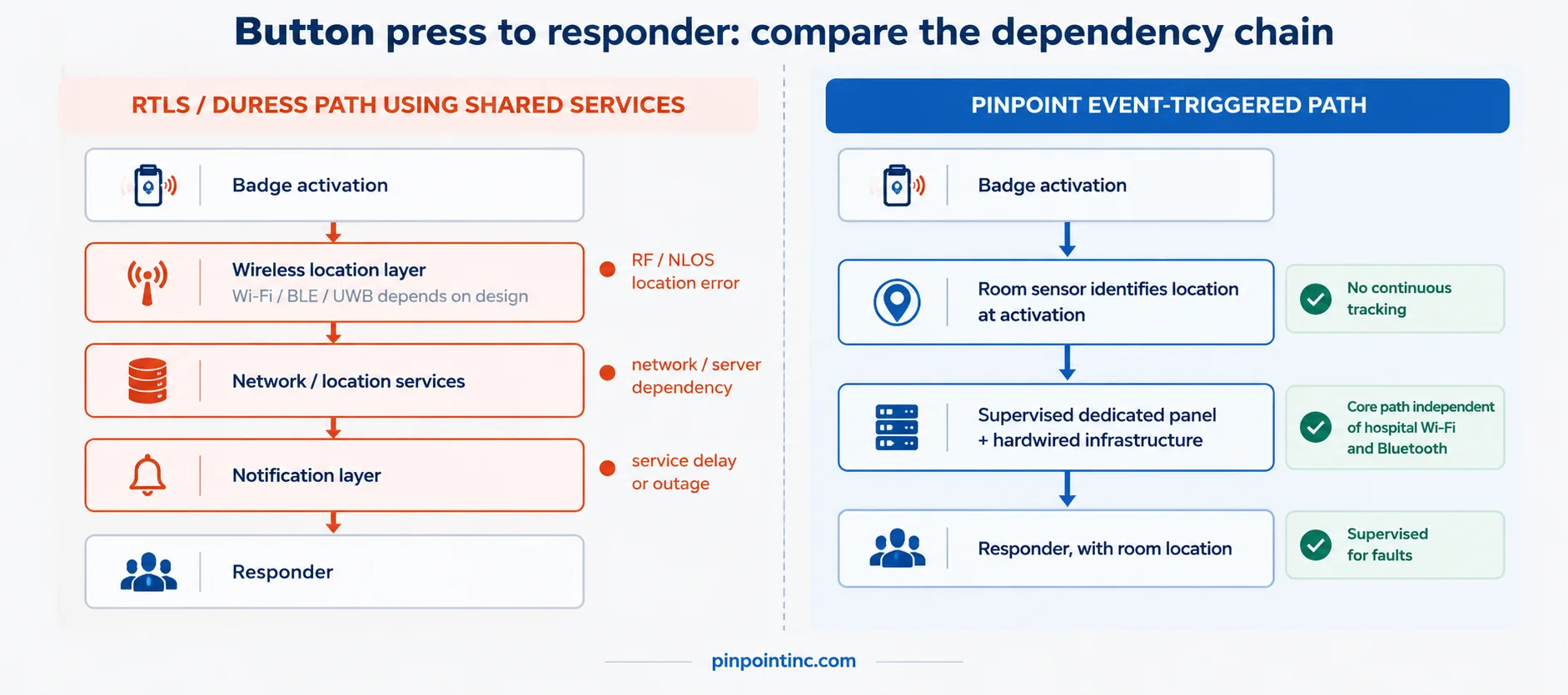
Once the building introduces signal uncertainty, trace the full alert path. A duress system can fail because of location sensing, network transport, back-end services, or notification delivery. Those dependencies differ by architecture. A hospital duress alarm system should be evaluated end to end, from button press through location, transport, notification, and responder receipt.
RTLS paths that depend on shared infrastructure
Some Wi-Fi and BLE RTLS deployments use hospital access points, gateways, servers, or shared network services as part of the location and alerting path. Other architectures, including dedicated UWB or hybrid systems, use separate anchors or infrastructure. The important point is to map the actual dependency chain rather than assume every RTLS platform works the same way. This is particularly important for workplace duress RTLS because the safety use case depends on both location and alert delivery. RTLS for staff protection should be mapped component by component before procurement.
Shared infrastructure can reduce deployment overhead, but it can also make location or alert delivery dependent on access points, controllers, network segments, servers, or cloud services. Ask vendors which components are required for a duress event to travel from the badge to the responder, and what happens when one becomes unavailable. Hospitals comparing architectures should weigh the tradeoffs between hardwired and wireless panic button infrastructure, then document every component that remains in the alert chain. A network-independent staff safety system reduces some shared-network dependencies, but it still needs the same end-to-end validation.
The shared-infrastructure risk to test
This is where security and IT reviews need to overlap. A platform may have good location accuracy under normal conditions but still inherit dependencies from the network, identity services, virtualization stack, or notification layer. The same test should be applied to any hospital panic button system that relies on enterprise infrastructure for one or more stages of alert delivery.
Did you know?
67%
of healthcare organizations surveyed by Sophos were hit by ransomware in 2024. Only 22% recovered within a week, while 37% took more than a month.
Microsoft Threat Intelligence also reported 389 U.S. healthcare institutions affected by ransomware in its fiscal year. Those figures do not mean every network-based duress system will fail during a cyber incident. They do mean hospitals should verify which parts of the alert path depend on enterprise services and what remains available during downtime.
Event-triggered paths on dedicated infrastructure
For a wearable duress system for healthcare, dedicated infrastructure can simplify the question of what remains operational during enterprise network disruption.
Pinpoint takes a different approach. Its core staff-duress infrastructure is hardwired and independent of hospital Wi-Fi and Bluetooth networks, with supervised components that can report faults. Room-level location is resolved when the badge is activated rather than continuously tracked. Pinpoint lists alert transmission within 85 milliseconds, while downstream notifications can be configured across on-site and digital channels. In practice, that architecture is designed to deliver a room-level location duress alert without requiring continuous staff tracking.
That distinction matters because room-level safety is not only an accuracy question. It is also an availability question. A precise location estimate has limited value if the alert chain cannot complete during the outage scenario you are planning for. The healthcare duress alarm system guide maps the broader architecture, while the RTLS alternatives for hospital staff safety comparison focuses on non-tracking approaches. In either case, RTLS for staff protection should be evaluated across accuracy, coverage, supervision, and dependency together.
Room-Level Location Without Continuous RTLS Tracking
This difference is central when comparing workplace duress RTLS with event-triggered safety architectures.
Not every coverage problem is RF. A staff-safety system also fails if the wearable is not carried, charged, or trusted enough to stay in use. A wearable panic button only protects staff if it remains available, trusted, and easy to carry throughout the shift.
Why continuous location tracking can affect adoption
Continuous location can raise legitimate privacy and workforce-governance questions, especially when a system designed for safety can also create a movement history. The concern is not universal, and policies differ by organization, but hospitals should address it directly with nursing leadership, labor representatives, privacy teams, and staff before rollout. A network-independent staff safety system can reduce location-data exposure when it is designed around event-triggered rather than continuous tracking.
The adoption question matters because the underlying safety problem is significant. In National Nurses United’s 2023 survey of nearly 1,000 nurses, 81.6% reported experiencing at least one type of workplace violence in the prior year. Only 29.5% said their employer had staff available at all times to respond to workplace violence. For a wearable duress system for healthcare, adoption is part of reliability because an unworn device cannot create a usable safety alert.
What event-triggered location actually logs
Pinpoint uses an event-triggered model. The system identifies room-level location when the staff member activates the badge; it does not continuously record normal movement. The result is a room-level location duress alert tied to the moment help is requested rather than a shift-long movement history.
That reduces the amount of employee location data created by the safety system and can make the privacy conversation more straightforward. It does not remove the need for clear retention, access, and incident-review policies, but it narrows the data set those policies have to govern.
This is especially relevant in behavioral health and other high-risk care settings, where staff may move quickly between rooms and need a discreet way to request help without reaching a phone. Joint Commission workplace violence standards emphasize worksite analysis, reporting, response processes, training, and mitigation, so the technology has to fit the broader prevention program rather than stand alone. A hospital panic button system should therefore be evaluated as one part of the hospital’s broader workplace violence prevention process.
Maintenance and daily use
Daily friction matters too. If a wearable requires frequent charging, syncing, or unit-level dock management, hospitals need a process that keeps devices ready across every shift. Pinpoint’s wearable uses a 5 to 7 year battery and does not require daily charging or syncing. That difference matters when comparing wearable panic buttons in hospital settings, because a long-life battery removes one common daily-readiness task from clinical units.
What to Ask a Vendor About Coverage in Your Building
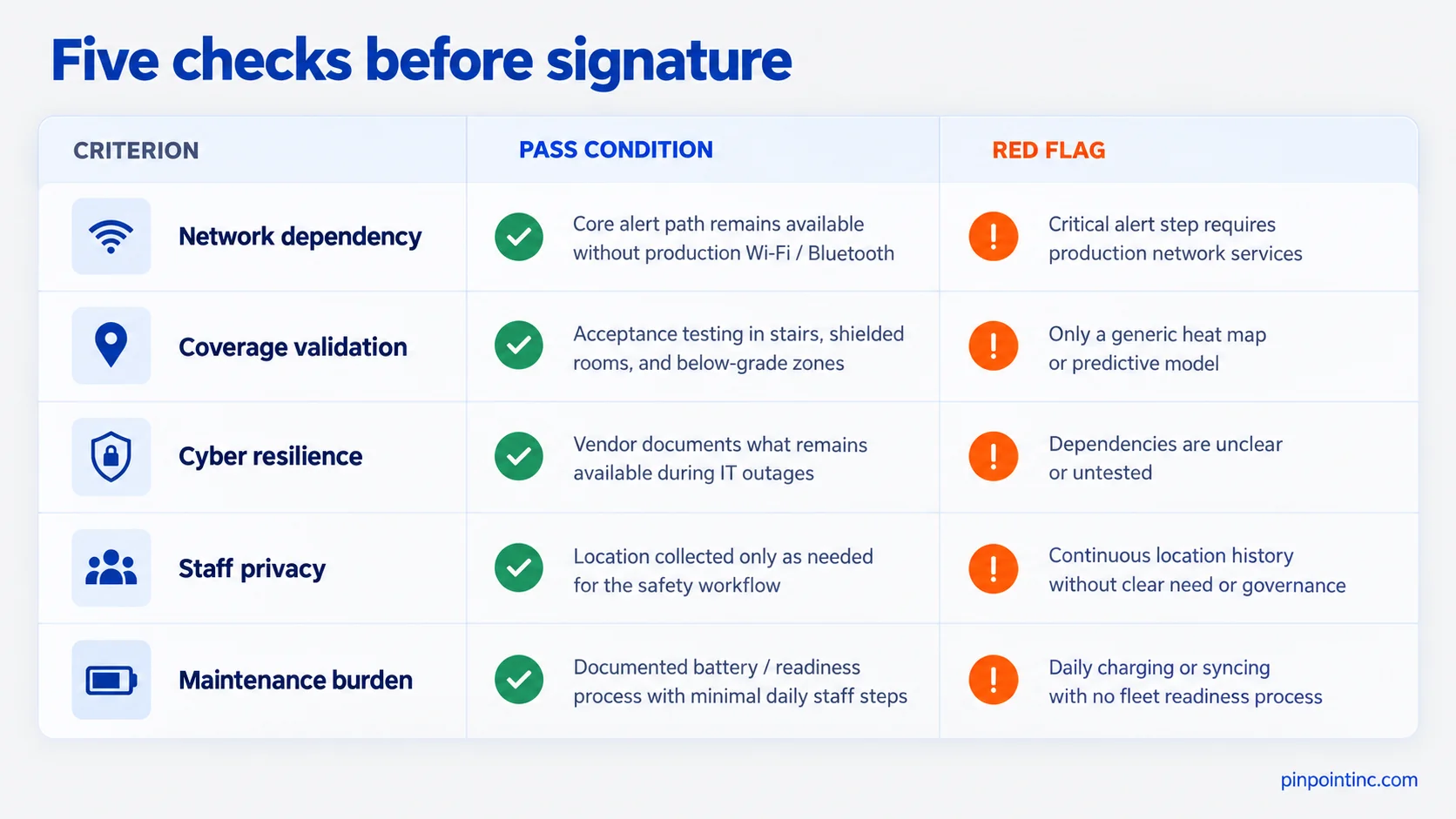
Ask these during the bid review and site validation. Strong answers should describe the architecture, test method, failure behavior, and evidence from comparable healthcare environments. The best duress alert system for healthcare facilities should be judged on real-building coverage, outage behavior, staff usability, and a clearly documented alert path.
- What path does the alert take when our primary Wi-Fi, Bluetooth, cellular, or enterprise network is unavailable?
Weak answer: failover is described, but the vendor cannot explain whether the backup shares the same controller, network, authentication, server, or cloud dependency. For a hospital duress alarm system, the vendor should be able to show exactly which components remain available during each outage scenario. - How is room-level location determined, and what happens in non-line-of-sight or high-multipath spaces?
Weak answer: an accuracy number with no test method, floor plan, room type, or confidence threshold. RTLS for staff protection should be tested in the same difficult spaces where multipath and non-line-of-sight conditions are most likely to appear. - How has the system been validated in stairwells, shielded imaging rooms, elevator lobbies, and below-grade spaces?
Weak answer: only a predictive survey or generic coverage promise. Ask for acceptance testing in your own building and examples from comparable facilities. For workplace duress RTLS, acceptance testing should include these zones before final sign-off. - What is the badge battery life, and what charging, replacement, syncing, or fleet-readiness process is required?
Weak answer: device readiness is treated as a nursing responsibility with no documented process for keeping the fleet available across shifts. A wearable duress system for healthcare should also have a documented battery and fleet-readiness plan that does not depend on informal staff routines.
Terminology varies between vendors, and the distinction between a duress button, panic button, and continuous RTLS platform affects how these answers should be read. The same terminology check matters when comparing a hospital panic button system with RTLS-based and event-triggered alternatives.
A Short Coverage Checklist Before You Sign
The best duress alert system for healthcare facilities is the one whose coverage and failure behavior can be demonstrated in the hospital itself, not only on a specification sheet.
These questions also support a broader workplace violence prevention review. Joint Commission standards require hospitals to maintain a workplace violence prevention program that includes worksite analysis, reporting, response processes, training, and mitigation. They do not prescribe a specific duress technology, so hospitals still need to validate whether the selected system supports those operational requirements. A hospital duress alarm system should support those operational requirements without being mistaken for the entire workplace violence prevention program.
Next Step
Send Us a Floor Plan. We'll Map the Zones.
Pinpoint designs room-level duress coverage around the actual facility, including stair cores, shielded spaces, elevator lobbies, and below-grade corridors where generic wireless assumptions are least useful. Our core infrastructure is supervised and independent of hospital Wi-Fi and Bluetooth, and staff location is identified only when the badge is activated.
The review covers a zone-by-zone look at your floor plan, sensor and infrastructure placement for shielded, concrete, and below-grade areas, outage testing for location and alert delivery, and a clear explanation of staff privacy, badge readiness, and rollout.
Start with the stair cores, shielded rooms, and basements on your plans.
FAQ’s
What causes RTLS signal interference in hospitals?
Hospital RTLS signals can be affected by reinforced concrete, metal surfaces, RF shielding, medical equipment, people, multipath reflections, and non-line-of-sight conditions. The impact varies by technology. Wi-Fi and BLE systems that infer location from received signal strength are especially sensitive to changes in the RF environment, while UWB, infrared, and hybrid systems have different design constraints. These factors should be part of any RTLS for staff protection test plan, especially when room-level identification is required.
Do concrete, metal, and lead affect RTLS accuracy?
Yes, but not in the same way for every RTLS technology. Reinforced concrete and metal can attenuate or reflect radio signals, creating weaker paths or multipath. Lead and RF shielding can further isolate specific clinical spaces. Hospitals should test the actual room, frequency, antenna placement, and door conditions rather than rely on a generic material assumption. A hospital duress alarm system should be validated with the doors, shielding, equipment, and room conditions that will exist during normal operation.
Why can an RTLS system show the wrong room or floor?
Indoor location engines estimate position from the signals or reference points they can see. Reflections, blocked paths, changing signal strength, sparse reference points, and vertical overlap between floors can shift that estimate. Published healthcare studies have reported room and floor errors in real deployments, which is why acceptance testing should use realistic staff movement rather than stationary demo points. The acceptance target for a room-level location duress alert should be the correct room or defined response zone, not simply a broad coordinate estimate.
How should hospitals test RTLS or duress coverage before purchase?
Test the spaces most likely to expose the architecture: stair cores, shielded imaging rooms, below-grade corridors, elevator lobbies, and transitions between floors. Confirm both location accuracy and end-to-end alert delivery. The acceptance plan should define the expected room or zone, response time, outage conditions, and what happens when a network or back-end component is unavailable. The best duress alert system for healthcare facilities should pass this end-to-end test in both normal and planned failure conditions, not only in a controlled demonstration.
Can a hospital duress system work during a Wi-Fi or network outage?
Yes, if the core alert path is built to operate independently of the hospital’s production network. Pinpoint uses dedicated, supervised infrastructure, so its room-level duress alerts do not rely on hospital Wi-Fi or Bluetooth to reach responders. When comparing any hospital panic button system, ask the vendor to show exactly what still works during a network outage.
Author:
Jordan Belous
Chief Marketing Officer of Pinpoint North America, where she leads marketing strategy, brand development, and digital growth initiatives. She earned a Bachelor of Science in Allied Health with a concentration in physical therapy sciences from the University of Tampa, bringing a unique interdisciplinary perspective that blends healthcare knowledge with modern marketing strategy.
Jordan writes about workplace violence prevention in healthcare, nurse safety, staff wellbeing, and emerging healthcare technologies that support frontline teams. Her work explores how hospitals and behavioral health facilities can build safer environments, reduce burnout and turnover, and implement safety systems that protect staff while preserving trust and dignity.
She is also the Chief Executive Officer of Whip Pediatric Cancer, a nonprofit dedicated to supporting children battling cancer and raising awareness and funds for pediatric cancer. Through her work with Whip, Jordan regularly visits pediatric cancer patients in hospitals and spends time alongside patients, families, and the clinicians who care for them. These experiences place her directly beside nurses and healthcare teams every day and reinforce her belief that the people providing care deserve to feel just as safe as the patients they serve.
Her experiences with Whip and her work at Pinpoint are closely connected, both driven by her deep respect for nurses and frontline healthcare workers. Seeing firsthand the compassion, resilience, and critical role nurses play has strengthened her commitment to advocating for safer healthcare environments and ensuring that those who dedicate their lives to caring for others have the protection and support they deserve.