
Nurse Safety Technology: Panic Buttons, Duress Alarms, and What Works

What would you do if a patient grabbed the stethoscope around your neck and pulled?
I didn’t invent that scenario. A nurse described it in National Nurses United’s latest workplace violence survey: a patient took hold of her stethoscope, tried to choke her with it, then swung it at her. She couldn’t shout down the hallway or reach a button on the wall.
So when someone asks me which nurse safety technology actually works, I start with one question: can it help nurses request assistance in those critical first seconds? That’s what this guide explores, examining how wearable panic buttons, duress alarms, and supporting technologies perform when nurses need help most.
Nurse Safety Technology, Sorted by When It Acts
Most comparisons sort products by form: badge, wall button, phone app. I find it more useful to ask when during an incident each tool becomes useful.
- Before an incident. Patient risk flags, virtual sitting, and weapons screening help identify or reduce risks, but offer limited assistance once a nurse faces an immediate threat.
- Early escalation. A discreet de-escalation alert can bring nearby support before a situation turns violent, provided someone is available to respond.
- Emergency. Panic alerts, wall buttons, overhead codes, and radios help summon assistance. Fixed or voice-dependent options may be difficult to use when a nurse is cornered.
- Response. Notifications reach phones, display panels, and over-door lights. A location reported only as “third floor, east wing” can leave responders searching for the right room.
- After. Alert records, incident logs, debriefs, and worksite analysis help review what happened, provided accurate information was captured.

Read that list again, and one thing stands out: early escalation and emergency alerts are especially important when a threat is unfolding. That’s why panic buttons and duress alarms deserve closer attention, along with the four main panic button architectures available to healthcare teams. I also treat different types of workplace violence in healthcare as separate planning challenges; a visitor with a weapon and a delirious patient require different response strategies.
Facilities that already run a real-time location system for equipment often ask whether it can double as the duress layer, or whether the healthcare emergency call buttons built into nurse call can cover staff. The cost, infrastructure, and staff-acceptance trade-offs between RTLS and non-tracking systems are worth settling before a vendor demo.
Where Workplace Safety for Nurses Breaks Down
The scale of workplace violence is well documented. Bureau of Labor Statistics data show health care and social assistance accounted for 72.8% of private-industry workplace violence injuries requiring days away, transfer, or restriction in 2021–2022, at 14.2 cases per 10,000 workers compared with 2.9 across all industries. What surprised me was where workplace safety for nurses falls short in practice.
National Nurses United’s 2025–26 workplace violence survey asked 1,267 registered nurses in 28 states and D.C. which prevention measures their employers had actually put in place. Training led at 74.8%. Then the numbers drop: 59.0% said incidents are investigated and 38.4% said there is a clear way to report them. Only 35.5% said staff are available at all times to respond to violence, 28.5% said extra staff are placed to reduce risk, and just 18.2% said nurses are included in violence risk assessments.

Those numbers point to a gap between training and the support available when violence occurs. Workplace safety tools for nurses are less effective when the people assigned to respond are occupied elsewhere.
California’s regulation addresses this directly. Under Section 3342(c)(11)(A), a staff member isn’t considered available if other assignments prevent an immediate response to an alarm. Hospital staff safety depends on response capacity as much as hardware, so any evaluation of nurse safety technology should ask two questions together: does the alert reach the right people, and who can act on it at 3 a.m. on a short-staffed night?
The 18.2% figure matters for another reason. California requires employee involvement in identifying and evaluating workplace hazards under Section 3342(c)(2). In my view, nurses involved in choosing a device can also identify practical issues, including why it might end up unused in a locker.
What Regulators Expect From an Emergency Call Button in Healthcare
There is still no specific federal OSHA workplace violence standard for health care; OSHA relies on the General Duty Clause. State regulations and accreditation requirements provide more specific guidance for workplace safety for nurses, including how employees summon help.
- Cal/OSHA, Title 8 Section 3342. The standard requires, as applicable to each unit’s hazards, an alarm or other effective means to summon aid, access to alarms that patients cannot block, alarms where layout prevents line of sight, an incident log with date, time, and specific location, and an annual review of alarm sufficiency. Certain hospitals must report qualifying incidents within 24 or 72 hours.
- The Joint Commission. Its workplace violence requirements, introduced in 2022 and organized under National Performance Goal #2a in 2026, cover designated leadership, incident monitoring, annual worksite analysis, and staff training. These requirements support a comprehensive prevention program without mandating a specific alarm device.
- New York. Senate Bill 5294B, signed in December 2025, requires hospitals and nursing homes to establish workplace violence prevention programs, including incident documentation and annual security assessments for general hospitals. The law took effect in September 2026, giving covered facilities twelve months to establish their programs. Wearable panic buttons have also become part of the broader conversation, including demands raised by New York City nurses.
None of these rules names a specific product. The distinction is between what an emergency call button system in healthcare can document and what the prevention program must provide.
- A system can document: alert activation, location, acknowledgment timestamps, supervision faults, and alert type, depending on its capabilities.
- The program must provide: training, room layout assessments, responder assignments, annual reviews, incident narratives, and corrective actions.
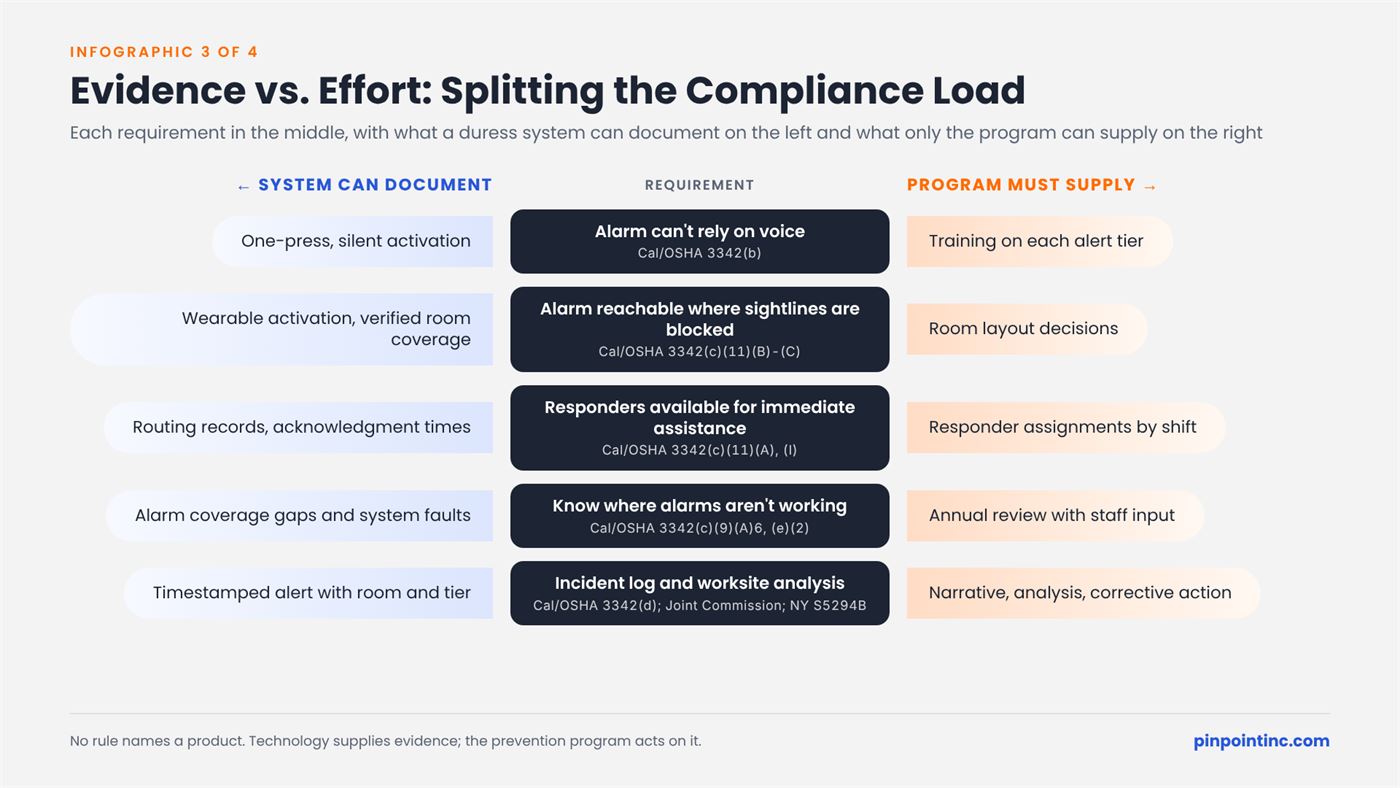
The technology produces the evidence, and the hospital staff safety program still has to review that evidence, train on it, and change something because of it.
Five Traits of Nurse Safety Technology That Works
1. It Works Without a Voice or a Free Hand to Reach a Wall
California’s standard defines an alarm as a device that doesn’t rely on an employee’s voice, and its access rule rules out a button a patient can stand between. Wearable nurse safety technology meets both by default. A fixed emergency call button in healthcare settings still suits reception desks, as this comparison of wearable and fixed duress systems explains, but can’t be the only layer for staff who move all shift.
2. It Gives Nurses a Reason to Press Early
A single button that summons a full security response asks a nurse to decide whether a pacing, raised-voice patient is “bad enough,” and many nurses will wait. A two-tier device separates a quiet request for support from an emergency alert, which moves the first press earlier. The practical difference between duress and panic alerts also decides how each tier should be routed.
3. It Locates the Room at the Moment of the Press, Not All Shift
Responders need room-level location when the alert fires, not a twelve-hour movement history. Non-tracking nurse safety technology determines location only when a button is pressed, which avoids the trust problem created when asset-tracking tags are clipped to nurses and the background strain that continuous location logging adds to nurse burnout.
4. It Reports Its Own Failures
Section 3342 asks facilities to identify locations where alarm systems aren’t operational. A supervised system flags a receiver or device fault when it happens, so the gap shows up on a maintenance screen, not during an assault. I’d ask every vendor what happens, and who is notified, when a receiver serving a healthcare emergency call button goes offline at night.
5. It Fills In Part of the Incident Log
California’s violent incident log asks for the date, time, specific location, and whether security was contacted. A timestamped alert carrying a room, a tier, and an acknowledgment time covers those fields and feeds the Joint Commission worksite analysis. The nurse’s own account still has to come from people.
Matching Wearable Nurse Safety Technology to the Care Setting
The five traits apply to every nurse safety technology purchase, but their weight shifts by setting. Workplace safety tools for nurses on a locked psychiatric unit face different constraints than those in a freestanding ED lobby, and I’d want any hospital staff safety plan to reflect that.
In hospitals, staff move between wings and buildings, so coverage has to follow them and alerts should reach the nearest responders, not only a central desk. Stairwells, patient rooms, and connecting corridors also need attention to avoid gaps as nurses move between units.
In behavioral health units, situations can escalate quickly, and rooms are often private. Accessible hardware should be ligature- and tamper-resistant, badges need breakaway lanyards, and discreet alerts should reach designated responders. Staff also need a way to request assistance without interrupting de-escalation or drawing unnecessary attention.
In residential rehab centers, overnight staffing may be lean, so discreet alerts for monitors and coverage of bedrooms, lounges, and exits are especially important. Response plans should also account for employees working alone or supervising residents across multiple areas.
In freestanding emergency departments, facilities often operate around the clock without nearby campus responders. Alerts must reach the available on-site team, supported by clear procedures for contacting law enforcement when necessary. Coverage should extend to treatment rooms, entrances, and other areas where staff regularly encounter patients and visitors.
How to Pilot Nurse Safety Technology Before a Hospital-Wide Rollout
A shortlist built on the eight evaluation criteria for healthcare duress alarm systems tells you which products could work. A pilot on one high-risk unit shows how they perform in practice. Here’s the five-week approach I’d recommend before committing to a workplace safety system for nurses across every floor.
- Week 0: prepare the pilot. Identify participating staff, define response procedures, and assign responders for each alert tier across shifts.
- Week 1: run scripted test presses. Test both alert tiers in representative locations and across shifts. Record alert delivery, acknowledgment times, and location accuracy.
- Weeks 2 to 4: evaluate daily use. Track device wear rates, alerts by tier, responder acknowledgment, and supervision faults with resolution times.
- Week 5: review the results. Gather nurse feedback on comfort, discretion, and ease of activation, then compare alert records against required incident documentation fields.

Set clear pass/fail criteria before the pilot begins, and let nurses assess how the system performs during actual shifts. Focus on ease of use, alert delivery, and responder acknowledgment. If the technology can’t demonstrate reliable results on one unit, I’d address those gaps before considering a hospital-wide rollout.
See Two-Tier Duress Alerts on Your Own Floor Plan
We built Pinpoint's badge around the traits above: a de-escalation button and a panic button, room-level location only when pressed, and supervised, hardwired infrared receivers that don't depend on hospital Wi-Fi. Bring one of your high-risk units, and we'll show you how alerts would route, what each incident record would capture, and where your current hospital staff safety coverage leaves gaps.
FAQs
Do hospitals have to install panic buttons?
Federal OSHA has no specific workplace violence standard for health care, so there is no universal federal panic button mandate. California’s Section 3342 requires an alarm system or other effective means to summon help, as applicable to workplace hazards. The Joint Commission and New York’s 2025 law establish workplace violence prevention requirements without mandating a specific device.
How is a staff duress alarm different from an emergency call button in healthcare patient rooms?
A patient call button requests care and typically alerts nursing staff. A staff duress alarm signals a safety threat and notifies designated responders. If nurse call includes staff emergency buttons, check whether alerts reach the right team with the appropriate urgency.
Can nurses use wearable panic buttons without being continuously tracked?
Yes. That’s exactly what we built Pinpoint’s wearable panic button around. Unlike systems that continuously monitor staff movement, our event-triggered technology identifies a nurse’s room-level location only when an alert is activated. This allows nurses to request help without creating a continuous movement history, supporting both staff safety and employee privacy.
Who should receive a duress alert?
Designated responders who can act without conflicting duties, as required by Section 3342(c)(11)(I) in California. Early alerts may reach nearby colleagues, while emergency alerts can also notify security. For workplace safety for nurses, routing should reflect actual staffing and response procedures.
- Nurse Safety Technology, Sorted by When It Acts
- Where Workplace Safety for Nurses Breaks Down
- What Regulators Expect From an Emergency Call Button in Healthcare
- Five Traits of Nurse Safety Technology That Works
- Matching Wearable Nurse Safety Technology to the Care Setting
- How to Pilot Nurse Safety Technology Before a Hospital-Wide Rollout
- FAQs
Author:
Jordan Belous
Chief Marketing Officer of Pinpoint North America, where she leads marketing strategy, brand development, and digital growth initiatives. She earned a Bachelor of Science in Allied Health with a concentration in physical therapy sciences from the University of Tampa, bringing a unique interdisciplinary perspective that blends healthcare knowledge with modern marketing strategy.
Jordan writes about workplace violence prevention in healthcare, nurse safety, staff wellbeing, and emerging healthcare technologies that support frontline teams. Her work explores how hospitals and behavioral health facilities can build safer environments, reduce burnout and turnover, and implement safety systems that protect staff while preserving trust and dignity.
She is also the Chief Executive Officer of Whip Pediatric Cancer, a nonprofit dedicated to supporting children battling cancer and raising awareness and funds for pediatric cancer. Through her work with Whip, Jordan regularly visits pediatric cancer patients in hospitals and spends time alongside patients, families, and the clinicians who care for them. These experiences place her directly beside nurses and healthcare teams every day and reinforce her belief that the people providing care deserve to feel just as safe as the patients they serve.
Her experiences with Whip and her work at Pinpoint are closely connected, both driven by her deep respect for nurses and frontline healthcare workers. Seeing firsthand the compassion, resilience, and critical role nurses play has strengthened her commitment to advocating for safer healthcare environments and ensuring that those who dedicate their lives to caring for others have the protection and support they deserve.