
Workplace Violence in Healthcare: Definition, Types, Causes, Effects, and Prevention

Ask any emergency department nurs
e how often they prepare for a patient or visitor to become aggressive, and most will not need long to answer.
91%
of emergency physicians responding to a January 2024 ACEP poll said they or a colleague had been threatened or attacked during the previous year.
Sit with that number for a moment. Hospitals are meant to be places of care, yet workplace violence in healthcare has become common enough that many staff now see aggression as part of the shift.
That normalization is the real problem. When threats, verbal abuse, grabbing, and physical assaults start to feel routine, reporting declines, recurring risks remain hidden, and prevention efforts lose momentum. Meanwhile, healthcare workers carry the physical and emotional effects beyond the workplace.
This guide explains what workplace violence means in a healthcare setting, the forms it takes, who faces the greatest exposure, how it affects workers and facilities, and which prevention measures can reduce risk. A clear, practical understanding of workplace violence is the foundation for every policy, reporting process, and safety decision that follows.
What Is Workplace Violence in Healthcare?
Workplace violence in healthcare refers to any act or threat of verbal, physical, or psychological harm that occurs in a healthcare work setting. It may involve patients, family members, visitors, coworkers, or people with no legitimate connection to the facility. OSHA’s broader definition includes physical violence, harassment, intimidation, and other threatening or disruptive behavior that occurs at a worksite.
In practical terms, it may involve a nurse being grabbed while repositioning an agitated patient, a physician assistant being threatened by a family member, or a security officer being shoved by someone attempting to enter a restricted unit. It also includes worker-on-worker bullying, intimidation, and harassment that may continue across multiple shifts.
A hospital policy should recognize verbal, physical, and psychological harm while clearly stating what employees are expected to report. A definition limited to physical assault excludes many incidents that affect staff safety and may signal a greater risk of escalation.
The Four Main Types of Workplace Violence in Healthcare
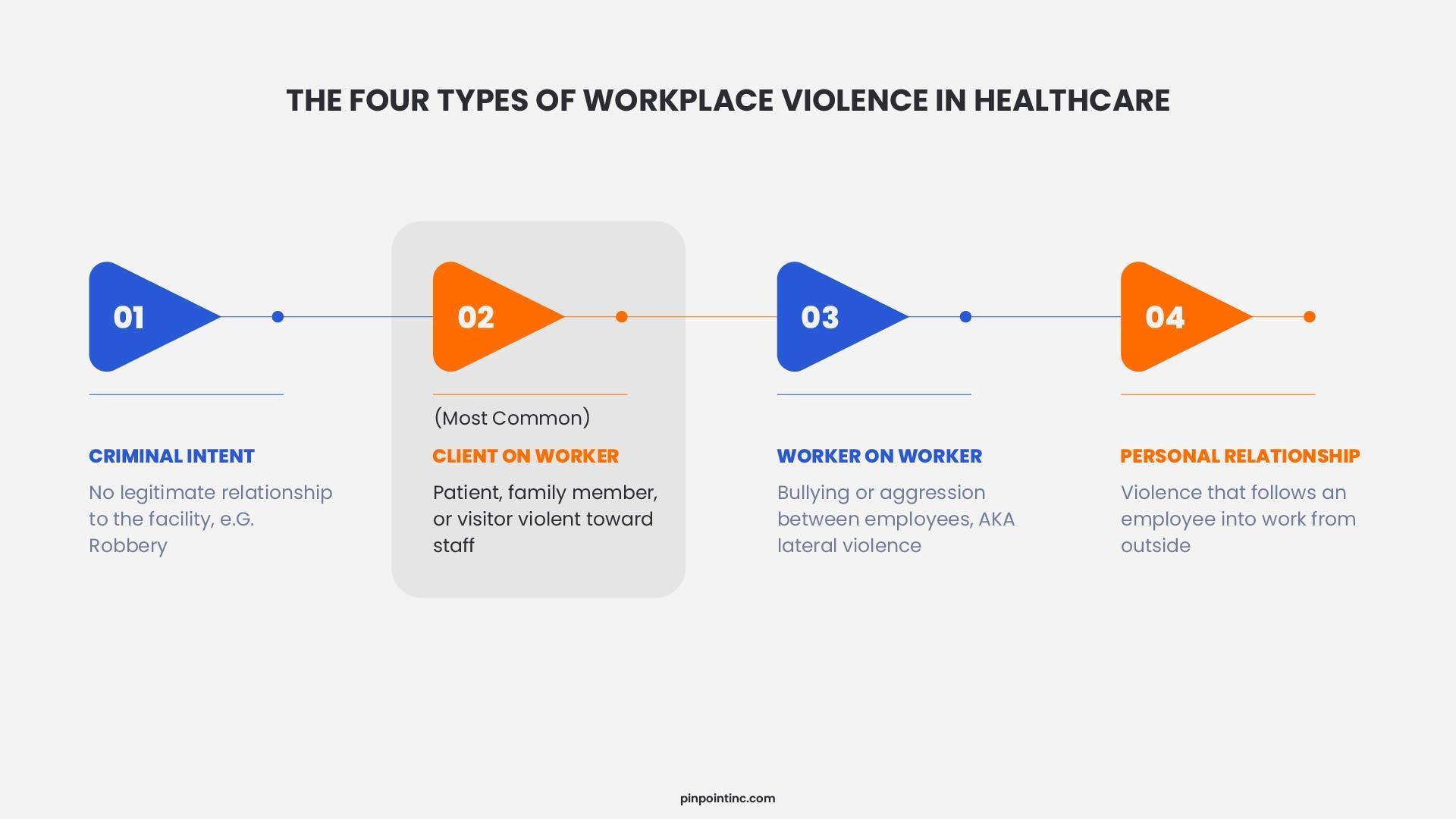
Workplace violence is generally grouped into four categories based on the relationship between the person responsible and the worker. Identifying the correct type helps healthcare facilities choose prevention and response measures that match the source of risk.
Type 1, criminal intent. The person has no legitimate relationship with the facility or its employees and is usually committing another crime, such as robbery or trespassing.
Type 2, client on worker. A patient, family member, or visitor directs violence toward a healthcare worker. This is the most common type of workplace violence in healthcare settings.
Type 3, worker on worker. A current or former employee threatens, bullies, harasses, or physically attacks another employee. This category is sometimes described as lateral or horizontal violence.
Type 4, personal relationship. A person who has a relationship with an employee outside work, such as a current or former intimate partner, brings threats or violence into the workplace.
Type 2 receives the greatest attention because incidents involving patients, family members, and visitors are the most common in healthcare. However, a complete prevention program must address all four types, since each involves different warning signs, reporting pathways, and controls.
Common Workplace Violence Examples in Healthcare
When we look beyond the numbers, workplace violence becomes easier to recognize. It does not always begin with a serious physical attack. Across hospitals, clinics, and long-term care facilities, it may appear as physical aggression, verbal threats, intimidation, or repeated mistreatment between coworkers.
- Physical assault during care delivery. A patient recovering from anesthesia or experiencing delirium strikes, bites, scratches, or grabs a nurse during a blood draw, transfer, or repositioning.
- Verbal abuse and threats in the ED. A frustrated family member shouts at triage staff over wait times or threatens a clinician after receiving difficult news about a loved one.
- Weapon-related incidents. A patient or visitor brings a firearm or knife into the facility, sometimes as part of a criminal act or personal dispute that reaches the workplace.
- Boarding and behavioral health escalation. A patient waiting for psychiatric placement becomes increasingly agitated and directs threatening or combative behavior toward nursing or security staff.
- Lateral violence among staff. A supervisor or coworker repeatedly humiliates, intimidates, excludes, or verbally abuses another employee. Because no patient is involved, this Type 3 violence may be treated as a conduct issue rather than a safety concern.
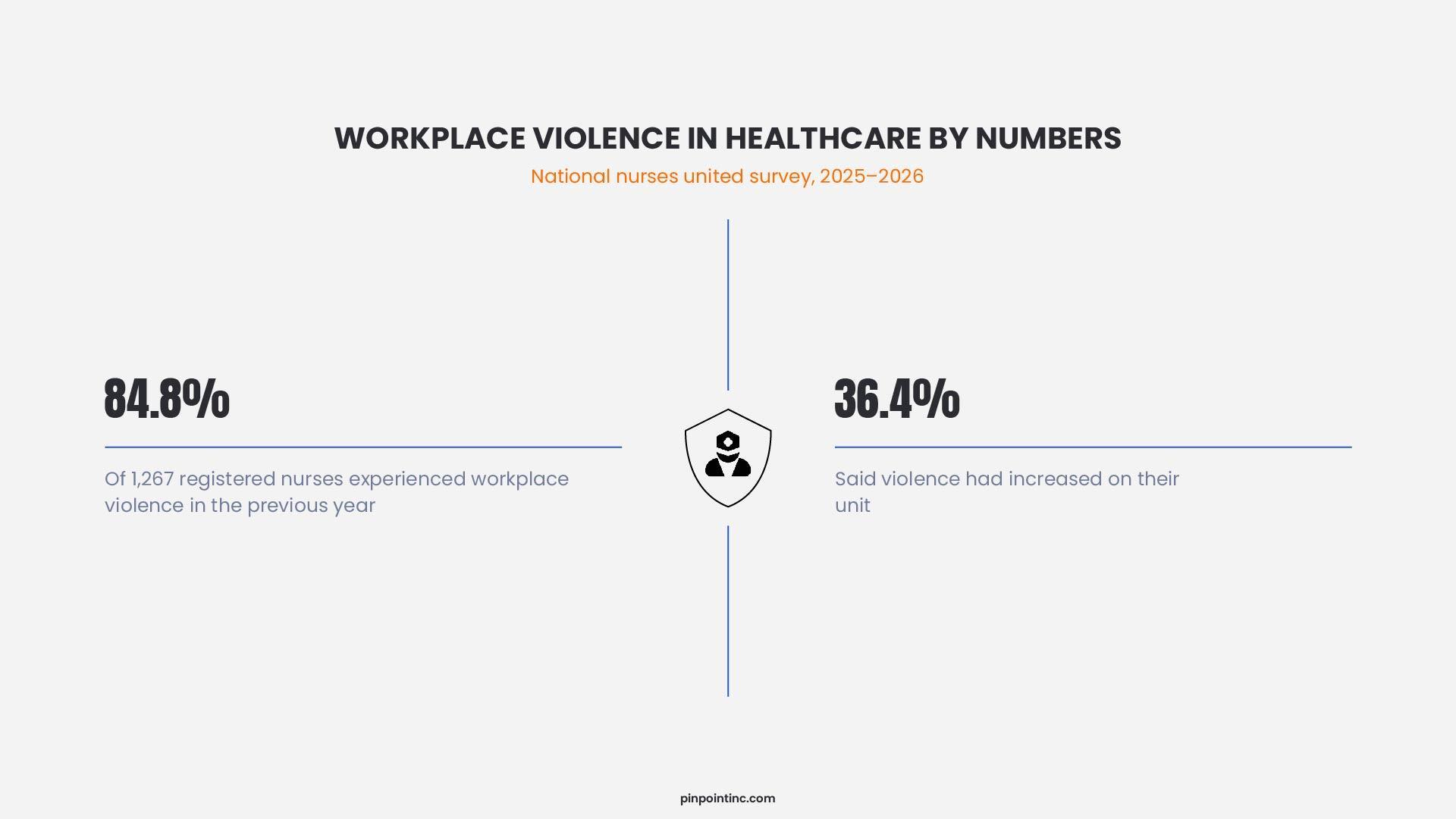
These are not isolated scenarios. A 2026 nationwide survey of 1,267 registered nurses found that 84.8% had experienced at least one type of workplace violence during the previous year, while 36.4% said violence had increased on their unit. The responses were collected across 28 states and Washington, D.C., between July 2025 and May 2026.
The value of reviewing these workplace violence examples is not simply to document what went wrong. When we examine incidents and near misses, we can identify recurring triggers, locations, behaviors, and response gaps. Regular safety huddles and post-incident reviews help teams recognize warning signs earlier and determine what should change before a similar situation escalates again.
Why Some Healthcare Units Face Greater Workplace Violence Risk
Workplace violence risk is not distributed evenly across a healthcare facility. Units with frequent public contact, long waits, high patient acuity, and limited staff or security coverage generally face greater exposure. Assessing each unit separately helps safety teams place resources and controls where they are needed most.
Common workplace violence risk factors in healthcare include:
- Working alone or in isolated areas. Overnight outpatient shifts, home healthcare visits, and patient transport can leave workers without immediate support.
- Unrestricted public access. Emergency departments, entrances, and waiting areas may allow patients and visitors to move through the facility with limited screening.
- Long waits and overcrowding. Delays, boarding, and uncomfortable waiting areas can increase frustration among patients and family members.
- Altered mental status. Dementia, intoxication, severe pain, cognitive impairment, and psychiatric crises can make behavior more difficult to anticipate.
- Understaffing. Fewer available employees can delay assistance and limit the facility’s ability to de-escalate or contain an incident.
- Inadequate security and environmental controls. Poor lighting, uncontrolled entrances, obstructed sightlines, and outdated response procedures can increase exposure.
Psychiatric units, emergency departments, waiting rooms, and geriatric settings are among the hospital areas where violence occurs most frequently. However, any healthcare worker may be exposed, which is why assessments should extend beyond departments traditionally viewed as high risk.
A single hospital-wide rating rarely tells the full story. A behavioral health unit may have controlled visitor access but greater patient-related risk, while an emergency department lobby may face heavier public access and longer waits. Unit-level assessments help safety teams direct staffing, access controls, training, reporting, and response procedures where they are most needed.
How Does Workplace Violence Affect Nurses and Their Teams?
To answer how does workplace violence affect nurses, we need to look beyond the incident itself. Workplace violence in healthcare can cause bruises, sprains, bites, fractures, and other physical injuries, but the emotional effects often last much longer. In National Nurses United’s 2025–2026 survey, 23.4 percent of nurses reported physical injuries or symptoms related to workplace violence, while 63.1 percent experienced anxiety, fear, or increased vigilance.
Violence can also affect sleep, concentration, confidence, and a nurse’s ability to return comfortably to the same environment. The need to remain alert even when no incident is actively occurring can contribute to ambient stress, allowing tension and fatigue to build across repeated shifts. A 2025 study of 1,540 emergency department nurses found that 59.3 percent experienced sleep disorders, with workplace violence associated with both burnout and disrupted sleep.
The impact quickly spreads to the wider team. The 2025–2026 NNU survey found that 18.6 percent of nurses took time away from work after a violent incident, while 25.5 percent considered leaving the profession because of workplace violence. When nurses step away or leave, their colleagues absorb heavier workloads and lose experienced support. That pressure matters when the United States is projected to have approximately 189,100 registered-nurse openings each year through 2034.
How to Prevent Workplace Violence in Healthcare: What Actually Works
Knowing how to prevent workplace violence in healthcare starts with recognizing that no single policy, training session, or device can solve the problem on its own. Effective prevention programs work in layers. Remove one layer, and the risk usually shifts somewhere else rather than disappearing.
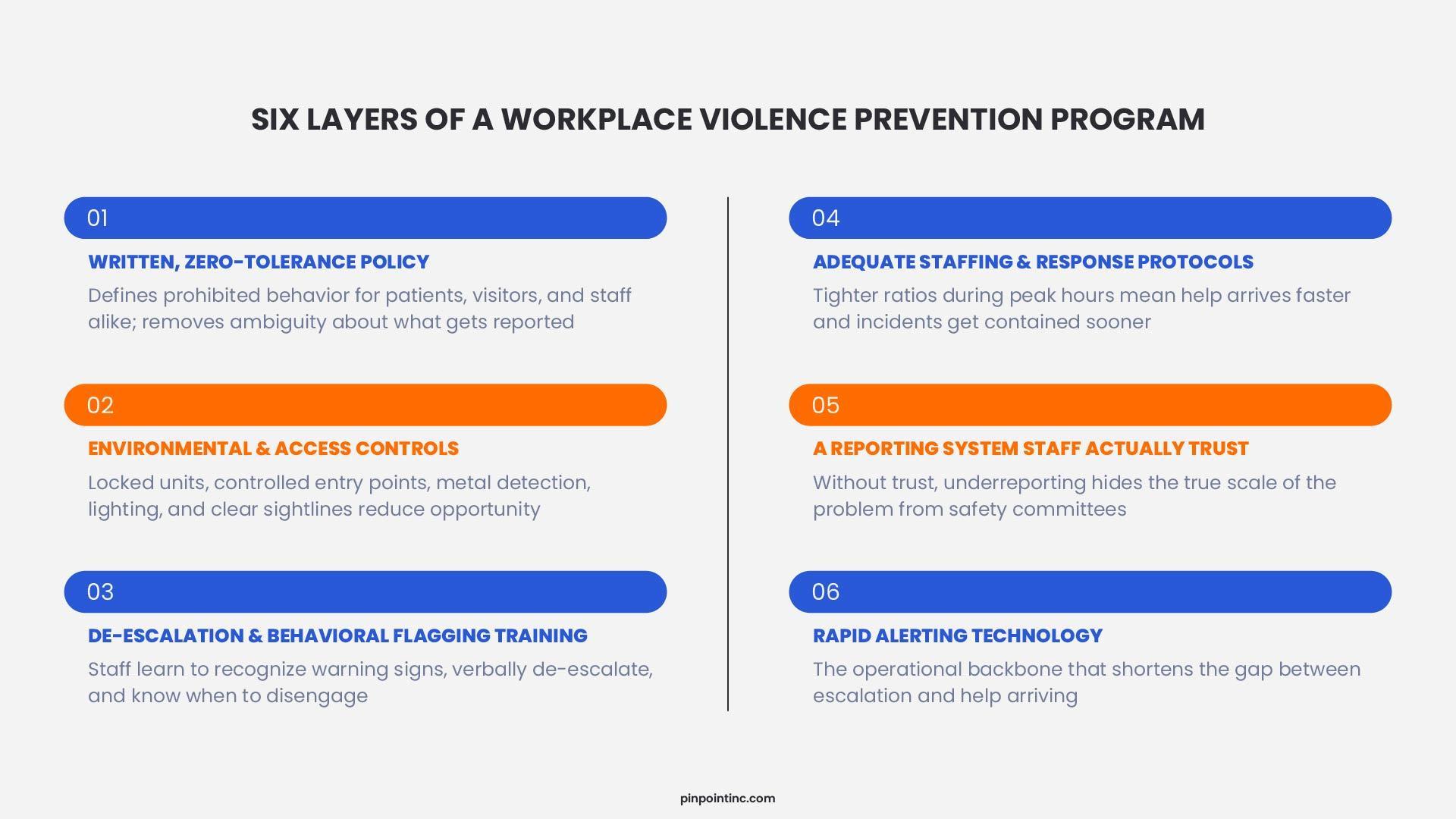
The value of this layered approach is how each measure supports the others. Training helps staff recognize escalation, but it is less effective without enough personnel or a clear response protocol. Access controls may reduce exposure, but they cannot replace a reporting process that reveals where incidents continue to occur.
Trust is especially important. In National Nurses United’s 2025–2026 survey, 22.8 percent of nurses said their employer ignored reports of workplace violence, while 17.4 percent said they were reprimanded or blamed after reporting. When workers expect reports to be dismissed or punished, safety teams lose the information needed to identify recurring risks and improve prevention measures.
Together, these six layers offer a practical answer to how to prevent workplace violence in healthcare. They also reflect what healthcare organizations are increasingly expected to document, review, and improve as part of a credible workplace violence prevention program.
Where Hospital Panic Buttons and Safety Technology Fit In
For years, the standard answer to “what happens when someone needs help right now?” was a hardwired duress button fixed to a wall near a reception desk or workstation. The limitation is clear: a fixed hospital panic button only helps when a staff member can reach it, and violence rarely unfolds in one predictable location.
That gap is why wearable hospital panic button systems have become increasingly common in mid-sized and large healthcare facilities. A wearable badge, clipped to a lanyard or worn on a belt, allows staff to summon help from a patient room, stairwell, hallway, or other work area. When activated, the alert can route to security or a designated response team along with the wearer’s location, helping responders reach the correct area faster.
Location accuracy matters more than many buyers initially expect. A hospital panic button that tells security only that an incident is occurring “somewhere on the third floor” can leave responders searching while the situation continues. Systems designed for healthcare may use infrared, Bluetooth-based positioning, or other indoor location methods instead of relying on GPS alone, which is often unreliable inside buildings. Teams evaluating different configurations can use this comparison of panic button types by healthcare use case to understand why a behavioral health unit and an outpatient clinic may require different approaches.
Workplace violence technology has also expanded beyond a single button press. Depending on the platform, modern systems may support:
- Silent duress activation. Staff can trigger an alert without drawing the aggressor’s attention.
- Two-way communication. A dispatcher may be able to confirm what is happening before responders arrive.
- Automatic incident logging. Alerts and response activity can be timestamped for later review and compliance documentation.
- Integration with existing nurse call systems. Some systems allow staff to use one wearable device for both routine workflows and emergency alerts.
- Location identification for high-risk areas. Facilities comparing tracking and non-tracking approaches can review these real-time location system alternatives for hospital staff safety to weigh privacy concerns against the need to identify where an alert originated.
The return on workplace violence technology is measurable through faster response, stronger incident documentation, and improved readiness. The American Hospital Association estimated that U.S. hospitals spent $3.62 billion in 2023 on violence prevention, training, technology, and security, showing how seriously healthcare facilities are investing in safer response systems.
Also, not every facility needs the same hardware, which is why teams should compare the different types of panic buttons used in healthcare before selecting a hospital panic button system.
It is worth being clear-eyed about what workplace violence technology can and cannot do. No wearable badge, sensor, or dashboard prevents a patient from becoming agitated in the first place, and no vendor should claim otherwise. What effective workplace violence technology does is shrink the window between an incident starting and help arriving, while giving safety committees incident data they can use to identify recurring patterns.
Regulation Is Catching Up, and Documentation Now Matters as Much as Intent
Workplace violence prevention in healthcare was once treated largely as recommended practice. That has changed. The Joint Commission’s workplace violence prevention standards for accredited hospitals and critical access hospitals took effect in 2022, requiring a documented program with leadership oversight, reporting processes, incident analysis, staff training, and post-incident support.
Documentation now affects how workplace violence technology is evaluated. Incident logs, alert records, response data, and location patterns can help facilities identify recurring risks and demonstrate that reported events lead to review and corrective action. Technology supports this process, but it does not replace the policies, worksite analysis, training, and follow-up required by the prevention program.
Similar requirements later expanded to other accredited healthcare settings, including behavioral health organizations in 2024 and home care organizations in 2025. The broader direction is clear: workplace violence in healthcare must be documented, analyzed, and actively managed rather than treated as an unavoidable part of the job.
Bringing It Together
Workplace violence in healthcare cannot be addressed through one policy or device alone. Effective prevention combines clear reporting, staff training, environmental controls, adequate staffing, and a reliable way to request help when a situation escalates.
That final response layer is where Pinpoint fits. Its non-tracking hospital panic button gives healthcare workers a discreet way to summon support while providing responders with precise room-level location, without continuously monitoring staff or relying on Wi-Fi, Bluetooth, or GPS.
See Pinpoint in Action
Explore how precise location identification and rapid alerting can strengthen your workplace violence response.
Next Step
See a Modern Panic Button System in Action
Policies, training, and reporting reduce workplace violence, but staff also need a fast, reliable way to call for help in the moment. Pinpoint's wearable panic button delivers room-level alerts without continuous tracking.
See how Pinpoint supports a complete workplace violence prevention program, from rapid duress alerting to the documentation OSHA and The Joint Commission expect.
See how rapid duress alerting fits your prevention program.
FAQ’s
Is workplace violence against healthcare workers actually rising, or is it just reported more now?
Both factors may contribute. Workplace violence remains underreported, while recent data also indicate a real increase. CDC found reported harassment among health workers more than doubled from 2018 to 2022, and 36.4 percent of nurses surveyed in 2025–2026 said violence had increased on their unit.
Do wearable panic buttons work in areas with weak Wi-Fi or no cell signal?
It depends on the system. Wi-Fi or cellular-based panic buttons may experience coverage gaps. Pinpoint uses supervised, hardwired infrared receivers and does not depend on Wi-Fi, Bluetooth, GPS, or cellular service, allowing room-level location within properly installed coverage areas. Basements and stairwells should still be included in site testing.
How is worker-on-worker violence investigated differently from patient-on-worker incidents?
The core steps remain similar: protect those involved, document the incident, interview witnesses, identify contributing factors, and implement corrective action. Worker-on-worker cases usually require HR or employee-relations involvement, while patient-on-worker reviews also examine clinical condition, care context, staffing, and security response.
- What Is Workplace Violence in Healthcare?
- Common Workplace Violence Examples in Healthcare
- Why Some Healthcare Units Face Greater Workplace Violence Risk
- How Does Workplace Violence Affect Nurses and Their Teams?
- How to Prevent Workplace Violence in Healthcare: What Actually Works
- Where Hospital Panic Buttons and Safety Technology Fit In
- Regulation Is Catching Up, and Documentation Now Matters as Much as Intent
- Bringing It Together
- FAQ’s
Author:
Jordan Belous
Chief Marketing Officer of Pinpoint North America, where she leads marketing strategy, brand development, and digital growth initiatives. She earned a Bachelor of Science in Allied Health with a concentration in physical therapy sciences from the University of Tampa, bringing a unique interdisciplinary perspective that blends healthcare knowledge with modern marketing strategy.
Jordan writes about workplace violence prevention in healthcare, nurse safety, staff wellbeing, and emerging healthcare technologies that support frontline teams. Her work explores how hospitals and behavioral health facilities can build safer environments, reduce burnout and turnover, and implement safety systems that protect staff while preserving trust and dignity.
She is also the Chief Executive Officer of Whip Pediatric Cancer, a nonprofit dedicated to supporting children battling cancer and raising awareness and funds for pediatric cancer. Through her work with Whip, Jordan regularly visits pediatric cancer patients in hospitals and spends time alongside patients, families, and the clinicians who care for them. These experiences place her directly beside nurses and healthcare teams every day and reinforce her belief that the people providing care deserve to feel just as safe as the patients they serve.
Her experiences with Whip and her work at Pinpoint are closely connected, both driven by her deep respect for nurses and frontline healthcare workers. Seeing firsthand the compassion, resilience, and critical role nurses play has strengthened her commitment to advocating for safer healthcare environments and ensuring that those who dedicate their lives to caring for others have the protection and support they deserve.