
De-escalation Technology for Behavioral Health: How Two-Tier Alert Systems Support Earlier Intervention
A behavioral health nurse who notices a patient sliding from agitated to unpredictable doesn’t need a siren. She needs a way to signal, quietly, that she wants someone else in the room, before the situation moves past the point where a calm voice and open hands still work. That’s the gap between de-escalation training and de-escalation technology. Training teaches staff what to do in that window. Technology decides whether they get the chance to do it.
Most hospital panic button systems were built around a single alert level: press it, and everyone treats it as an emergency. That works for a genuine crisis. It works less well for the far more common moment when a nurse wants a colleague to step in for two minutes, not a visible security response that can make an already tense patient feel cornered.
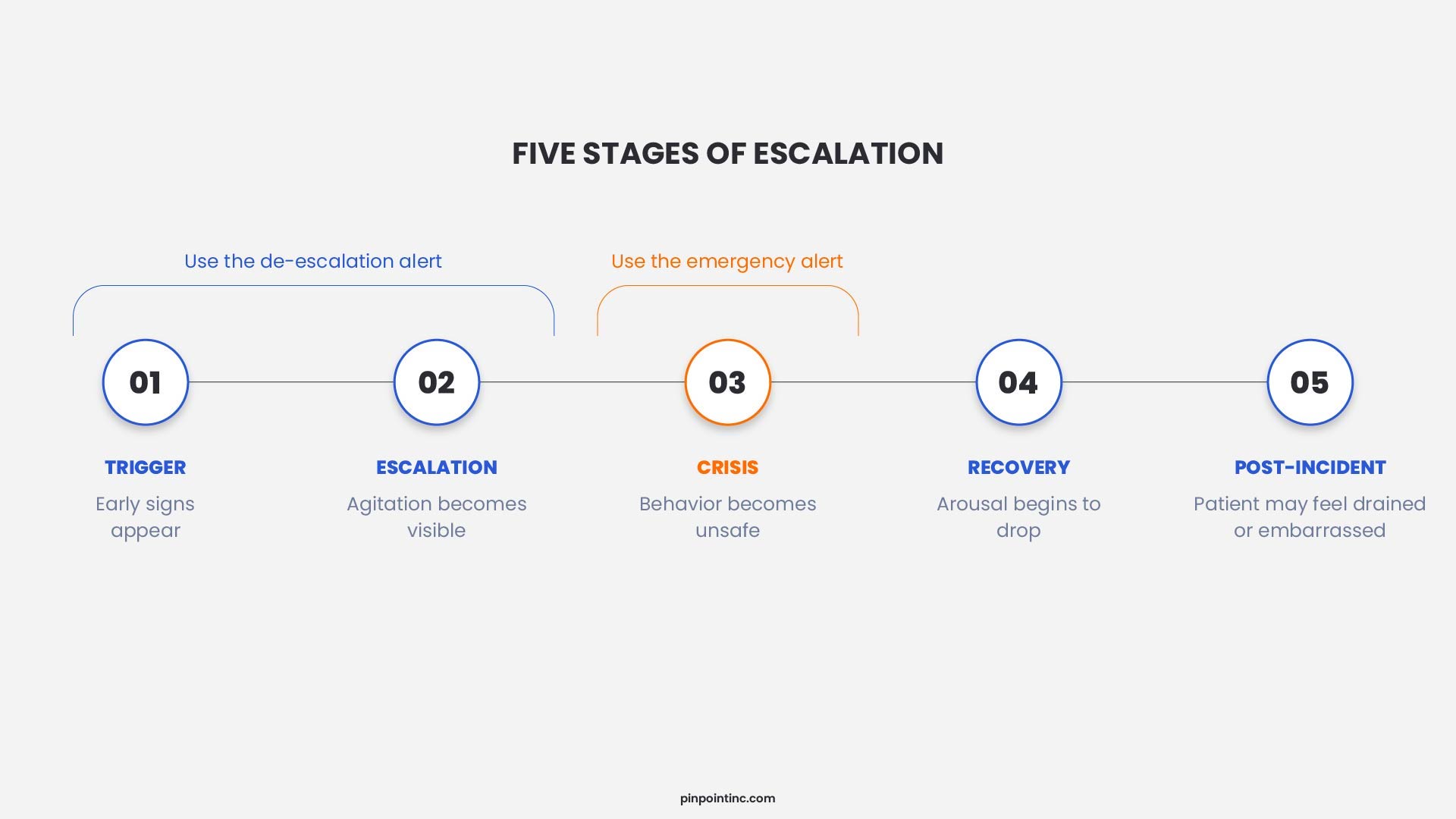
This guide looks at what de-escalation technology actually does inside a behavioral health unit: how a two-tier alert system lines up with the way clinicians are already trained to recognize escalation, where alert fatigue creeps in, and what to check before choosing de-escalation or employee safety technology in healthcare built for psychiatric and behavioral settings specifically. The timeline below is the fastest way to see the core idea before the detail.
What Is De-escalation Technology in a Behavioral Health Setting?
Clinical de-escalation is a set of communication, self-regulation, and assessment skills staff use to reduce a patient’s agitation before it becomes aggression. The Joint Commission describes it as a combination of communication, self-regulation, assessment, actions, and safety maintenance aimed at reducing harm and avoiding restraint or seclusion.
De-escalation technology is a different layer entirely. It’s the alerting infrastructure that lets a trained staff member call for backup without narrating it out loud. It doesn’t teach anyone how to talk a patient down. It shortens the distance between “I need someone else in this room” and someone actually walking in. For a broader look at the hardware side of that infrastructure, panic button types by use case covers the device categories in more depth than this article will.
How Smart Alert Systems Support an Existing De-escalation Program
Most hospitals already run de-escalation training. The open question is what happens the moment a trained staff member decides they need support. A smart alert system’s job is narrow: identify who pressed it, where they are, and what kind of help they’re asking for, then get that information to the right person fast. It sits downstream of the clinical judgment, not in place of it.
How a Two-Tier Alert System Matches the Stages of Patient Escalation
The Five Stages of Escalation Staff Are Trained to Recognize
Clinical literature on managing aggression commonly describes an assault cycle with five stages, shown in the figure above: a trigger stage, where something raises a patient’s arousal; an escalation stage, where visible signs of agitation build; a crisis stage, where behavior becomes unsafe; a recovery stage, where arousal begins to drop; and a depression stage, where the patient may feel drained or embarrassed after the incident. Staff trained in tools like STAMP, which flags staring, tone changes, anxiety, mumbling, and pacing, are watching for the trigger and escalation stages specifically, because that’s where intervention still has room to work.
Why a Single Alert Level Forces an All-or-Nothing Response
A single-tier alert system is effectively calibrated for the crisis stage only. That leaves staff with two bad options during the escalation stage: press the button and trigger a response sized for an emergency that hasn’t happened yet, or wait and hope the situation resolves on its own. A two-tier system removes that choice. A quiet de-escalation-level alert fits the escalation stage, calling in a second staff member while the situation is still manageable. The emergency-level alert stays reserved for the crisis stage, where a fast, visible response is actually warranted.
Preventing Alert Fatigue in Behavioral Health Alert Systems
What Causes Alert Fatigue in a Duress System
If a request for quiet backup and a full-blown crisis both reach security as identical pages, responders start triaging by instinct instead of by design. Over months, staff and responders learn to treat routine alerts as background noise, which is the exact desensitization risk a duress system is supposed to prevent. This isn’t a hardware failure. It’s a workflow design gap that shows up regardless of how reliable the devices themselves are. The matrix below shows how that risk shifts once alerts carry a clear tier.

How to Route De-escalation and Emergency Alerts Separately
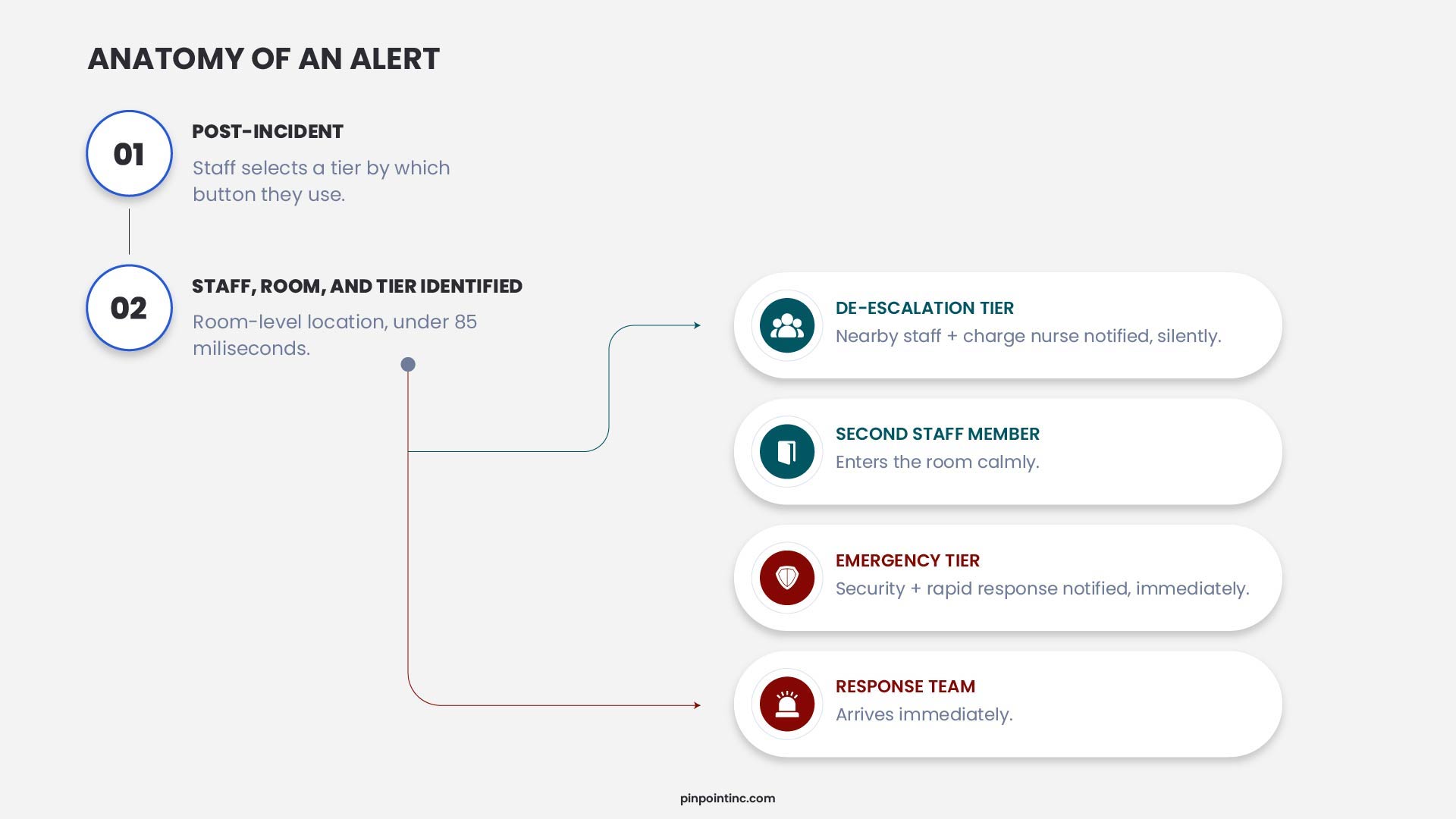
Fixing this means the two alert levels need to route differently, not just look different on a screen. A de-escalation-level alert should reach nearby staff and a charge nurse. An emergency-level alert should reach security, the charge nurse, and any designated rapid-response team at the same time, with a distinct notification pattern that makes the priority obvious on sight. That routing logic is a decision made during implementation, so it belongs on a facility’s setup checklist rather than something assumed to happen automatically.
What Happens After a De-escalation Alert Is Activated?
How the System Identifies Staff, Location, and Alert Type
Once a badge is pressed, the system needs to answer three things immediately: who pressed it, where they are, and which tier they selected. Room-level accuracy matters more on a behavioral health unit than almost anywhere else in a hospital. A single hallway can have a dozen similar doors, and every extra second spent locating the right room is a second the staff member is alone with an escalating patient. The diagram below traces that path end to end.
Routing the Alert to the Right Responder
For a de-escalation-level alert, the goal is a second staff member walking in calmly, without a visible security presence that can make the patient feel watched or cornered. For an emergency-level alert, the same infrastructure needs to summon a faster, more visible response instead. The system should make that call automatically based on which button was pressed, rather than leaving it to whoever picks up the page to guess how serious the situation is.
Improving Staff Adoption of De-escalation Alert Systems
Wearable Design and Activation Speed
A device that requires staff to unlock a phone, open an app, or reach a wall-mounted button across the room won’t get used in the moment it’s built for. Wearable badges that clip to a lanyard or ID and activate with a single press, no screen involved, are more likely to get used in the first ten seconds of an escalating situation, which is exactly when a de-escalation-level alert does the most good. This is covered in more depth when comparing wearable panic button systems across vendors.
Why Non-Tracking Design Increases Staff Trust
Staff who feel like a badge tracks their movement all shift tend to stop wearing it consistently, and a duress system that isn’t worn doesn’t help anyone. Systems that only share location data at the moment an alert fires, rather than monitoring continuously, tend to see faster staff adoption in behavioral health specifically, where staff already balance patient privacy and trust as part of daily practice.
Discreet Alerts and Patient Privacy in Behavioral Health Units
Discreet Alerts vs. Audible Alarms in Psychiatric Units
An audible siren or overhead page changes the room the instant it goes off, for the patient in crisis and for every other patient on the unit. Discreet alerting, meaning a silent notification to responders with no public announcement, keeps the environment from escalating further while help is already on the way. That distinction matters more on a behavioral health unit than a general med-surg floor, since patients there are often more sensitive to sudden noise or visible signs that something is wrong.
Location Awareness Without Continuous Staff Surveillance
A supervised system continuously checks that every badge and receiver is functioning, so staff aren’t relying on hardware that failed silently, without tracking staff location outside of an actual alert. That distinction, hardware supervision without people surveillance, is covered in more depth when comparing supervised vs. unsupervised staff safety systems.
Meeting Joint Commission Requirements With a Two-Tier Alert System
The Joint Commission’s current National Performance Goal on workplace violence asks hospitals to show a documented, active prevention program, not just a written policy. A two-tier alert system generates data that feeds directly into that program. De-escalation-level alerts show where and how often staff are catching agitation early, which is precisely the kind of worksite pattern data the annual review process expects to see. Full detail on the requirements themselves is covered in the piece linked above, along with the broader compliance picture in OSHA and Joint Commission workplace violence prevention requirements.
Privacy-first technology also supports this broader prevention approach by limiting staff location visibility to the moment an alert is activated, rather than continuously tracking movement throughout a shift. In behavioral health settings, that can help balance staff safety with privacy and trust. When combined with room-level routing and separate de-escalation and emergency alert tiers, the system can support incident review, response planning, and safer escalation workflows without turning staff safety technology into constant surveillance.
Behavioral Health Safety Technology Evaluation Checklist
Questions to Ask Before Choosing a De-escalation Alert System
De-escalation technology and employee safety technology in healthcare describe the same category of tools, whichever term shows up in an RFP. The evaluation questions hold either way:
- Does the system distinguish between a de-escalation-level and an emergency-level alert, or treat every press the same?
- Is location accuracy room-level, or does it only narrow down to a unit or floor?
- Does the badge activate with a single press, without a phone, app, or screen involved?
- Is staff location tracked continuously, or only shared when an alert fires?
- Does the system supervise its own hardware, flagging a dead battery or receiver to IT before it becomes a gap during a real incident?
- Is the hardware ligature-resistant and built for psychiatric and behavioral health units specifically, not adapted from a general hospital device?
- Can alert routing be configured separately for each tier, so a de-escalation request doesn’t page the same responders as a crisis alert?
- Does the system support the hospital’s OSHA and Joint Commission workplace violence prevention requirements, including incident documentation, response planning, and ongoing program review?
How Pinpoint's Two-Button Badge Supports De-escalation, Emergency Response, and Staff Privacy
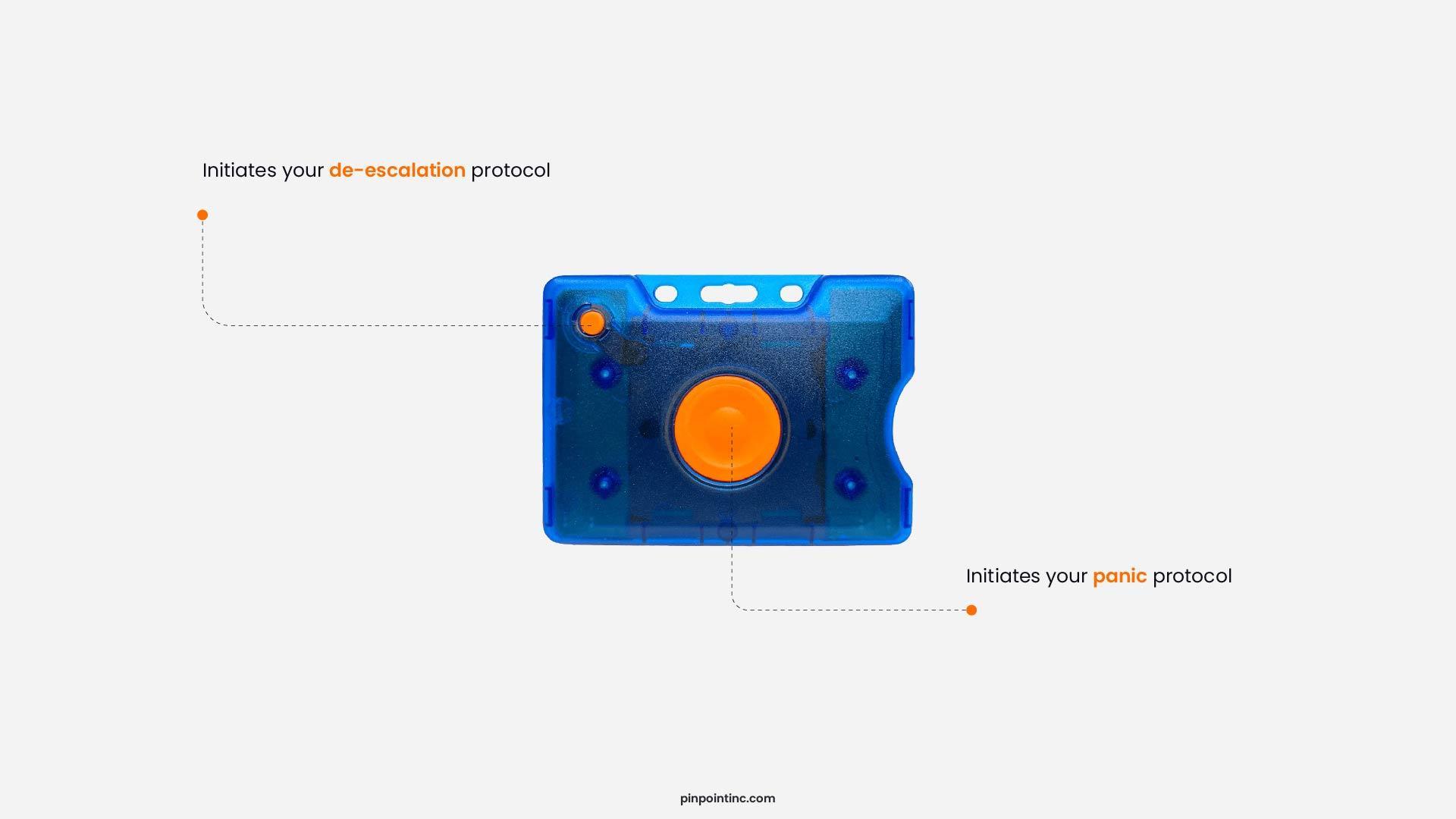
Pinpoint’s wearable panic button system uses an ID badge holder with two physical buttons: a smaller one typically configured as a de-escalation or assistance request, and a larger one for an emergency alert. Each press routes differently. A de-escalation alert can notify nearby staff and a charge nurse without triggering a visible security response, while an emergency alert reaches security and designated responders right away. Pinpoint wearables deployed in psychiatric emergency and behavioral health settings are built ligature-resistant as standard, not offered as an upgrade. For a closer look at how this plays out on a psychiatric emergency unit specifically, see how a CPEP unit director evaluates staff safety technology.
Room-Level Routing Without Continuous Tracking
Location is identified using infrared technology at the room level, with alerts delivered to responders in under 85 milliseconds from activation. The system doesn’t track staff movement outside of an actual alert, and it continuously checks its own devices and receivers, so a failed badge or a dead zone gets flagged to IT before it becomes a gap during a real incident, rather than after one.
Next Step
See a Two-Tier Alert System on Your Unit
A de-escalation tier only earns its place if it fits the way your staff already work: who they call first, which rooms create the longest response times, and what a quiet request for backup needs to look like on your floor.
We can walk your behavioral health unit, map the escalation points, and show how two-tier routing and room-level location would work against your actual layout and response workflow.
See how a quiet de-escalation alert and an emergency alert route differently.
FAQ’s
What is de-escalation technology in behavioral health?
De-escalation technology refers to wearable or fixed alert systems that let staff request help early, during the trigger or escalation stage of a patient encounter, instead of only after a situation becomes a full emergency. It supports verbal de-escalation training by giving staff a fast, discreet way to bring a second person into the room.
What's the difference between a de-escalation alert and a panic alert?
A de-escalation alert is typically a quiet request for backup, routed to nearby staff and a charge nurse, meant for the early stages of an escalating situation. A panic or emergency alert is reserved for an active crisis and routes immediately to security and designated rapid-response staff. The two should route differently so responders know at a glance which situation they’re walking into.
Does de-escalation technology replace de-escalation training?
No. A 2017 Cochrane systematic review found no randomized controlled trials proving de-escalation training’s effectiveness, though it remains the accepted standard of clinical practice under Joint Commission and NICE guidance. Technology’s role is to get a trained colleague into the room fast enough for that training to matter, not to substitute for it.
Can a behavioral health safety system work without tracking staff?
Yes. Non-tracking systems only share a staff member’s location when they activate an alert, rather than monitoring movement continuously through a shift. In behavioral health specifically, where trust and privacy already shape daily practice with patients, non-tracking design tends to see higher staff adoption than continuous-tracking alternatives.
- What Is De-escalation Technology in a Behavioral Health Setting?
- How a Two-Tier Alert System Matches the Stages of Patient Escalation
- Preventing Alert Fatigue in Behavioral Health Alert Systems
- What Happens After a De-escalation Alert Is Activated?
- Improving Staff Adoption of De-escalation Alert Systems
- Discreet Alerts and Patient Privacy in Behavioral Health Units
- Meeting Joint Commission Requirements With a Two-Tier Alert System
- Behavioral Health Safety Technology Evaluation Checklist
- How Pinpoint's Two-Button Badge Supports De-escalation, Emergency Response, and Staff Privacy
- FAQ’s
Author:
Jordan Belous
Chief Marketing Officer of Pinpoint North America, where she leads marketing strategy, brand development, and digital growth initiatives. She earned a Bachelor of Science in Allied Health with a concentration in physical therapy sciences from the University of Tampa, bringing a unique interdisciplinary perspective that blends healthcare knowledge with modern marketing strategy.
Jordan writes about workplace violence prevention in healthcare, nurse safety, staff wellbeing, and emerging healthcare technologies that support frontline teams. Her work explores how hospitals and behavioral health facilities can build safer environments, reduce burnout and turnover, and implement safety systems that protect staff while preserving trust and dignity.
She is also the Chief Executive Officer of Whip Pediatric Cancer, a nonprofit dedicated to supporting children battling cancer and raising awareness and funds for pediatric cancer. Through her work with Whip, Jordan regularly visits pediatric cancer patients in hospitals and spends time alongside patients, families, and the clinicians who care for them. These experiences place her directly beside nurses and healthcare teams every day and reinforce her belief that the people providing care deserve to feel just as safe as the patients they serve.
Her experiences with Whip and her work at Pinpoint are closely connected, both driven by her deep respect for nurses and frontline healthcare workers. Seeing firsthand the compassion, resilience, and critical role nurses play has strengthened her commitment to advocating for safer healthcare environments and ensuring that those who dedicate their lives to caring for others have the protection and support they deserve.