
RTLS Infrastructure Complexity: The Hidden IT Burden
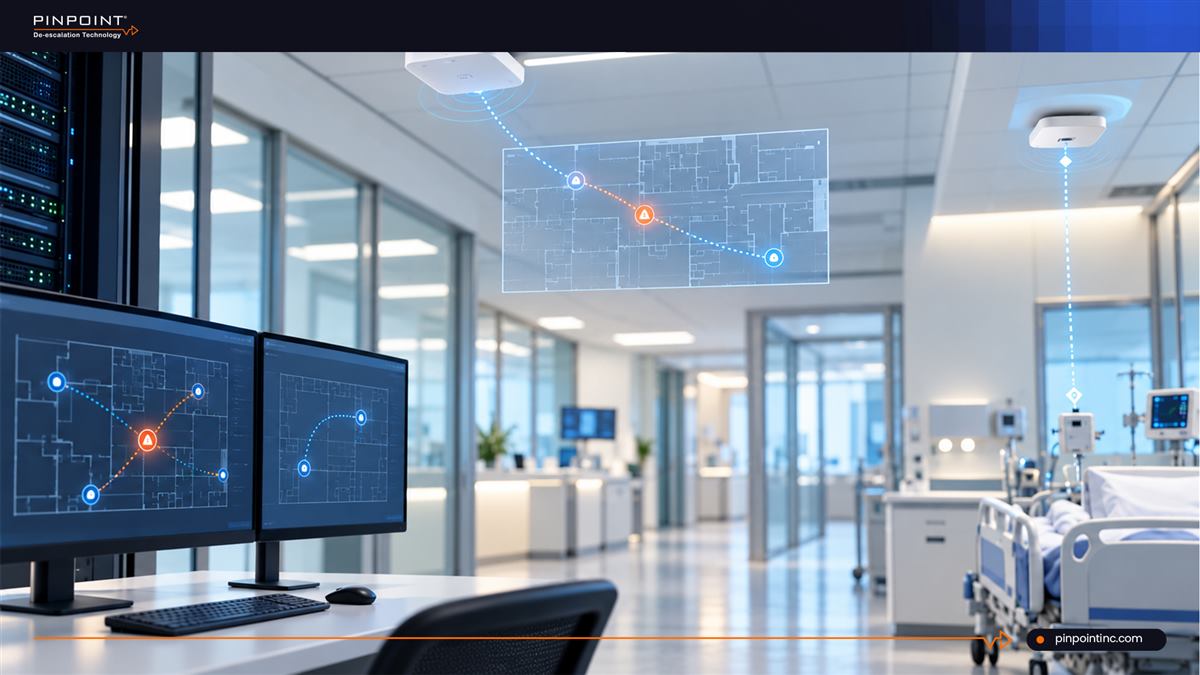
Who gets paged when the duress badges stop reporting at 3 a.m.?
If you run IT, networking, or security at a hospital, you already know the answer. It’s your team.
Staff safety projects usually start in nursing or security, and they should. Nurses are the ones facing threats, and security officers are the ones responding to emergencies. But when the chosen solution is an RTLS system, much of the technical responsibility, and the RTLS infrastructure complexity that comes with it, lands on you. Depending on the architecture, that means anchors, network infrastructure, location servers, integrations, and patch windows. It also means troubleshooting when a charge nurse reports an alert showing the wrong room.
I’m writing this for the people who inherit that system. I believe RTLS infrastructure complexity is one of the most overlooked aspects of staff safety technology, largely because the teams responsible for maintaining it aren’t always involved when purchasing decisions are made.
The hardware quote gets scrutinized. Depending on the hospital’s size, coverage requirements, and technology, an RTLS deployment can involve substantial upfront infrastructure expenses before licensing and maintenance are counted. Buyers examine those numbers carefully. What often receives less attention is the IT work that begins the day after go-live.
What You Actually Inherit When an RTLS System Goes Live
The vendor demo shows you three things: a badge, a live floor map, and an alert appearing on a screen. That’s the visible part. The RTLS deployment challenges rarely surface during that demonstration, and neither do the responsibilities that follow. Behind those three features sits an infrastructure that requires ongoing maintenance, monitoring, and coordination to keep the system running reliably for years.
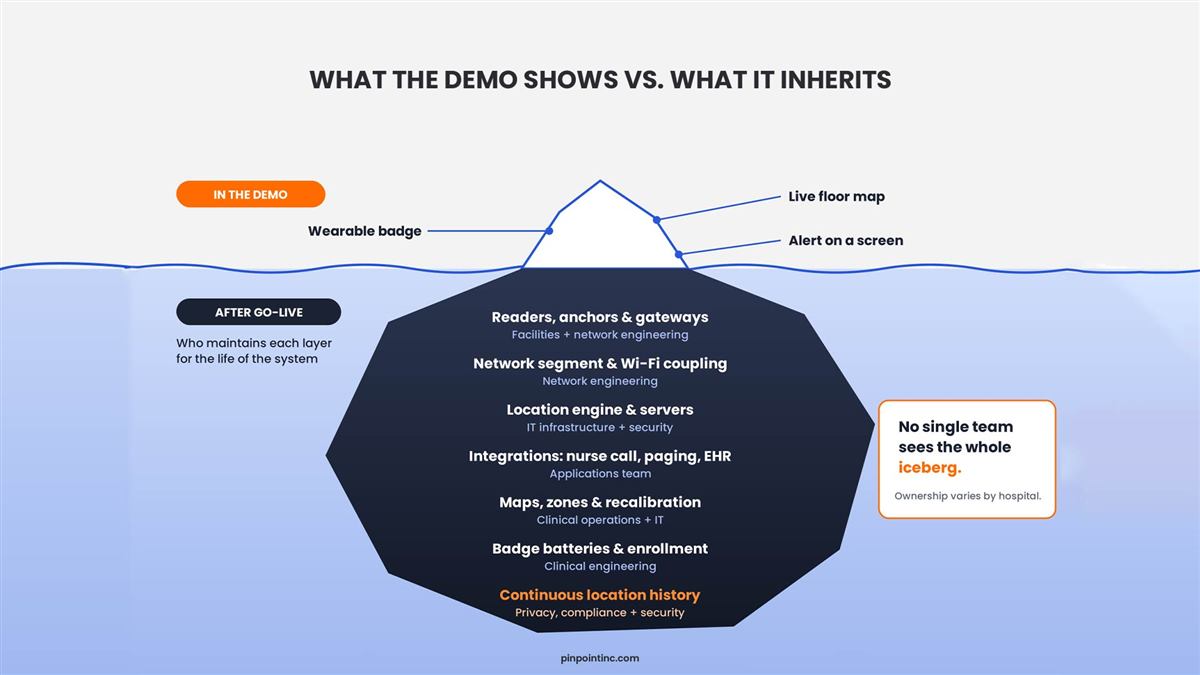
Walk through it from the bottom up, and nearly every layer of an RTLS system adds something your team may need to manage:
- If the platform uses BLE or Wi-Fi, it may ride on your enterprise access points or dedicated gateways. If it depends on your Wi-Fi, its uptime is now tied to your network’s uptime, and your AP firmware schedule may affect a life-safety system.
- If it uses UWB with time-difference-of-arrival positioning, it means keeping clocks synchronized across the anchors involved in location detection.
- The location engine is one more system to harden, back up, and monitor.
- The nurse call, paging, and security integrations are interfaces that need testing whenever another vendor ships an upgrade.
- Every anchor and gateway is another component in an inventory you are already working to keep current.
The vendors’ own lists of RTLS implementation challenges are consistent, covering signal interference, infrastructure compatibility, high sensor counts, and tag battery replacement. Hospitals have their own challenges, too, with concrete walls, lead-lined imaging suites, ligature-resistant behavioral health rooms, and frequent renovations that can complicate installation and signal coverage. That’s RTLS infrastructure complexity in plain terms: multiple technical layers, several departments involved, and no single team responsible for the whole system.
Six Months After Go-Live: The Ticket Queue
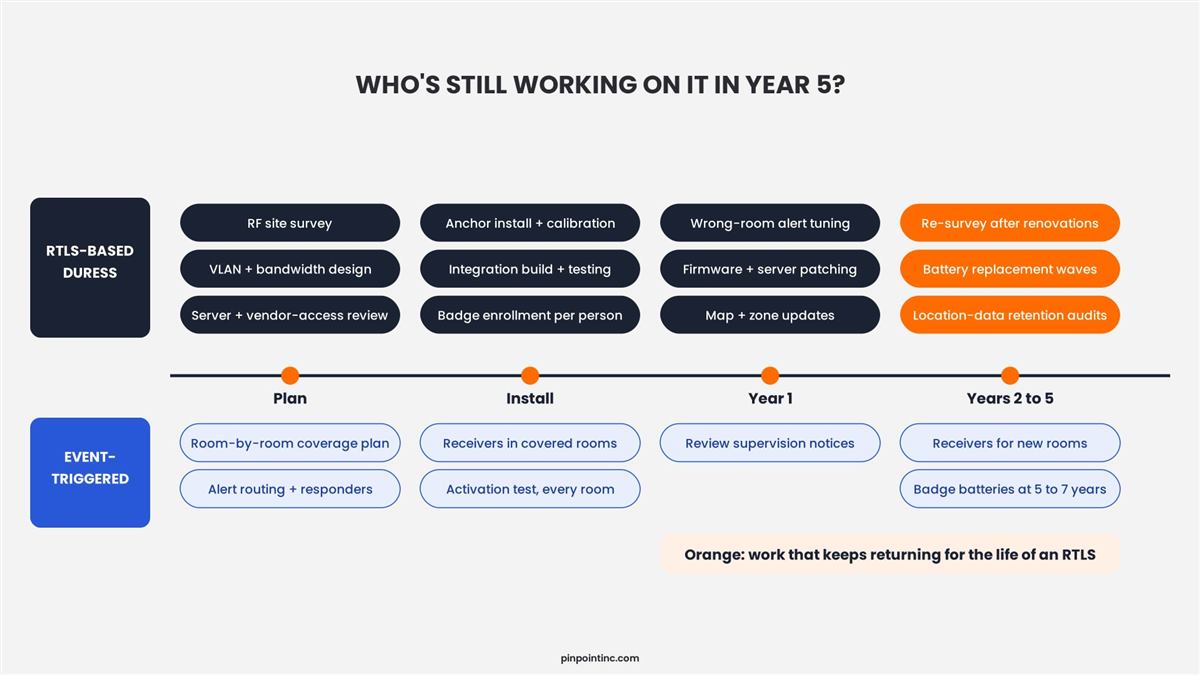
Most RTLS deployment challenges get framed as project risks, such as site surveys, cabling, calibration, and training. But those challenges don’t necessarily end at go-live. Operating the system brings its own responsibilities, and here’s the kind of ticket queue your IT team could be dealing with six months later:
- “Alert placed the nurse in the 4 West corridor. She was in 412.” Could be signal reflection or a calibration issue, and it may take a site visit to figure out which.
- “Med-surg renovation moved two walls. Zones are wrong.” Re-survey, recalibrate, and update the location map.
- “Nurse call upgrade went live. Duress alerts stopped reaching pagers.” Regression-test an integration you didn’t build.
- “Quarterly scan flagged the location server.” Patch it without disrupting the location engine.
- “A batch of badges is reporting low battery.” Replace batteries or badges, and re-enroll them if the system requires it.
None of this is unusual. It’s ordinary IT work that may never have appeared in the original business case, and it doesn’t stop once the system is installed.
Your Network, Your Attack Surface: The Cyber Side of RTLS Infrastructure Complexity
You don’t need me to tell you healthcare is a target. Still, the 2025 numbers are worth having in front of you when an RTLS proposal lands on your desk:
- Most-attacked sector. The FBI’s 2025 Internet Crime Report recorded 460 ransomware incidents and 182 data breaches involving healthcare, the highest reported figures among critical infrastructure sectors.
- Most expensive breaches. IBM’s 2025 Cost of a Data Breach Report put the average healthcare breach at $7.42 million, with the longest identification and containment cycle of any industry at 279 days.
- Vulnerable connected devices. Claroty analyzed more than 2.25 million connected medical devices across 351 healthcare organizations and found devices with known exploited vulnerabilities in 99% of those organizations.
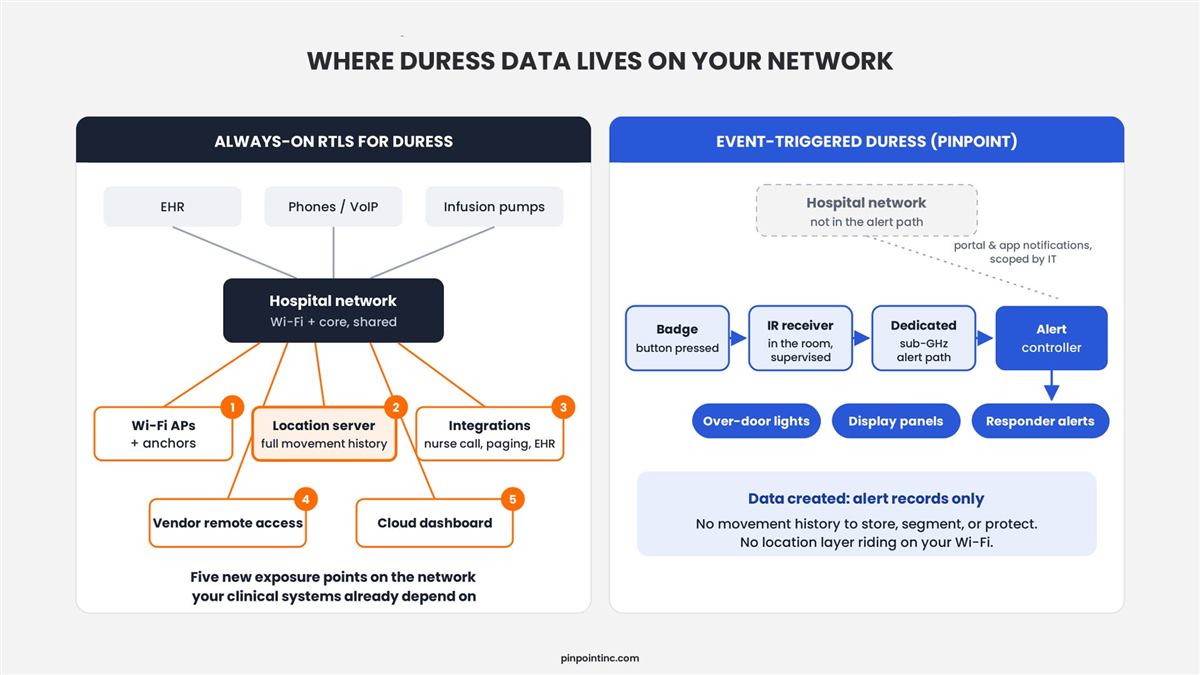
Cybersecurity doesn’t always receive the attention it deserves during RTLS implementation planning, but depending on its architecture and network connections, an RTLS system can introduce three additional areas of exposure.
It adds endpoints. Every anchor, gateway, and access point supporting location services adds another component to your network infrastructure that may need segmentation, patching, and monitoring.
It creates a crown-jewel dataset. Depending on its configuration, the location server may hold timestamped records of where badges have been, potentially revealing staff movements throughout the facility. That makes it a valuable target for attackers. CISA has documented vulnerabilities in RTLS server software that could allow unauthorized access, service disruption, or even remote code execution.
It opens inbound paths. Integrations with nurse call and security systems, along with vendor remote-support access, can introduce additional connections into your environment that your team now has to secure and manage.
Regulation is moving in the same direction. HHS’s proposed HIPAA Security Rule update would require technology asset inventories, network maps of ePHI flows, network segmentation, and vulnerability scans every six months. It isn’t final yet. If adopted as proposed, RTLS components connected to systems handling ePHI may require additional documentation, security assessments, and ongoing oversight.
The Ransomware Drill Nobody Runs on the Duress System
When Ascension was hit by ransomware in May 2024, staff across many of its hospitals relied on paper records for weeks, while some facilities diverted ambulances. Imagine an emergency department dealing with slower workflows, mounting frustration, and limited information. That’s when reliable staff safety systems become even more important.
So run the drill. Your incident response team isolates the core network at 2 a.m. Do duress alerts still reach security? If your RTLS system depends on that network, the answer may be no. That’s why a supervised, hardwired receiver backbone operating independently of enterprise Wi-Fi deserves consideration.
RTLS vs RFID: What You're Actually Being Sold
Okay, so let’s first clear up the confusion between RTLS and RFID. You’ve probably heard “RFID badge” and “RTLS badge” used interchangeably in sales conversations, but they aren’t the same thing. And understanding that difference matters because it determines how much infrastructure you’re actually signing up for.
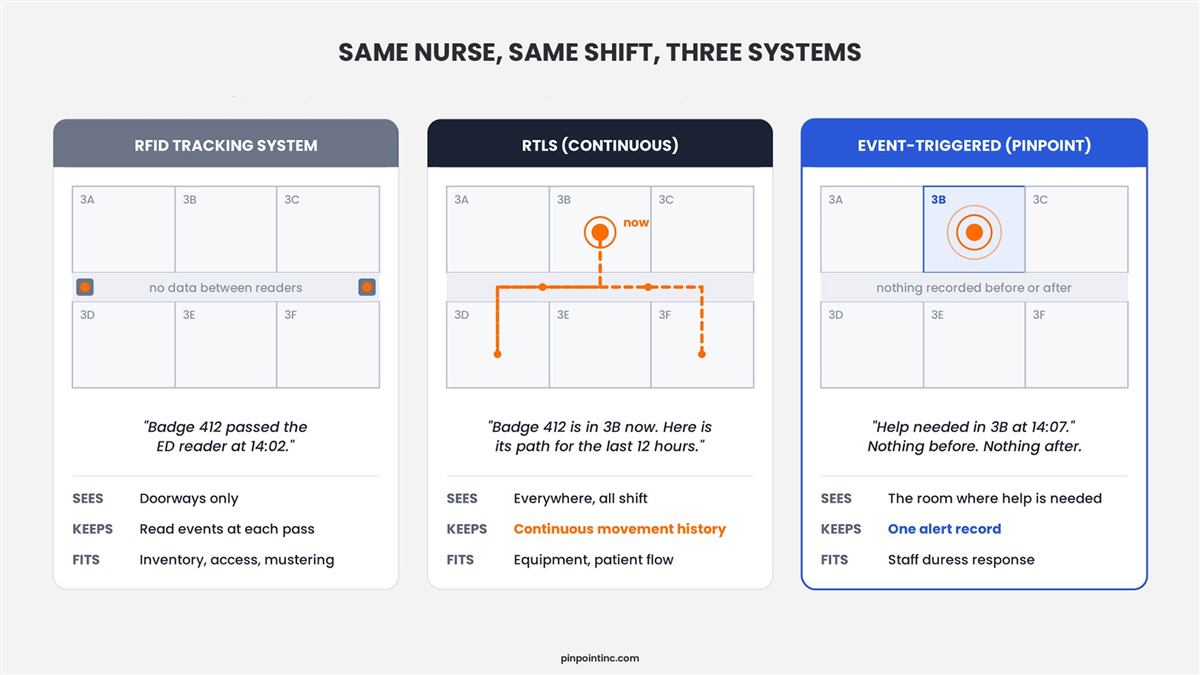
- An RFID tracking system identifies a tag when it comes within range of a reader. In a typical passive RFID setup, that might tell you a badge passed through a doorway, but not where it went next.
- An RTLS is the full stack: tags, readers or anchors, a location engine, and software that updates position in real time. Underneath it might be RFID, BLE, UWB, Wi-Fi, or infrared.
- The standards make the same distinction. ISO/IEC 24730 separates real-time location from simply knowing a tag passed one checkpoint but hasn’t reached another.
- Active RFID blurs the line. Battery-powered tags can broadcast signals that support real-time location when paired with the right reader infrastructure, bringing many of the same technical requirements.
Confusing the two can lead to unexpected infrastructure requirements. A basic RFID tracking system detects badges at specific checkpoints, while an RTLS can pinpoint a nurse inside Room 3B, depending on its design. But that accuracy comes with additional infrastructure. There’s also a third option worth considering, a system that identifies location only when someone requests help.
What Changes When Location Only Exists During an Alert
Pinpoint is built on that third model. From an IT seat, the difference is less about features and more about what never lands on your plate.
- Alerts don’t ride on your Wi-Fi. Pinpoint uses dedicated signaling infrastructure instead of your hospital’s 2.4 or 5 GHz Wi-Fi networks. The core alert system doesn’t depend on Bluetooth, GPS, or cellular coverage either.
- Room accuracy comes from infrared, not radio math. Ceiling-mounted receivers are hardwired and supervised, detecting badge alerts within the covered room. Because infrared doesn’t penetrate walls, an alert from Room 3B can be identified as Room 3B.
- There’s no movement history to protect. Location is identified only when someone presses a button, rather than continuously tracking employees throughout their shifts. Alert records may still be retained, but there’s no routine movement history for monitoring staff productivity.
- There’s no per-person enrollment. Badges aren’t programmed or assigned to individuals, so they can move between staff without additional administrative setup.
- The edge stays quiet. Badges run for 5 to 7 years on a battery without charging. Receivers continuously report their status, allowing faults to be identified through supervision alerts before they compromise coverage.
On the floor, staff wear it like an ID badge, with one button for de-escalation and one for emergencies. The system delivers room-level alerts in under 85 milliseconds, with notifications available through over-door lights, display panels, desktop systems, audible alarms, and smartphones. That design removes many of the dependencies associated with RTLS infrastructure complexity, rather than passing them to another team.
Badge Compliance Is an Infrastructure Problem, Too
One coverage gap never shows up on a network diagram: the badge sitting in a locker. You can have perfect anchor density and still have no protection on the unit if nurses won’t wear the device.
Nurses have been clear about their concerns. In 2025 contract talks with Fairview, the Minnesota Nurses Association pushed for guarantees that panic alarm location data would be used only in emergencies, not for routine tracking or discipline. When staff believe a safety badge doubles as a monitoring tool, they may be less willing to wear it. The stress of feeling watched throughout a twelve-hour shift can also raise concerns about burnout and employee trust.
That makes adoption your problem as much as nursing’s. It’s the layer of RTLS infrastructure complexity you can’t patch. A system that identifies location only during an alert is easier to build a privacy policy around and defend during staff discussions. It also reduces the amount of employee location data your organization needs to manage and protect.
Five Questions to Ask Before You Sign
These questions surface RTLS infrastructure complexity before the contract does. Ask them of every vendor, including us.
- Which network does the location layer run on, and who owns its segmentation? If the answer is “your Wi-Fi,” the RTLS system inherits your Wi-Fi’s outages and change windows.
- Who patches the location engine, anchors, and gateways, and how fast? Get it in writing, including how patches are tested against your integrations.
- What happens to duress alerts if we isolate the network during a ransomware response? Ask to see it working, not to read about it.
- How many endpoints join our asset inventory, and who keeps that list current?
- What staff location data is stored, for how long, and who can use it for anything other than safety? The answer should be one you’re comfortable reading aloud to your nurses’ union.
Most RTLS deployment challenges trace back to assumptions nobody wrote down. If a vendor’s answers depend on assumptions about your network, put those assumptions in the contract.
Make Staff Safety Simpler With Pinpoint
Pinpoint helps hospitals protect staff without adding unnecessary IT complexity. Let's discuss your facility's safety needs and how our non-tracking system can fit into your existing operations.
FAQs
What is the difference between RFID and RTLS?
RFID (radio frequency identification) uses radio signals to identify tagged items or people when they come within range of a reader, while RTLS (real-time location system) uses technologies such as RFID, BLE, UWB, Wi-Fi, or infrared to provide ongoing location visibility. In simple terms, an RFID tracking system identifies where a tag was detected, while RTLS determines its current location and may record movement history, depending on the system.
Can an RTLS system safely share our clinical Wi-Fi?
Yes, with proper network segmentation using VLANs and firewall rules. While segmentation reduces cybersecurity risks, it doesn’t eliminate the IT responsibilities involved. Devices still require patching, monitoring, and security assessments. If the RTLS system relies on hospital Wi-Fi, its location services also depend on that network remaining available.
Does a non-tracking duress system still go in our asset inventory?
Yes. Receivers, controllers, and management software are still hospital technology assets that should be documented. The difference lies in the data collected. An event-triggered system doesn’t continuously record employee movements, reducing the amount of location data that needs to be managed, protected, and retained.
Is infrared location affected by Wi-Fi congestion or RF noise?
No. Infrared uses light rather than radio frequencies, so Wi-Fi congestion and radio interference don’t directly affect infrared location detection. Unlike radio signals, infrared generally doesn’t penetrate walls, allowing room-level identification. However, reliable coverage still requires properly positioned receivers in designated areas.
Who should own the duress system: IT, security, or facilities?
Usually all three share it:
- security owns the response;
- facilities owns the physical installation;
- IT reviews the network and data questions.
- What You Actually Inherit When an RTLS System Goes Live
- Your Network, Your Attack Surface: The Cyber Side of RTLS Infrastructure Complexity
- RTLS vs RFID: What You're Actually Being Sold
- What Changes When Location Only Exists During an Alert
- Badge Compliance Is an Infrastructure Problem, Too
- Five Questions to Ask Before You Sign
- FAQs
Author:
Jordan Belous
Chief Marketing Officer of Pinpoint North America, where she leads marketing strategy, brand development, and digital growth initiatives. She earned a Bachelor of Science in Allied Health with a concentration in physical therapy sciences from the University of Tampa, bringing a unique interdisciplinary perspective that blends healthcare knowledge with modern marketing strategy.
Jordan writes about workplace violence prevention in healthcare, nurse safety, staff wellbeing, and emerging healthcare technologies that support frontline teams. Her work explores how hospitals and behavioral health facilities can build safer environments, reduce burnout and turnover, and implement safety systems that protect staff while preserving trust and dignity.
She is also the Chief Executive Officer of Whip Pediatric Cancer, a nonprofit dedicated to supporting children battling cancer and raising awareness and funds for pediatric cancer. Through her work with Whip, Jordan regularly visits pediatric cancer patients in hospitals and spends time alongside patients, families, and the clinicians who care for them. These experiences place her directly beside nurses and healthcare teams every day and reinforce her belief that the people providing care deserve to feel just as safe as the patients they serve.
Her experiences with Whip and her work at Pinpoint are closely connected, both driven by her deep respect for nurses and frontline healthcare workers. Seeing firsthand the compassion, resilience, and critical role nurses play has strengthened her commitment to advocating for safer healthcare environments and ensuring that those who dedicate their lives to caring for others have the protection and support they deserve.