
Workplace Duress RTLS: 5 Real Drawbacks and the Non-Tracking Alternative

How long should it take for help to reach a nurse cornered in a supply closet? Ten seconds? Thirty? In a mid-size hospital where a real-time location system monitors every badge, the honest answer can still be: longer than the sales brochure promised.
Nearly one in four nurses reported physical injuries or symptoms linked to workplace violence in the past year. That reality helps explain why so many health systems have invested in duress RTLS system over the last two years, and why some later discover that continuous tracking does not always translate into faster, more reliable protection.
This is not another vendor pitch disguised as an explainer. It examines what workplace duress RTLS actually does, the five drawbacks hospitals often encounter once the system moves beyond the demo, and how a non-tracking approach to duress alerting can support genuine staff safety without reducing a person to a location dot on a floor plan.
What Workplace Duress RTLS Actually Is
RTLS stands for real-time location system. It uses wireless infrastructure, usually Bluetooth Low Energy, active RFID, or ultra-wideband, to calculate the position of a badge, tag, or wearable inside a building. Hospitals often use the same infrastructure to locate equipment, monitor patient movement, and support staff safety.
With duress RTLS system, a nurse or other staff member wears a badge connected to the hospital staff tracking system. If the wearer presses the duress button, or a supported device detects forced removal, the system sends an alert with the badge’s recorded location so security knows where help is needed.
Though it may sounds simple: the badge is already transmitting, so responders should immediately know where a staff member is when something goes wrong. But before assessing how well that promise holds up in practice, it helps to look at the wider safety environment in which these systems are being introduced.
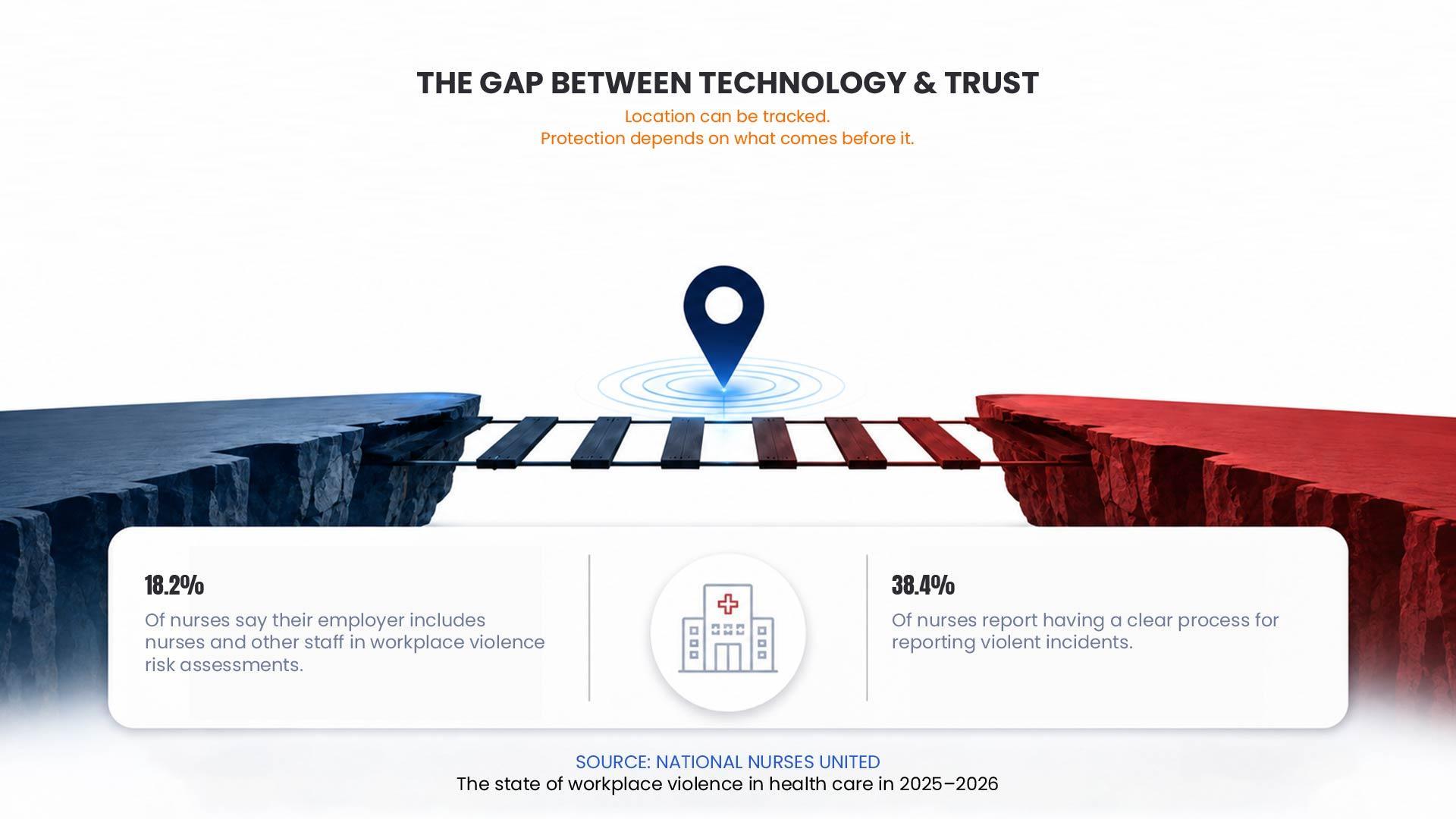
Only 18.2 percent of nurses say their employer includes nurses and other staff in workplace violence risk assessments. Just 38.4 percent report having a clear process for reporting violent incidents. Those numbers were sufficient enough that many hospitals are investing in safety technology before addressing the reporting, participation, and trust issues that determine whether staff will actually use it.
A workplace duress RTLS system may provide location data, but location alone does not guarantee an accurate alert, a fast response, or confidence among the people wearing the badge. That gap between “we purchased a safety system” and “staff actually feel protected” is where the real evaluation needs to begin.
Five Real Drawbacks of Workplace Duress RTLS
The limitations of workplace duress RTLS often become clearer after the pilot ends and the system is introduced across real clinical environments. Privacy questions emerge, location accuracy varies between spaces, infrastructure demands increase, and staff may respond differently once they understand how their location data is being collected.
Before committing to a full deployment, hospitals should compare RTLS alternatives for hospital staff safety and weigh five drawbacks that often become clearer once the system moves beyond the pilot stage.
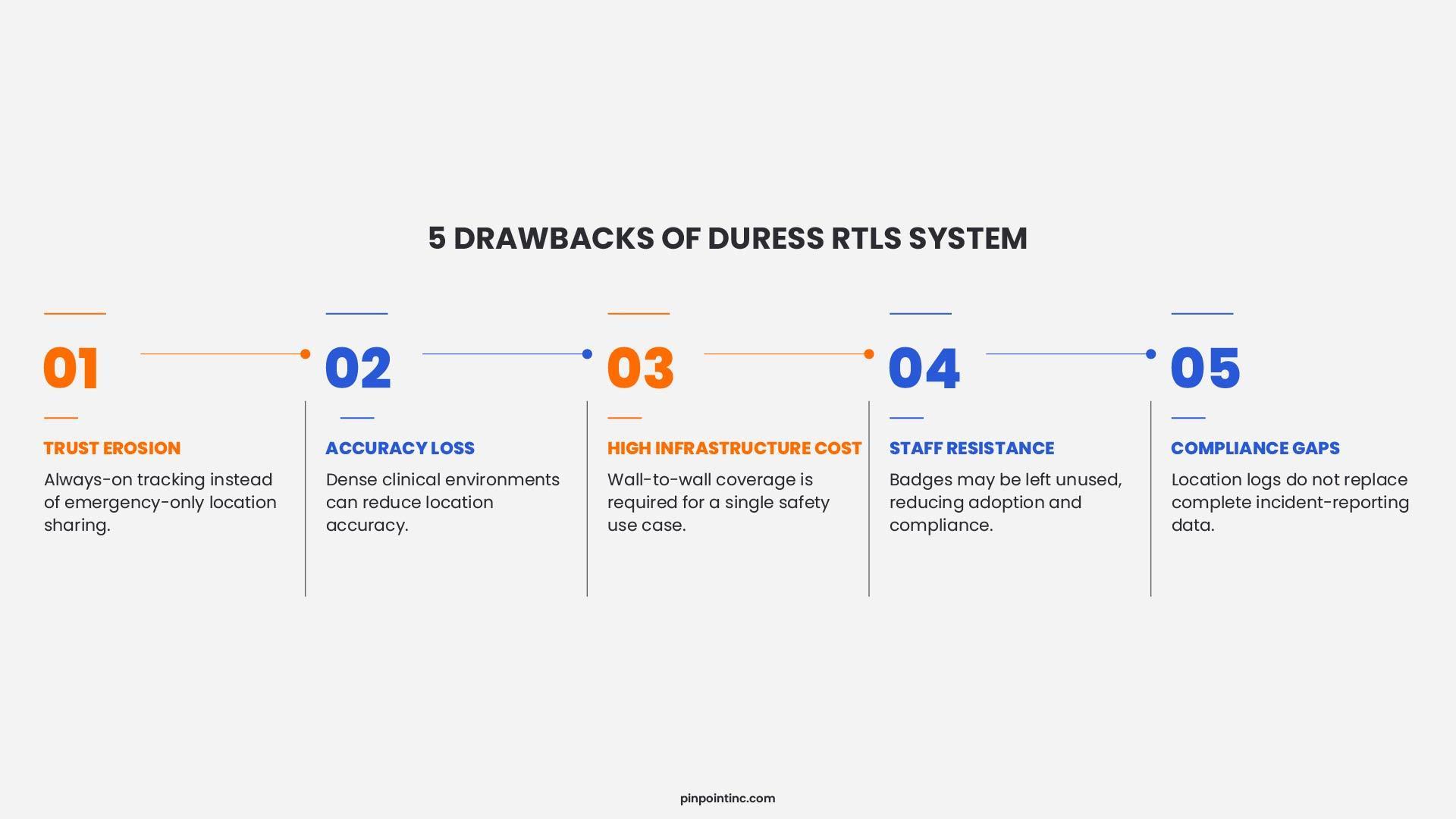
1. Continuous Tracking Creates a Trust Problem, Not Just a Privacy One
In continuously tracking deployments, a workplace duress RTLS badge does not activate only during an emergency. It may transmit throughout the shift, meaning the same infrastructure intended to protect a nurse during an assault can also log breaks, restroom visits, and routine movement. Staff notice this quickly, and employee safety monitoring can begin to feel less like protection and more like surveillance. A badge that always knows where someone is can be difficult to introduce to a workforce that already questions how incident reports and employee data are handled.
2. Location Accuracy Breaks Down Exactly Where It Matters Most
RTLS accuracy depends on signal strength, and hospitals contain metal equipment, concrete walls, elevators, and radio-frequency interference from medical devices. In open hallways, a badge may locate someone within a few feet. Inside a supply room, stairwell, basement, or equipment area, the same system may identify the wrong room or floor. That is a serious concern for a hospital staff tracking system whose primary value is directing security to the correct location during a crisis. An alert is less useful when responders still need to search for the person requesting help.
3. Infrastructure Cost and Timeline Can Outpace the Safety Win
Workplace duress RTLS may require hospitals to install access points, gateways, beacon networks, cabling, and system integrations across large parts of the building. For a single-campus health system, that can mean months of planning, installation, mapping, and calibration before the system is fully operational. The investment may make sense when the hospital also needs asset tracking or patient flow monitoring. Facilities that primarily need duress alerting, however, can end up purchasing far more infrastructure than the staff safety use case actually requires.
4. Staff Resistance Slows or Stalls Adoption
Nurses have seen safety initiatives that looked effective during demonstrations but delivered less value once implemented. When workplace duress RTLS is introduced as an employee safety monitoring tool, staff may interpret it differently: management can now see where everyone is throughout the shift. Frontline employees may reasonably question why a panic button needs to include continuous positioning. That concern can lead to lower badge compliance, devices being left in lockers, and a system that appears fully deployed on a dashboard but is not consistently being worn where protection is needed.
5. Location Logs May Leave Compliance Gaps
The Joint Commission’s National Performance policy, effective January 2026, places clearer emphasis on incident reporting, worksite risk analysis, leadership responsibility, and governing body oversight. Hospitals must maintain a comprehensive prevention program with defined reporting, training, data review, and corrective-action processes. A workplace duress RTLS platform built mainly for asset or patient tracking may produce location logs, but not the structured incident records, response-time data, and follow-up documentation surveyors may review. Adding that reporting layer after deployment can become a separate implementation project.
Tracking and Safety Are Not the Same Thing
It is worth separating two ideas that vendors tend to blend together: knowing where someone is at all times and knowing where someone is the moment they need help. A hospital staff tracking system is built for the first purpose, and a duress system only needs to solve the second. Continuous tracking is a reasonable design choice for locating valuable medical equipment. It is a much harder sell when the “asset” being tracked is a person who did not agree to have every movement logged throughout a shift for a safety feature they may never need. This distinction becomes clearer when comparing the different types of healthcare panic button systems and how they handle location during an emergency.

This is also where RTLS and employee safety can feel like a mismatch rather than a natural pairing. Safety does not require a live map but requires a fast, accurate, and reliable signal exactly when help is needed, and nothing more.
The Non-Tracking Alternative Safety Technology
A non-tracking alternative takes a different approach to staff safety. Instead of continuously transmitting a wearable’s location, the system remains inactive until the staff member presses the button or, where supported, the device detects a forcible pull. Location is identified only when the alert is triggered, so routine movement throughout the shift is not recorded.
This event-triggered model addresses several concerns associated with continuous positioning. Staff are not asked to carry an always-on location feed, the system is easier to explain, and the infrastructure can focus on reliable alert coverage rather than movement tracking. It functions as a duress alert, not an activity log. Hospitals comparing wearable and fixed duress alert systems should consider where staff work and whether coverage extends into isolated areas.
Choosing the right approach for your facility
Explore practical guides on staff safety technology, workplace violence prevention, privacy, coverage, and response planning to help you evaluate the right approach for your facility.
Location accuracy depends less on whether tracking is continuous and more on the technology, installation, and testing behind the system. A non-tracking solution using room-level location infrastructure can identify the alert location at activation without maintaining a live map of the wearer throughout the day. The facility should test patient rooms, stairwells, supply areas, basements, parking structures, and other difficult spaces before deployment.
For hospitals that need staff protection but not continuous asset, patient, or employee tracking, this approach can be a more focused fit. It may also be easier for staff to trust because location data is tied to a safety event. The better answer is not necessarily a larger beacon network, but a system designed around rapid activation, reliable location, and response workflow.
Continuous Tracking vs. Event-Triggered Duress Alerting
Factor | Workplace Duress RTLS | Non-Tracking Duress Alerting |
|---|---|---|
Location data collected | Continuously throughout the shift | Only when an alert is activated |
Privacy consideration | Creates ongoing location-data concerns | Limits location data to the safety event |
Infrastructure focus | Continuous building-wide positioning | Reliable alert and room-level coverage |
Staff adoption | May face resistance over continuous tracking | Easier to position as a safety-only system |
Incident reporting | May require a separate reporting layer | Can connect alerts directly to incident records |
What This Means When Evaluating RTLS and Employee Safety Together
If your hospital is comparing healthcare RTLS vendors, separate the decision into two questions before scheduling a demo. Do you need continuous asset and patient tracking for operational reasons? If so, a full RTLS deployment may make sense, with duress alerting added to it. Or is staff duress the primary concern? In that case, a lighter, non-tracking wearable may provide a more focused fit with fewer privacy concerns.
OSHA recordkeeping adds another consideration. A work-related violence injury must generally be recorded when it results in medical treatment beyond first aid, loss of consciousness, restricted work, job transfer, or days away from work. Fatalities must be reported within eight hours, while qualifying inpatient hospitalizations, amputations, or eye losses must be reported within 24 hours.
A sophisticated location engine is not enough if the system cannot provide clear alert, response-time, and incident data. When evaluating RTLS and employee safety together, hospitals should consider whether the full workflow supports investigation, OSHA documentation, corrective action, and reliable emergency response.
How Pinpoint Approaches This Differently
So, where does Pinpoint fit into all of this?
Pinpoint is built around what happens in the moment a staff member needs help, not around tracking where they have been throughout the shift. Its wearable panic button stays private during normal activity and identifies the wearer’s precise room-level location only when the badge is activated.
That gives responders the information they need without turning a safety system into an employee monitoring tool. It also does not depend on Wi-Fi, Bluetooth, GPS, or cellular coverage, which helps it remain reliable in stairwells, basements, treatment rooms, and other areas where wireless signals can be inconsistent.
For hospitals that need fast, accurate duress alerting without continuous staff tracking, Pinpoint offers a more focused approach to workplace safety.
Request a live demo to see how alerts, location sharing, and response work.
Next Step
Duress Alerting Without Continuous Tracking
The drawbacks of workplace duress RTLS — cost, accuracy gaps, staff resistance, and privacy risk — trace back to one design choice: tracking everyone, all the time. Pinpoint is built around the moment a staff member needs help, not their entire shift.
See how fast, accurate duress alerting works without turning a safety system into a surveillance tool.
See event-triggered duress alerting in action.
FAQ’s
Does the Joint Commission's 2026 standard require RTLS specifically?
No. Joint Commission has said its 2026 chapter does not introduce brand-new requirements, it organizes existing ones into clearer, measurable goals, which raises the bar on documentation, not on any specific technology. Hospitals need evidence that risk assessments, reporting, training, and follow-up are actually happening, not a specific brand of tracking hardware. A well-documented, event-triggered duress system can meet this just as effectively as a full workplace duress RTLS platform, often with a cleaner audit trail.
Can a non-tracking system still tell responders where a staff member is during a real emergency?
Yes. The difference isn’t whether location data exists, it’s when it’s collected. A non-tracking duress wearable calculates and sends location the moment it’s activated, whether by a button press or a forced removal, so responders still get an actionable position. What it skips is the constant background tracking between alerts, which is the part staff tend to object to
Can a Hospital Use RTLS for Equipment Tracking Without Continuously Tracking Staff?
Yes. A hospital can limit RTLS to tagged equipment such as infusion pumps, monitors, and portable imaging devices while using a separate, event-triggered system for staff duress.
What Location-Data Questions Should Hospitals Ask RTLS Vendors?
Ask whether staff location is collected continuously or only during an emergency, who can view or export it, how long it is retained, and whether it may be used for attendance, productivity, or disciplinary decisions. Hospitals should also confirm who owns the data, whether access is logged, how records are deleted, and what information remains available after a system outage or contract termination.
How Should Hospitals Test Duress Coverage in Difficult Areas?
Test the full alert process from every high-risk or isolated space, including stairwells, basements, supply rooms, parking areas, elevators, and rooms separated by dense walls. Record whether the correct room and floor appear, whether the alert reaches the intended responder, and how long acknowledgment and arrival take.
Author:
Jordan Belous
Chief Marketing Officer of Pinpoint North America, where she leads marketing strategy, brand development, and digital growth initiatives. She earned a Bachelor of Science in Allied Health with a concentration in physical therapy sciences from the University of Tampa, bringing a unique interdisciplinary perspective that blends healthcare knowledge with modern marketing strategy.
Jordan writes about workplace violence prevention in healthcare, nurse safety, staff wellbeing, and emerging healthcare technologies that support frontline teams. Her work explores how hospitals and behavioral health facilities can build safer environments, reduce burnout and turnover, and implement safety systems that protect staff while preserving trust and dignity.
She is also the Chief Executive Officer of Whip Pediatric Cancer, a nonprofit dedicated to supporting children battling cancer and raising awareness and funds for pediatric cancer. Through her work with Whip, Jordan regularly visits pediatric cancer patients in hospitals and spends time alongside patients, families, and the clinicians who care for them. These experiences place her directly beside nurses and healthcare teams every day and reinforce her belief that the people providing care deserve to feel just as safe as the patients they serve.
Her experiences with Whip and her work at Pinpoint are closely connected, both driven by her deep respect for nurses and frontline healthcare workers. Seeing firsthand the compassion, resilience, and critical role nurses play has strengthened her commitment to advocating for safer healthcare environments and ensuring that those who dedicate their lives to caring for others have the protection and support they deserve.