
Physical Security Badge vs. Mobile Panic Button: Which is Better?
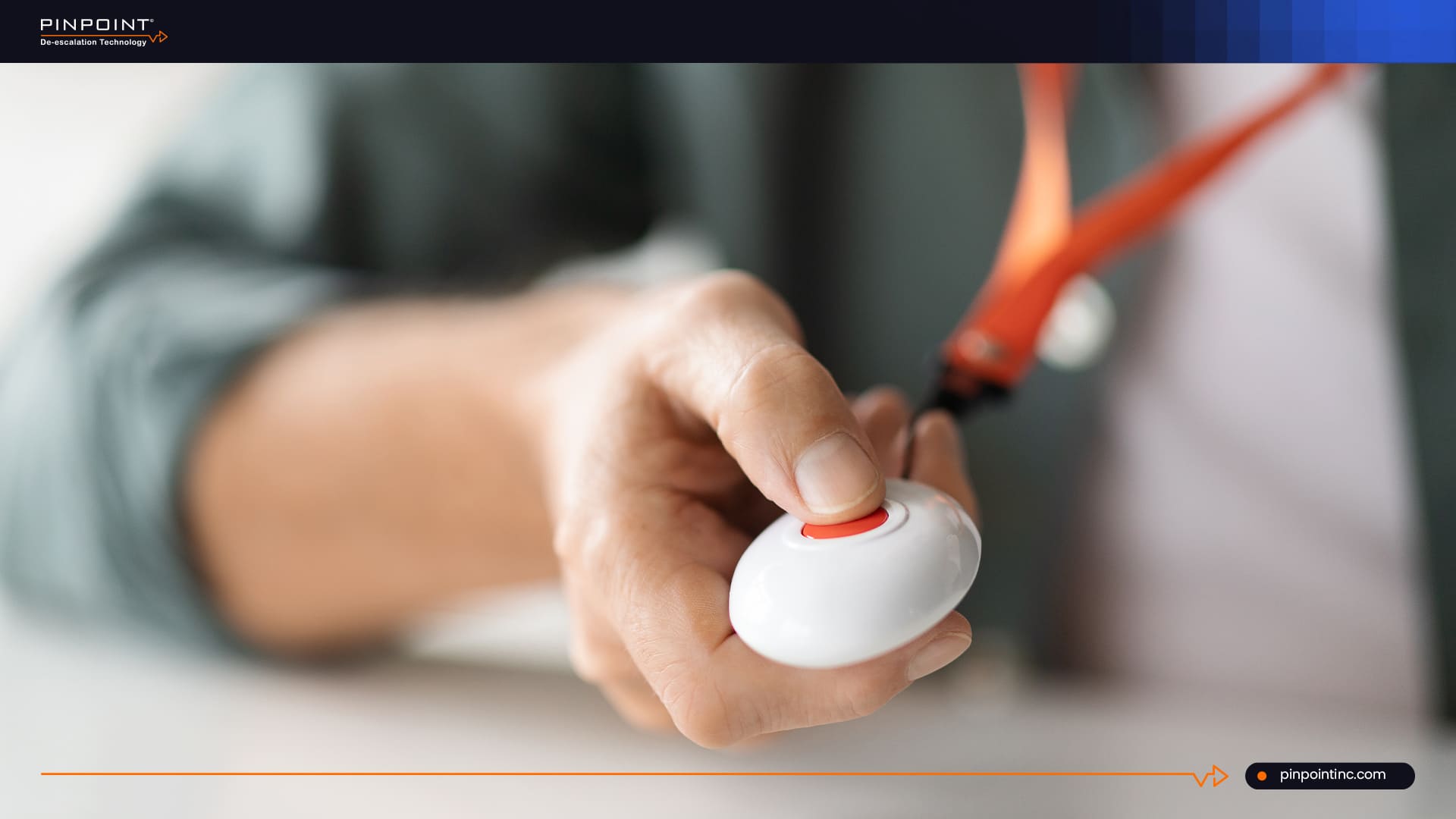
“Workplace violence in healthcare is not a rare event, it is something staff deal with as part of their everyday environment”
What makes this difficult is not awareness, everyone knows the risk exists, the problem is that exact moment when things shift from under control to not, when a patient becomes aggressive or a situation starts to escalate and suddenly the only thing that matters is how quickly help can be reached and how clearly that signal is understood. In those moments, no one is thinking about systems or steps, they are reacting, moving, and trying to manage what’s in front of them.
That is where panic button systems come in. They are meant to create a direct path between the person in that situation and the people who need to respond, but the real question is not whether a button exists, it is whether it can actually be used in that moment, wherever the person is, without needing them to stop, think, or adjust.
Because incidents don’t happen in perfect conditions. They happen in hallways, across rooms, while someone is walking, handling multiple things at once, or trying to calm a situation down. Even a small delay caused by distance, access, or unclear alerts can slow everything down.
So the conversation is not about whether you need a panic button system, that part is already clear. The real question is what kind of system actually works when things are beyond your control.
Let’s dive into the conversation.
What Are the Different Types of Panic Buttons Used in Workplaces?
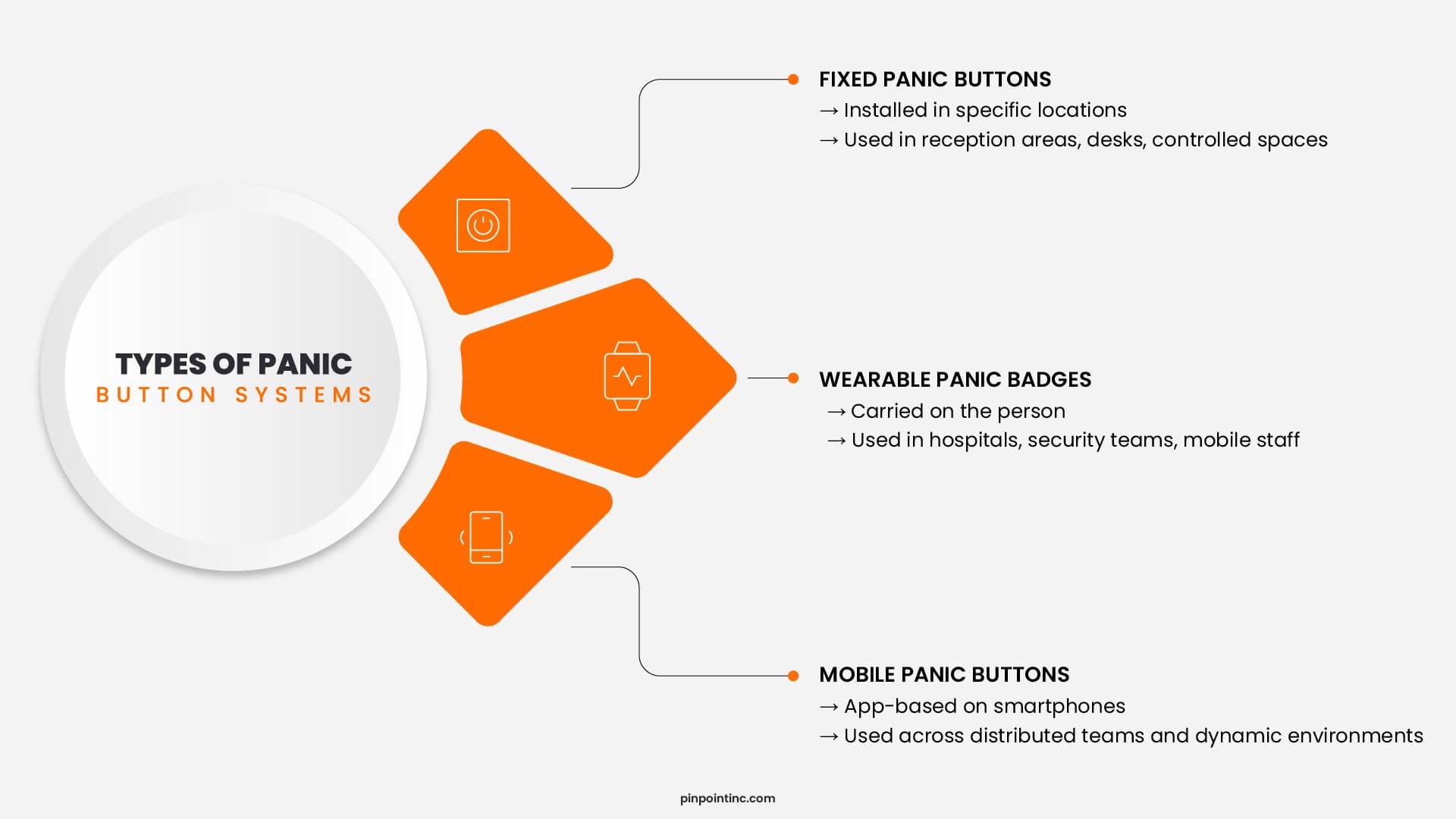
Let’s start with a simple question, what types of panic button systems are actually used in workplaces today, because before comparing anything, it’s important to understand how these systems are built.
Here’s what most comparisons miss.
Most panic button systems don’t fail because they are missing features, they fail because of the assumptions they are built on. Every type of system is designed around a simple idea of where the user will be and how they will react, and that assumption directly affects how useful it becomes in a real situation.
Explore our range of healthcare safety solutions designed to support faster response, improve coordination, and strengthen staff protection across your facility.
Fixed panic buttons are built on the idea that risk happens at predictable points, like a front desk, a nurse station, or a specific room, which works as long as the situation stays within that boundary, but the moment it shifts beyond that location, access becomes a problem.
Wearable panic badges move closer to how people actually work. They stay with the user, which removes the dependency on being in the right place, but they still rely on a separate device that needs to be worn, managed, and available at all times.
Mobile panic buttons take a different route by using something employees already carry, removing the need for dedicated hardware and extending coverage across any space the user moves through, but this also introduces a different kind of dependency on user behavior and device readiness.
You can see while all three systems are built to solve the same problem, they approach it from completely different assumptions, and those assumptions are exactly what determine how they perform when things are not predictable.
What Is a Physical Security Button Badge and How Does It Work?
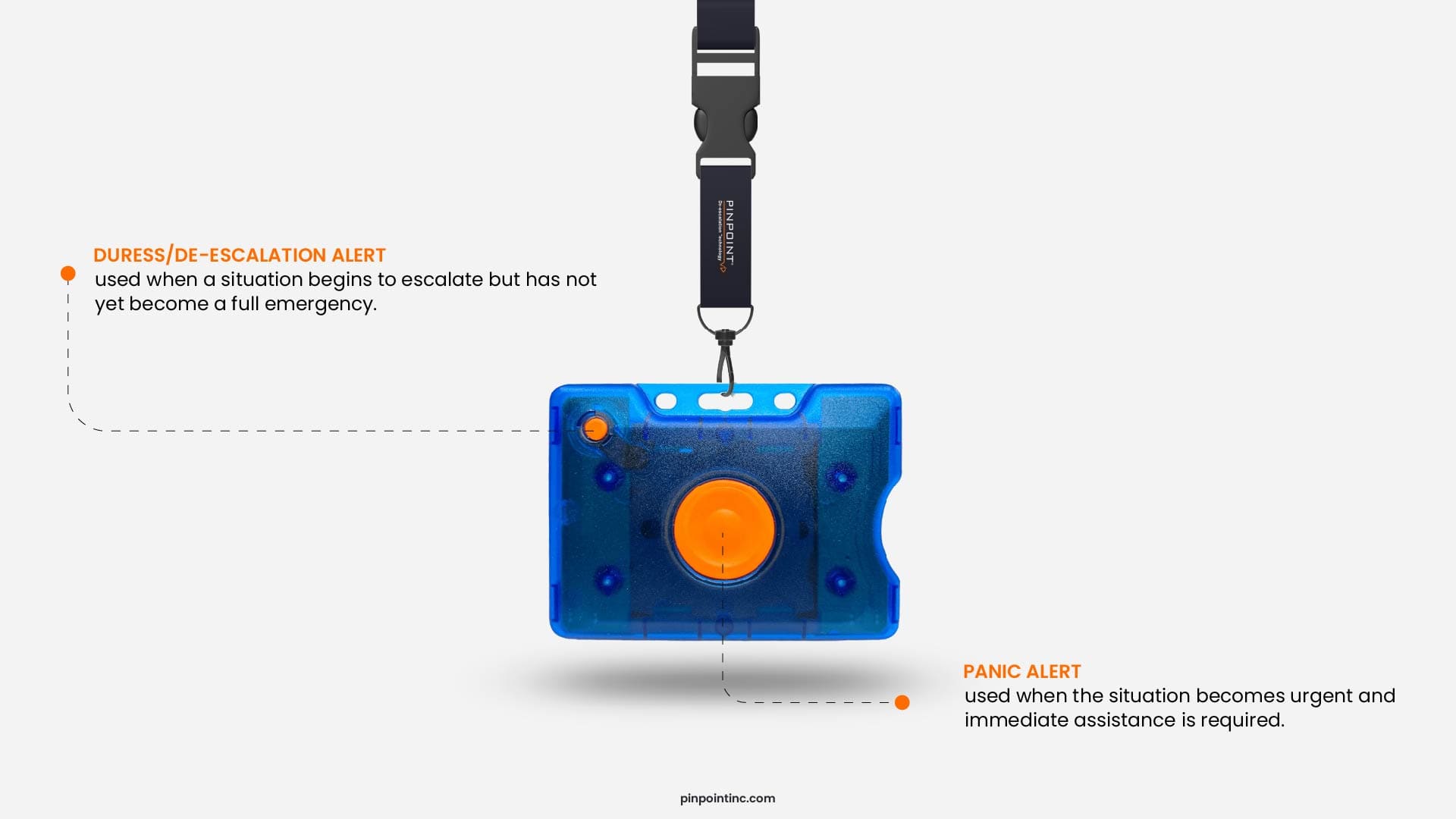
A physical security badge in the context of panic buttons is a dedicated hardware device, not a smartphone app. It comes in two forms: fixed (mounted to a wall, desk, or counter) and wearable (carried on a lanyard, ID reel, or uniform).
How fixed panic buttons work:
Press the button at its mounted location → wired or wireless signal sends to a central receiver → alert goes to security or response teams. The alert identifies which button was pressed, but not where the person is beyond that fixed point.
How wearable physical badges work:
The device stays on the person. When pressed, it transmits a signal through facility-installed receivers. The system identifies which badge triggered the alert and, depending on the technology, may provide location data.
Typical environments:
Fixed buttons at reception desks, nurse stations, pharmacy windows, and security checkpoints. Wearable badges in hospitals, behavioral health units, residential treatment centers, and for mobile security staff.
What Is a Mobile Panic Button and How Does It Work?
A mobile panic alert button is an app-based system that turns a smartphone into an emergency alert device. Unlike physical buttons that require dedicated hardware, this system uses something employees already carry.
How it works:
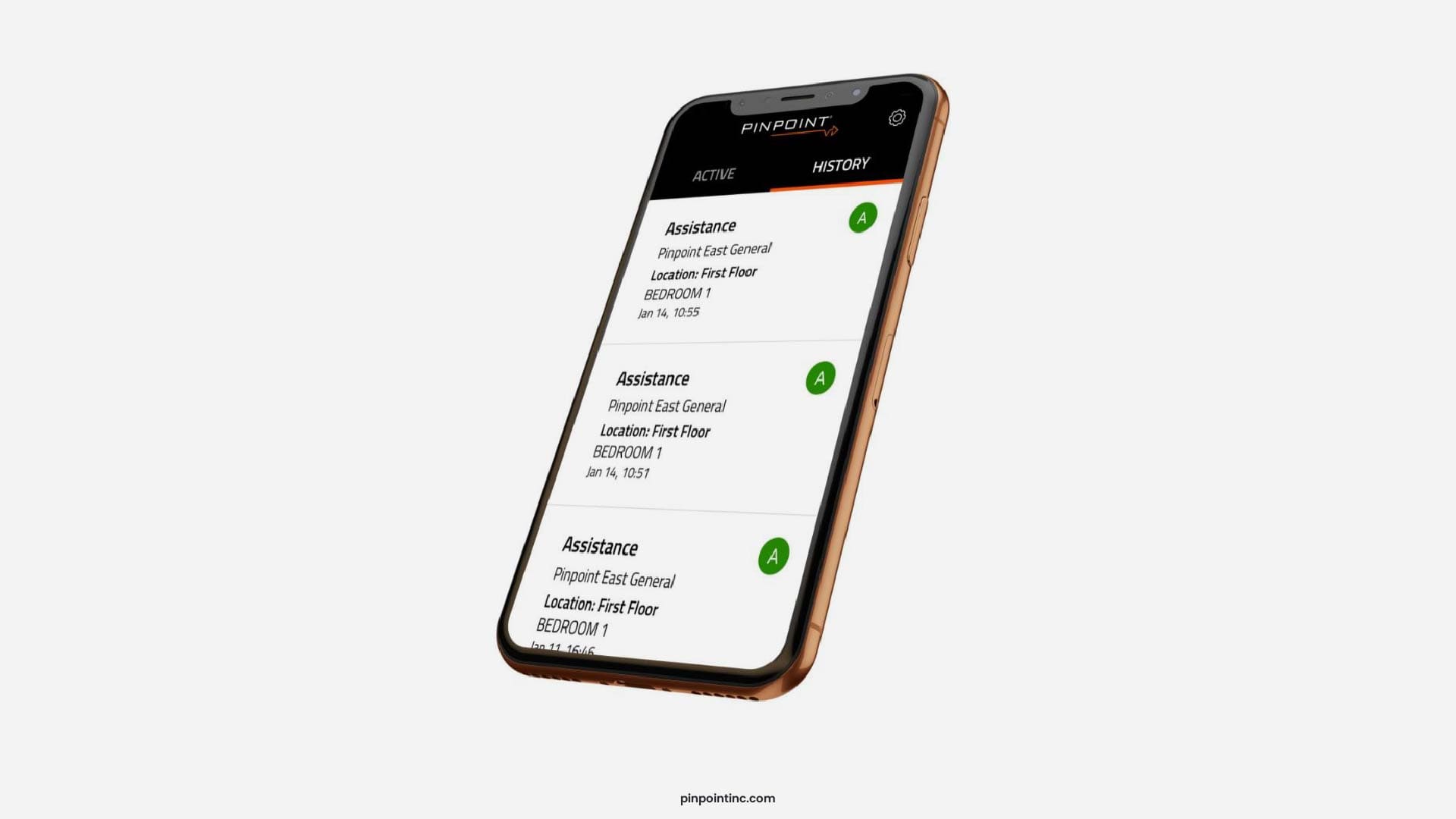
The user opens an app or uses a pre-set shortcut (lock screen button, gesture, or voice command) to trigger an alert. The app sends a signal via cellular or Wi-Fi, typically including real-time GPS location. Responders receive the alert on a central dashboard, showing where the user is or at least where their phone is.
Real-time alerting + GPS:
Most mobile panic buttons continuously transmit location during an incident. As the user moves down a hallway, across a parking lot, or between buildings, the location updates. This is the core advantage over fixed buttons: the alert moves with the person.
Typical environments:
Corporate campuses, universities, remote field staff, home healthcare workers, large retail locations, and workplaces where employees are spread across wide areas or off-site. Less common in hospitals and behavioral health settings, where phone restrictions and indoor GPS limitations create real barriers.
Physical Security ID Badge vs Mobile Panic Alert: The Differences That Actually Matter
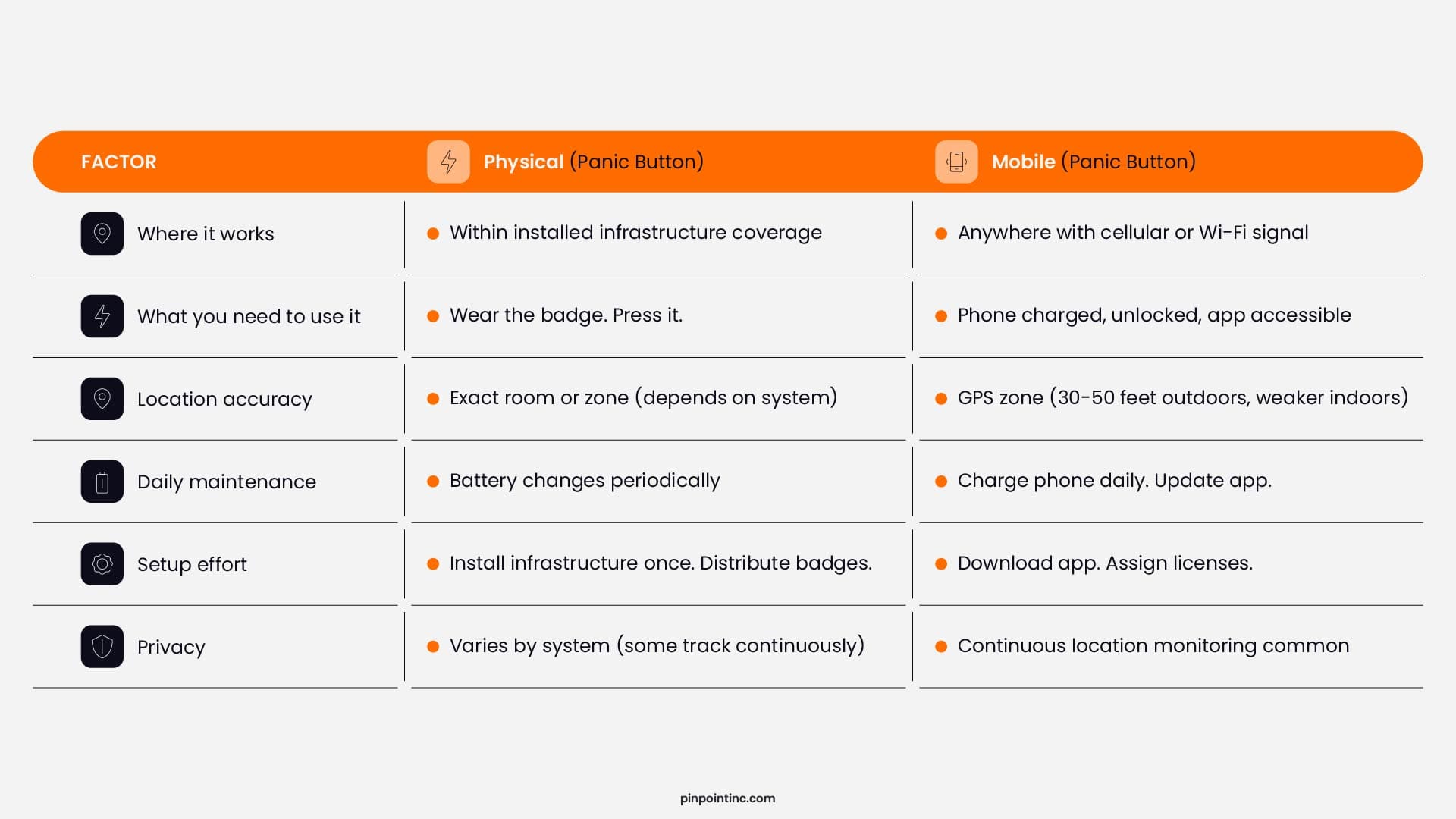
Where It Works
A wearable physical badge works everywhere the infrastructure reaches. Hallways, patient rooms, stairwells, basements, and parking lots across the campus. No signal gaps because the system uses dedicated hardware. A mobile app works anywhere with cellular or Wi-Fi. But inside buildings with thick concrete walls, down in basements, or across rural facilities, that coverage becomes unreliable. You might have signal in one corner of a room and lose it in another.
What You Need to Use It
With a physical badge, you wear it on your lanyard and press it. No screens to unlock, no apps to find. With a mobile app, the person needs their phone in hand, the screen unlocked, the app located, and then the button pressed. Under stress, those extra steps become real obstacles. Your hands are shaking, you are trying to calm a situation, and finding the right icon feels harder than it should be.
Location Accuracy
A physical badge with installed receivers can tell responders the exact room, not just the floor but room 217B specifically. Mobile GPS works well outdoors, but inside a building the accuracy falls apart, giving you a 30 to 50 foot radius that could cover four patient rooms, a hallway, and a supply closet. Responders arrive and have to search, and those seconds spent searching are seconds the person in trouble does not have.
Daily Maintenance
A physical ID panic badge asks almost nothing from staff. No charging, no syncing, no updates and the battery last for years. On the other hand mobile app asks for more: keep your phone charged every shift, keep the app updated, make sure you have signal. If the phone dies, the panic button dies with it. Phones die in the middle of shifts all the time.
Setup Effort
Installing a physical badge system takes work upfront. Put in the infrastructure once, distribute badges, and the system runs. A mobile app deploys fast, sometimes in hours. Download, configure, add users, and you are live. But fast deployment does not mean reliable performance. You trade setup speed for ongoing dependency on networks, batteries, and user behavior.
Privacy
Physical badge systems vary, some track staff location continuously, which creates resistance. Others only activate location when the button is pressed. Mobile apps commonly track location by default because GPS is how they know where to send help. In healthcare settings, where staff already feel overmonitored, continuous tracking becomes a real barrier. People will not carry a system they do not trust.
Which Panic Button System Is More Reliable in Real Emergencies?
Let’s look at the same situation from two different angles.
Sara, a nurse on a busy shift, walks into a patient room where tension is already building. The patient becomes verbally aggressive, and within seconds, the situation starts to escalate. Sara needs help, but how she asks for it matters just as much as how fast she does it. So,
Scenario 1: Sara Wearing a Physical Security Badge
Sara presses the button on the badge clipped to her uniform. The alert is sent instantly, along with her location, directly to the response team. The patient has no indication that she has requested help, so the interaction does not escalate further and Sara is able to stay present and continue managing the situation.
This kind of setup works well in moments where drawing attention could make things worse. There is no need to step away, reach for another device, or change behavior. Help is already on the way while the situation continues to be handled in real time.
Scenario 2: Sara Using a Mobile Panic Button
In the same situation, Sara uses a mobile panic button. She reaches for her phone and triggers the alert, which immediately shares her exact location with responders. The team knows where to go and can move directly without needing to confirm anything.
At the same time, this depends on how quickly she can access her phone in that moment. If her hands are occupied, or the phone is not immediately within reach, that small delay can matter. There is also a reliance on the device being active and connected at that point.
What Actually Defines Reliability
Both systems can trigger alerts and share location. The difference shows up in how easily they can be used in that exact moment and how naturally they fit into the situation. One allows Sara to act without changing her behavior. The other gives responders immediate visibility but depends on device access.
So reliability is not just about sending an alert. It comes down to how quickly it can be triggered, how smoothly it fits into the situation, and how fast the response can follow.
When Should You Choose a Physical Panic vs a Mobile Panic Button Solution?
Let’s expand this beyond reliability, because the choice is not just about which system works in an emergency, it’s about how well that system fits into your environment, your infrastructure, and how your teams actually operate day to day.
Infrastructure and Environment Fit
Physical Security Badge fits better when:
- Your environment is contained and structured (hospitals, schools, facilities)
- You want a system that works independently without relying on personal devices
- Coverage is designed around how your space operates internally
- You need consistent performance without depending on external factors
Mobile Panic Button fits better when:
- Your operations extend across multiple buildings, open areas, or off-site locations
- You need flexibility across changing environments without physical constraints
- You want a system that scales without installing additional hardware
System and Usage Dependency
Physical Security Badge depends on:
- The device being worn or carried consistently
- A setup that allows alerts to be received reliably within the environment
- Minimal user interaction, usually a single press with no navigation
Mobile Panic Button depends on:
- The phone being accessible in that moment
- The device being active, charged, and in use
- The user being able to open or trigger the alert quickly
How Your Teams Actually Work
Physical Security Badge aligns better when:
- Staff are actively engaged in tasks and need hands-free, immediate access
- Situations require discreet activation without changing behavior
- Teams move, but still operate within a defined environment
Mobile Panic Button aligns better when:
- Staff frequently move across unpredictable or wide areas
- Teams are already using phones as part of their daily workflow
- Access to a phone is consistent and immediate
Explore healthcare safety solutions designed to support discreet alerts, faster response times, and reliable coverage across dynamic clinical environments.
Risk Distribution and Response Needs
Physical systems are stronger when:
- Risk is present within known environments where teams are already positioned
- Immediate, discreet alerts are needed without drawing attention
- Response teams are operating within the same facility
Mobile systems are stronger when:
- Risk is distributed across multiple or undefined locations
- You need visibility across a wider area in real time
- Response may come from different teams or locations
What Features Should You Look for in a Modern Panic Button System?
Regardless of format, modern systems should meet these requirements, because in real environments, performance is not measured by what a system claims to do, but by how consistently it works when conditions are not ideal.
Instant Activation Without Friction
A panic button system should allow users to trigger an alert instantly, without needing to unlock a device, navigate an interface, or follow multiple steps. In real scenarios, staff are often engaged in active situations, moving, handling equipment, or managing a person directly, which means activation needs to be immediate and natural. Any delay caused by interaction or process reduces the effectiveness of the system.
Room-Level Location Accuracy That Requires No Interpretation
Location data should be precise enough to guide responders directly to the exact room or area without requiring additional confirmation. Systems that rely on broad zones or unclear positioning create delays during response, especially in large facilities. A modern system should provide clear, usable location information that allows teams to act without hesitation.
Discreet Duress and Panic Activation in a Single System
A system should support both discreet duress alerts and full panic activation without changing how the user behaves in the moment. In many situations, drawing attention can escalate risk, so the ability to request help silently is critical. At the same time, there should be a clear way to trigger a more urgent response when needed, without switching devices or processes.
Reliable Alert Delivery Across Multiple Channels
Alert delivery should not depend on a single pathway. A modern system needs to ensure that alerts are transmitted and received consistently, even if one channel fails. This includes delivering alerts to the right responders immediately, without delays caused by routing, processing, or system limitations.
Secure Infrastructure Without External Dependency
In environments like healthcare, security and privacy are non-negotiable. An ID badge panic button system should operate without relying on external networks or personal devices that can introduce cybersecurity risks. Stability should come from a controlled infrastructure that performs consistently regardless of connectivity conditions.
Compliance Readiness for Joint Commission and OSHA Standards
A modern panic button system should support compliance with evolving standards like Joint Commission workplace violence requirements and OSHA safety guidelines. This means providing clear documentation, reliable alert logs, and consistent system performance that can stand up to audits. Beyond just meeting requirements, the system should help organizations demonstrate that safety protocols are not only in place but actively functioning in real scenarios.
Centralized Monitoring and Response Coordination
All alerts should be visible within a centralized system that allows teams to track incidents, coordinate responses, and manage escalation in real time. Without centralized visibility, alerts can become fragmented, making it harder for teams to respond effectively and consistently.
Scalability Without Operational Complexity
As organizations grow, the system should be able to expand without requiring major changes to infrastructure or workflows. Adding new areas, teams, or users should not introduce friction or require constant reconfiguration. A modern system should adapt to growth while maintaining consistent performance.
How Pinpoint Delivers Faster and More Reliable Emergency Response
Let’s end our conversation with what actually matters in real situations, how quickly someone can ask for help and how reliably that response reaches them.
Pinpoint is built around the realities we’ve discussed. In healthcare, response time matters, privacy cannot be compromised, and reliance on external systems introduces risk. Our wearable panic badge system is designed to remove those gaps, allowing instant, discreet activation with room-level precision, without depending on phones or unstable networks. It’s a system built to fit how teams actually work, not the other way around.
FAQ’s
What is an ID badge panic button and how does it work?
An ID badge panic button is a wearable device that looks like a standard employee ID badge but has a hidden button. Staff wear it on a lanyard, reel, or uniform clip. When pressed, it sends a silent alert to security or response teams.
How do you know which panic button system your facility actually needs?
Start by mapping where your staff spend their time, what technology they already carry, and what your IT team can support. If everyone works inside one building and you have budget for infrastructure, an physical badge panic button system would be great fit. If your team is spread across multiple sites with no single facility, a mobile solution might be the only practical option.
What usually slows down response after an alert is triggered?
It’s rarely the alert itself. The delay usually comes from unclear location, multiple steps in communication, or responders trying to figure out where to go. Pinpoint’s physical panic badge focus on reducing that gap, delivering alerts in milliseconds with room-level accuracy so teams can move directly instead of stopping to interpret the situation.
Why does discreet activation matter so much in healthcare?
Because not every situation should be escalated visibly. In many cases, staff need help without signaling it. A visible action can change behavior, increase tension, or make a situation harder to control.
- What Are the Different Types of Panic Buttons Used in Workplaces?
- What Is a Physical Security Button Badge and How Does It Work?
- What Is a Mobile Panic Button and How Does It Work?
- Physical Security ID Badge vs Mobile Panic Alert: The Differences That Actually Matter
- Which Panic Button System Is More Reliable in Real Emergencies?
- When Should You Choose a Physical Panic vs a Mobile Panic Button Solution?
- What Features Should You Look for in a Modern Panic Button System?
- How Pinpoint Delivers Faster and More Reliable Emergency Response
- FAQ’s
Author:
Jordan Belous
Chief Marketing Officer of Pinpoint North America, where she leads marketing strategy, brand development, and digital growth initiatives. She earned a Bachelor of Science in Allied Health with a concentration in physical therapy sciences from the University of Tampa, bringing a unique interdisciplinary perspective that blends healthcare knowledge with modern marketing strategy.
Jordan writes about workplace violence prevention in healthcare, nurse safety, staff wellbeing, and emerging healthcare technologies that support frontline teams. Her work explores how hospitals and behavioral health facilities can build safer environments, reduce burnout and turnover, and implement safety systems that protect staff while preserving trust and dignity.
She is also the Chief Executive Officer of Whip Pediatric Cancer, a nonprofit dedicated to supporting children battling cancer and raising awareness and funds for pediatric cancer. Through her work with Whip, Jordan regularly visits pediatric cancer patients in hospitals and spends time alongside patients, families, and the clinicians who care for them. These experiences place her directly beside nurses and healthcare teams every day and reinforce her belief that the people providing care deserve to feel just as safe as the patients they serve.
Her experiences with Whip and her work at Pinpoint are closely connected, both driven by her deep respect for nurses and frontline healthcare workers. Seeing firsthand the compassion, resilience, and critical role nurses play has strengthened her commitment to advocating for safer healthcare environments and ensuring that those who dedicate their lives to caring for others have the protection and support they deserve.