
New York's 2026-2027 Hospital Workplace Violence Requirements: What Changes and When

If you oversee safety, HR, or compliance at a New York hospital, the next twelve months contain several important statutory deadlines.
New York enacted Public Health Law §§ 2832 and 2832-a on December 12, 2025. The provisions took effect on September 18, 2026, beginning a phased compliance schedule that hospital leaders need to understand.
The 2026 workplace violence requirements New York hospitals face cannot be treated as one distant deadline. Emergency department security requirements took effect first. Annual workplace safety and security assessments begin January 1, 2027. By September 18, 2027, every covered facility must establish the required workplace violence prevention plan.
Good to know
The New York healthcare law adds specific state obligations and deadlines alongside existing OSHA requirements and guidance, CMS Conditions of Participation, and applicable accreditation standards. Each framework operates differently, so meeting one does not automatically establish compliance with the others.
The broader concern behind the law remains visible across New York healthcare. Recent labor activity involving 15,000 New York nurses has kept workplace violence, staffing, and employee protection in public discussion. It did not create the statute, which had already been signed, but it reinforces why implementation deserves attention.
What PHL §§ 2832 and 2832-a Actually Require
PHL § 2832 establishes related but distinct responsibilities. Beginning January 1, 2027, every New York general hospital must conduct a workplace safety and security assessment at least annually, develop a written safety and security plan, and implement measures addressing identified threats or hazards.
Separately, every covered facility, including general hospitals and nursing homes, must establish a workplace violence prevention plan by September 18, 2027. The program must protect healthcare workers, patients, nursing home residents, and visitors.
Nursing homes may satisfy § 2832 by complying with specified federal facility-assessment and emergency-preparedness provisions under 42 CFR 483.71 and 483.73, provided their assessments and plans address workplace violence threats and hazards.
PHL § 2832-a focuses specifically on emergency department security. It creates two staffing rules based on whether a hospital is located in a city or county with a population of at least one million. Together, the sections establish a clearer framework for hospital safety compliance across New York.
Neither section replaces existing CMS or accreditation obligations. Instead, § 2832 requires a general hospital’s prevention program to remain consistent with specified CMS Conditions of Participation and applicable workplace violence standards established by its CMS-deemed accrediting organization. Each hospital should map its workplace violence policy against these overlapping requirements while tracking the new state deadlines.
Three deadlines every NY hospital needs on the calendar
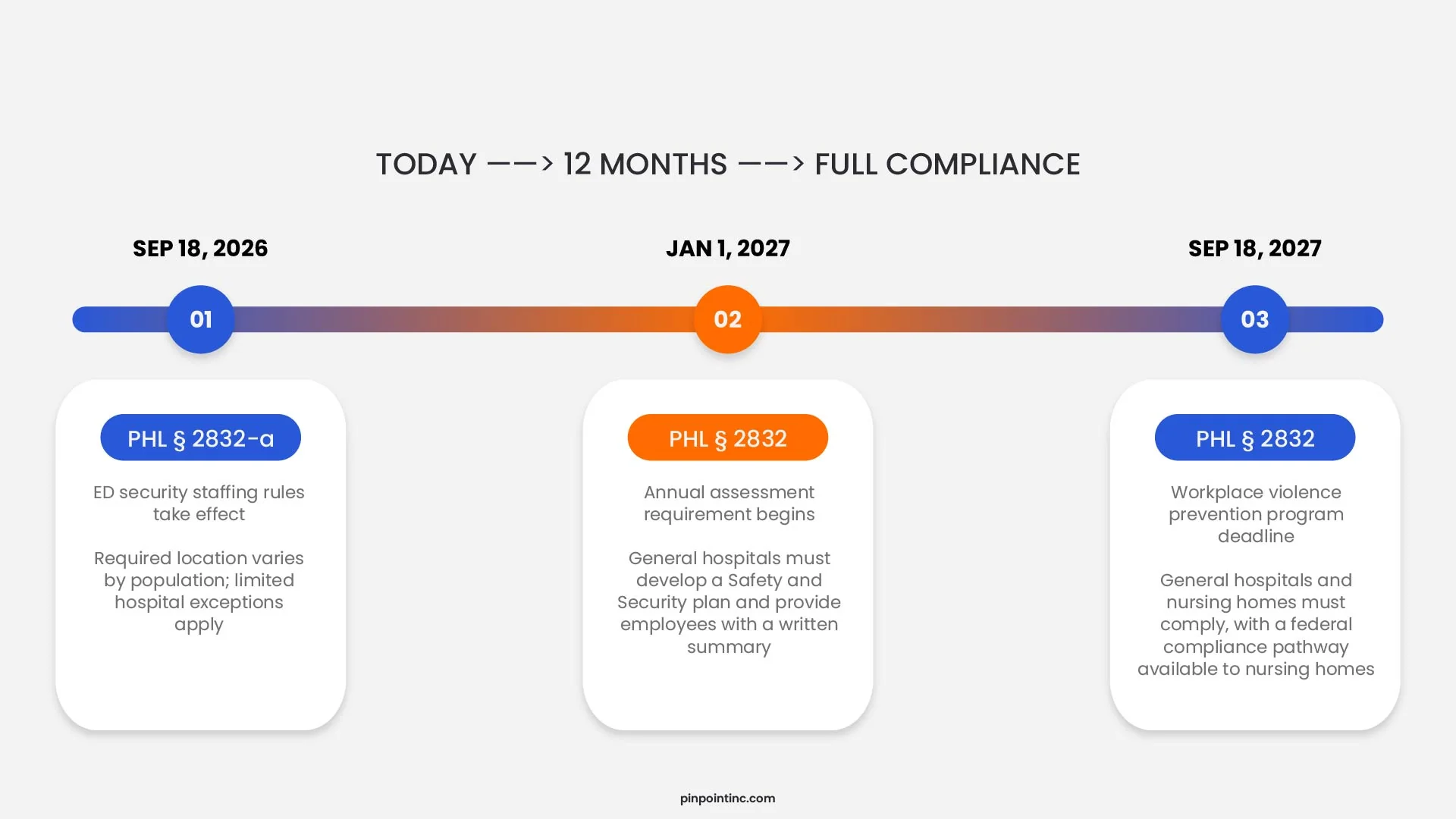
September 18, 2026: Emergency Department Security Personnel
The first operational deadline addresses a setting where workplace violence presents a documented risk. In its 2022 survey, the American College of Emergency Physicians found that 55 percent of respondents had experienced physical assault while working in an emergency department. Among physicians who had been assaulted, 33 percent reported being injured. These findings were cited by the bill’s sponsors as part of the case for PHL § 2832-a.
The requirement follows two tiers based on the population of the city or county where the hospital is located. Each hospital’s workplace violence policy should clearly document which tier applies and how the corresponding staffing requirement will be met.
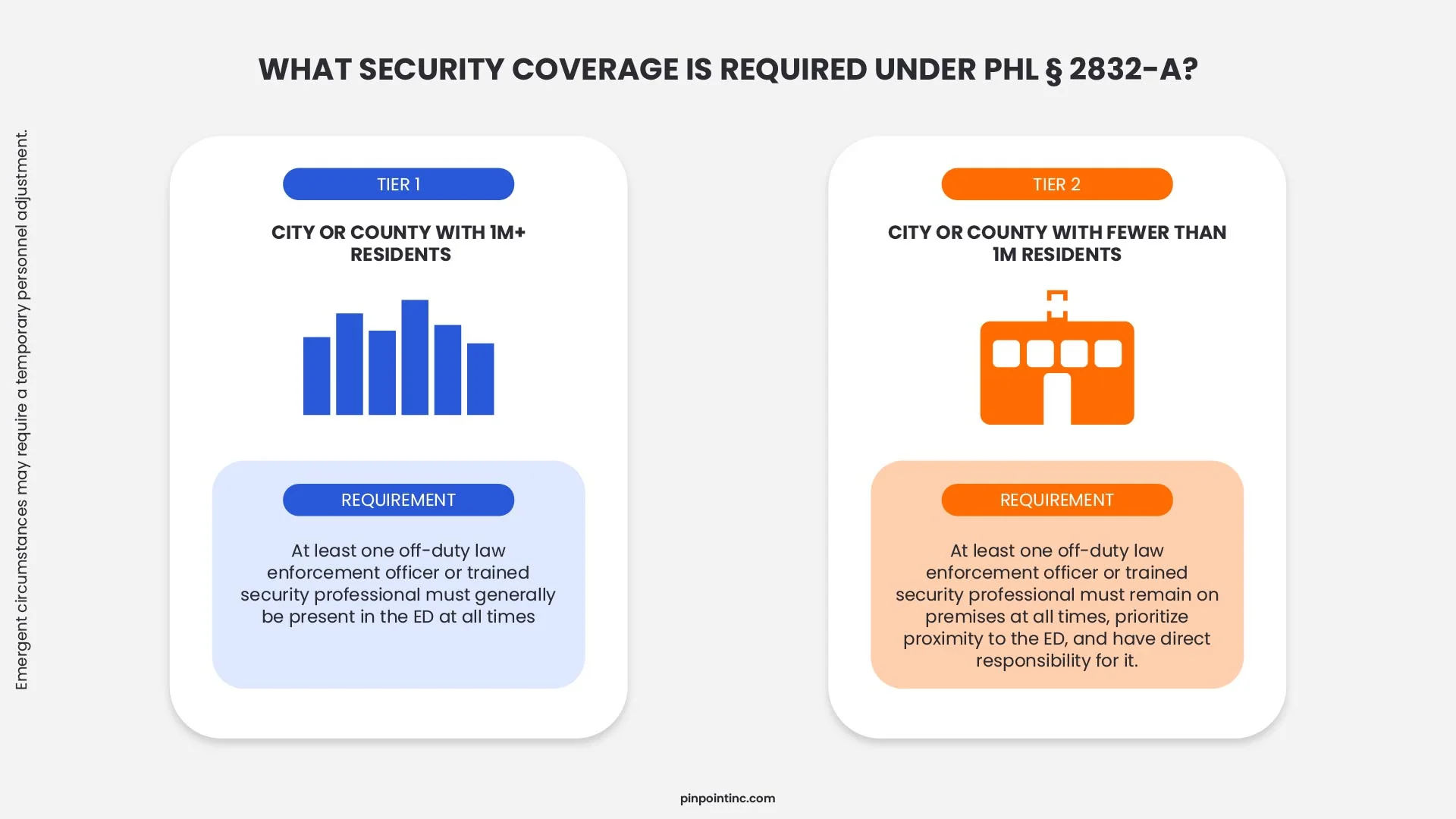
The exceptions are limited. Critical access hospitals, sole community hospitals, and rural emergency hospitals in the lower-population tier are initially exempt from the on-premises requirement. However, if increased violence or abuse is documented through internal reports or law enforcement records, the state health commissioner must work with the hospital toward compliance. Smaller facilities therefore still need a defensible workplace violence policy, reliable incident reporting, and evidence that identified risks are being addressed.
Security staffing is only one layer of protection. PHL § 2832 separately directs general hospitals to consider alarms and communication systems during their safety assessments. Hospitals may therefore evaluate options such as wearable panic buttons for hospital safety when their risk assessment identifies a need for faster communication. The law does not specifically require panic buttons, so any technology decision should follow the hazards identified by the hospital.
January 1, 2027: Annual Safety and Security Assessment and Plan
The second deadline is the analytical core of the statute. Beginning January 1, 2027, every New York general hospital must conduct a workplace safety and security assessment at least annually. It must then develop and implement a written Safety and Security Plan addressing the threats and hazards identified.
The assessment cannot be treated as a checkbox exercise. PHL § 2832 identifies factors hospitals must consider, including incident reports and logs, concerns raised by employees and visitors, building layouts, access points, visitor management, alarms, communication systems, training policies, and procedures for handling disruptive or violent individuals.
Two statutory requirements deserve particular attention. First, employees must be actively involved in conducting the assessment and developing the Safety and Security Plan. Recognized collective bargaining agents must also participate where applicable. Hospitals may organize that involvement through existing safety, security, or labor-management committees, but simply having a committee does not establish compliance. Because these activities inform the broader workplace violence prevention plan, meaningful employee participation should be documented. Under the New York healthcare law, that involvement is a requirement, not a courtesy.
How PHL § 2832 turns data into a compliant plan
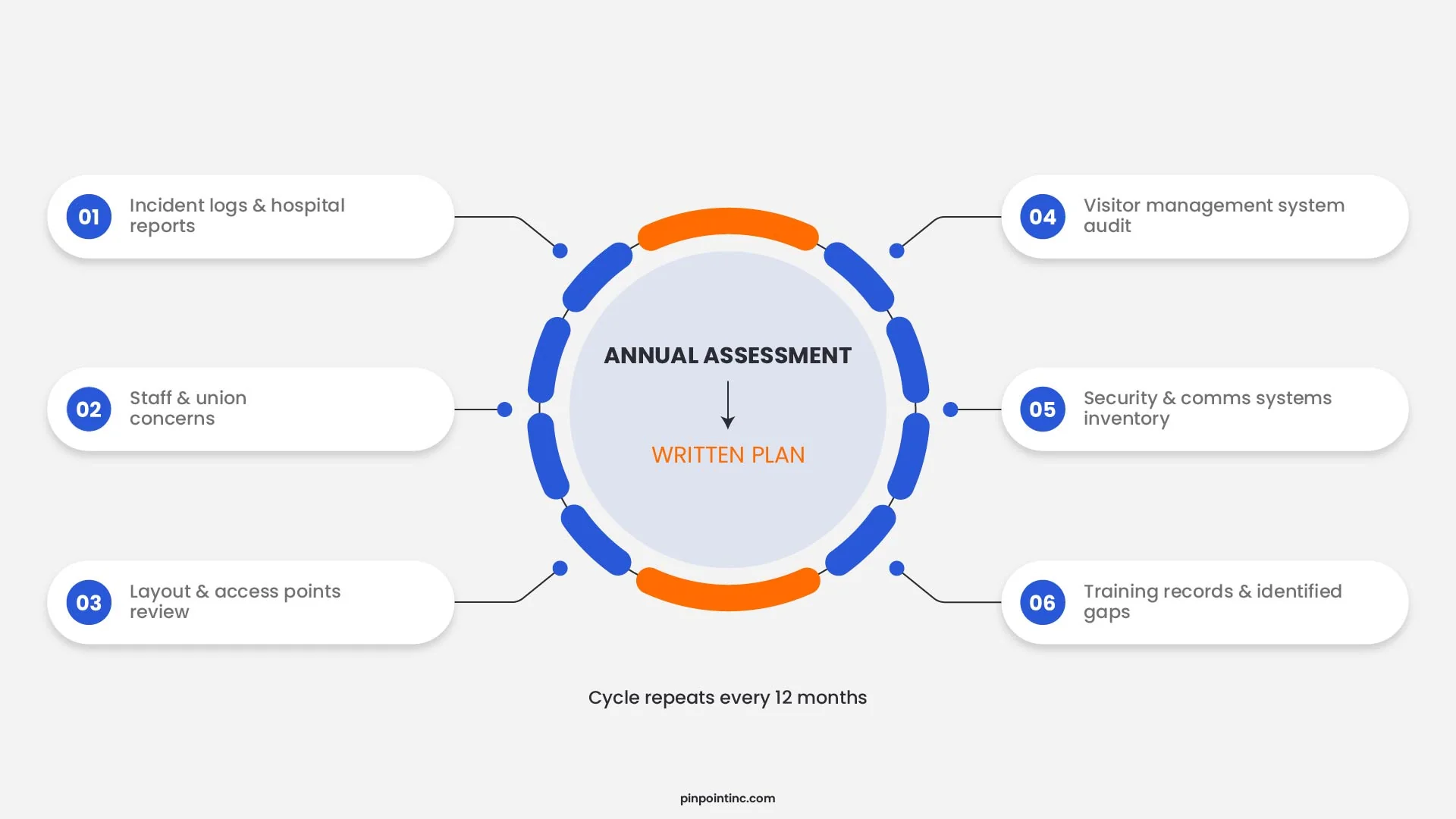
Second, hospitals must provide employees and applicable bargaining representatives with a detailed written summary of the plan. They must also explain how employees can report workplace violence incidents. The statute does not necessarily require a new reporting system, but the existing process must be clearly communicated and usable. This requirement turns the workplace violence policy from a document stored in the compliance office into guidance employees can understand and apply.
Important point
PHL § 2832 requires incident data to inform the assessment, but it does not require continuous employee location tracking. When incident-log summaries, trends, and analyses are shared with the responsible committee, identifying information must be appropriately redacted. Hospitals evaluating badge or location data should consider employee privacy expectations around location tracking and collect only what their documented safety purpose requires.
Existing OSHA-aligned processes and Joint Commission workplace violence standards can provide a useful foundation, but hospitals should not assume that existing accreditation work automatically satisfies PHL § 2832. Teams can compare their current approach with the core components of a healthcare workplace violence prevention program and document where state-specific updates are required.
September 18, 2027: Full Workplace Violence Prevention Program
The third deadline has the broadest scope. By September 18, 2027, every covered facility, meaning New York general hospitals and nursing homes, must establish a workplace violence prevention program. Although organizations may refer to the governing document as a workplace violence prevention plan, the statute requires operational measures beyond a written policy.
For general hospitals, the program must be consistent with the CMS Conditions of Participation addressing care in a safe setting under 42 CFR 482.13(c)(2) and specified emergency-preparedness requirements under 42 CFR 482.15(a) and (d)(1). It must also align with the workplace violence standards of the hospital’s CMS-deemed accrediting organization, provided those standards are comparable to those established by The Joint Commission.
Nursing homes have an alternative compliance pathway. A nursing home can satisfy PHL § 2832 through compliance with 42 CFR 483.71(a)(3), 483.71(b)(1), and 483.73(a)(1), provided its facility assessment and emergency plan specifically address workplace violence threats and hazards. Facilities should review their existing documents carefully because federal compliance alone is insufficient if those risks are not addressed.
The word “program” matters. A workplace violence prevention plan may organize the requirements, but the complete program also includes risk assessment, employee involvement, training policies, protective measures, incident reporting, communication, and ongoing review. Technology may support those measures when justified by identified hazards, but it is not universally required. Effective hospital safety compliance depends on showing how the documented program operates in practice.
How the New York Healthcare Law Aligns with CMS and Joint Commission Standards
The New York healthcare law did not emerge in isolation. The Joint Commission’s workplace violence standards, effective since January 2022, require accredited hospitals to maintain a prevention program led by a designated individual and multidisciplinary team. Requirements include worksite analysis, training, incident reporting, trend analysis, response procedures, and follow-up support. In 2026, workplace violence prevention also appears within The Joint Commission’s National Performance Goals framework. A written workplace violence policy can organize these responsibilities, but compliance depends on demonstrating that the broader program operates in practice.
The cited CMS Conditions of Participation are narrower. They require hospitals to provide care in a safe setting and maintain emergency-preparedness programs, but they do not independently establish a complete workplace violence program. OSHA has also published healthcare workplace violence guidance, although that guidance is advisory. OSHA may address recognized violence hazards through inspections and the General Duty Clause.
PHL § 2832 adds state-specific duties, assessment inputs, employee participation, reporting expectations, and fixed deadlines. The current Joint Commission workplace violence requirements provide substantial structure, while the New York healthcare law is more prescriptive in certain operational areas and places covered facilities under New York State Department of Health oversight.
A useful distinction is that CMS supplies federal patient-safety and emergency-preparedness requirements, The Joint Commission establishes explicit workplace violence program standards for accredited organizations, and PHL § 2832 defines what covered New York facilities must address and when. Together, these frameworks shape the facility’s workplace violence prevention plan.
| Framework | Scope | Oversight or enforcement |
|---|---|---|
| PHL §§ 2832 and 2832-a | § 2832 covers general hospitals and nursing homes; § 2832-a covers general hospitals | NYSDOH oversight and statutory deadlines |
| The Joint Commission workplace violence standards | Joint Commission-accredited hospitals and critical access hospitals | Accreditation surveys and required corrective action |
| CMS Conditions of Participation | Medicare-participating hospitals | CMS, state survey agencies, or CMS-approved accrediting organizations |
| OSHA and New York PESH | OSHA covers applicable private-sector employers; PESH covers New York public-sector employers | Inspections and citations; OSHA guidance itself is nonbinding |
What Hospitals Should Do in the Next 12 Months
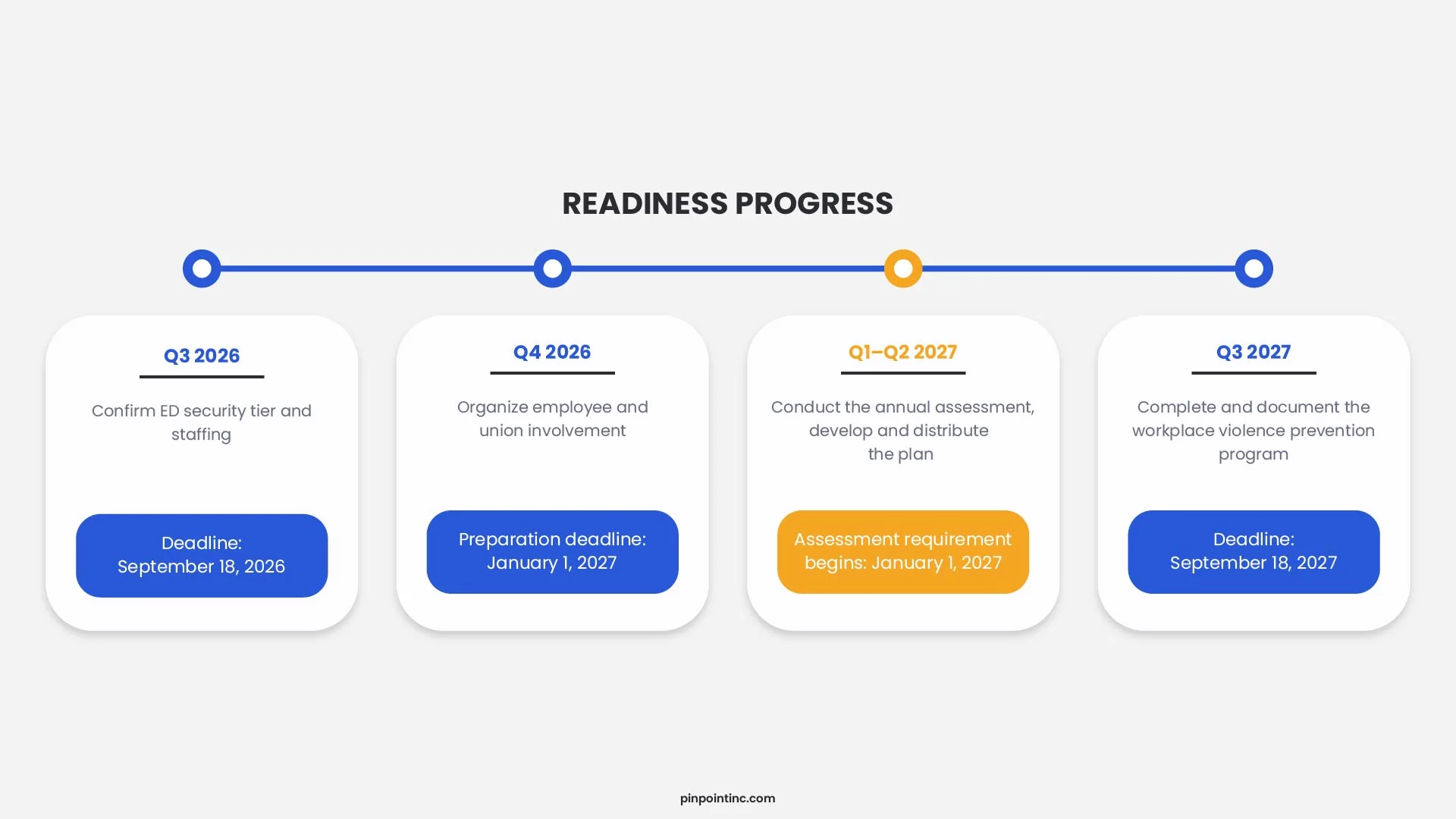
The staggered deadlines allow hospitals to sequence the work. Before planning later phases, each general hospital should confirm which PHL § 2832-a security tier applies, document any exception, and prepare employee and union participation for the assessment process beginning January 1, 2027.
Quarter-by-quarter path to full compliance
Technology decisions should follow the assessment rather than predetermine it. PHL § 2832 does not require a specific duress-alert system, visitor platform, or vendor. When identified hazards justify alarms, communication tools, or access controls, the workplace violence prevention plan should explain the selected measure, its purpose, responsible owner, and review process. Hospitals evaluating duress technology can use this guide to wearable panic-button systems to compare options without treating a purchase as proof of compliance.
Section 2832 covers general hospitals and nursing homes, while PHL § 2832-a applies only to general hospitals. Standalone ambulatory surgery centers, urgent care clinics, and physician offices are not directly covered unless they meet the law’s definition of a covered facility. Separate OSHA, New York PESH, or accreditation requirements may still apply.
Next Step
Turn Your Assessment Into a Response Plan
PHL § 2832 directs New York general hospitals to consider alarms and communication systems in their annual assessment, then act on the hazards they find.
See how Pinpoint's non-tracking wearable duress system can address identified alerting gaps within your workplace violence prevention plan.
A 15-minute Pinpoint walkthrough, built around your assessment findings.
FAQ’s
Does PHL § 2832 apply to nursing homes the same way it applies to hospitals?
No. Nursing homes must establish a workplace violence prevention program by September 18, 2027, but they have an alternative compliance pathway. They may satisfy § 2832 by complying with 42 CFR 483.71(a)(3), 483.71(b)(1), and 483.73(a)(1), provided their assessments and plans specifically address workplace violence threats and hazards. This is not a blanket exemption. Nursing homes are not subject to the § 2832-a emergency department security requirement.
What counts as “trained security personnel” for the ED requirement?
PHL § 2832-a uses the term “off-duty law enforcement officer or trained security personnel” but does not define the required credentials or curriculum. PHL § 2832 separately requires healthcare workers regularly assigned to security duties to receive training on security’s role in hospital operations. Until additional authoritative guidance is available, hospitals should document each person’s qualifications, training, responsibilities, and readiness without presenting an unstated curriculum as a legal requirement.
Can we build the annual Safety and Security Assessment on our existing TJC worksite analysis?
An existing Joint Commission worksite analysis can provide a foundation, but it does not automatically satisfy PHL § 2832. Hospitals should compare it against the statute’s assessment inputs, employee and union participation requirements, written-plan obligations, reporting instructions, and incident-data provisions. Any gaps should be addressed and documented.
Are critical access hospitals fully exempt from § 2832-a?
No. The exception applies to critical access hospitals, sole community hospitals, and rural emergency hospitals within the lower-population tier. If increased ED violence or abuse is established through internal reports or law enforcement data, the commissioner must work with the facility toward compliance over a reasonable period. These hospitals also remain subject to applicable § 2832 assessment and program requirements.
References
Federal regulations
- 42 CFR § 482.13: Hospital patient rights and safe setting
- 42 CFR § 482.15: Hospital emergency preparedness
- 42 CFR § 483.71: Nursing-home facility assessment
- 42 CFR § 483.73: Nursing-home emergency preparedness
New York requirements
- New York Public Health Law § 2832: Violence prevention program
- New York Public Health Law § 2832-a: Emergency department security
- New York Public Health Law § 2801: Facility definitions
Accreditation and compliance resources
- What PHL §§ 2832 and 2832-a Actually Require
- September 18, 2026: Emergency Department Security Personnel
- January 1, 2027: Annual Safety and Security Assessment and Plan
- September 18, 2027: Full Workplace Violence Prevention Program
- How the New York Healthcare Law Aligns with CMS and Joint Commission Standards
- What Hospitals Should Do in the Next 12 Months
- FAQ’s
- References
Author:
Jordan Belous
Chief Marketing Officer of Pinpoint North America, where she leads marketing strategy, brand development, and digital growth initiatives. She earned a Bachelor of Science in Allied Health with a concentration in physical therapy sciences from the University of Tampa, bringing a unique interdisciplinary perspective that blends healthcare knowledge with modern marketing strategy.
Jordan writes about workplace violence prevention in healthcare, nurse safety, staff wellbeing, and emerging healthcare technologies that support frontline teams. Her work explores how hospitals and behavioral health facilities can build safer environments, reduce burnout and turnover, and implement safety systems that protect staff while preserving trust and dignity.
She is also the Chief Executive Officer of Whip Pediatric Cancer, a nonprofit dedicated to supporting children battling cancer and raising awareness and funds for pediatric cancer. Through her work with Whip, Jordan regularly visits pediatric cancer patients in hospitals and spends time alongside patients, families, and the clinicians who care for them. These experiences place her directly beside nurses and healthcare teams every day and reinforce her belief that the people providing care deserve to feel just as safe as the patients they serve.
Her experiences with Whip and her work at Pinpoint are closely connected, both driven by her deep respect for nurses and frontline healthcare workers. Seeing firsthand the compassion, resilience, and critical role nurses play has strengthened her commitment to advocating for safer healthcare environments and ensuring that those who dedicate their lives to caring for others have the protection and support they deserve.