
RTLS vs. Non-Tracking Staff Safety Systems: A Feature-by-Feature Buyer Comparison

When hospital leaders start evaluating staff safety technology, RTLS (real-time location systems) often dominates the conversation. It shows up in search results, appears in vendor recommendations, and is commonly discussed across the industry.
But healthcare RTLS system is not the only way to protect staff.
For many facilities, the real question is whether they need continuous location tracking, or a non-tracking safety system that delivers the same core staff duress outcome: fast alerts, room-level response, and reliable protection without the same infrastructure burden. RTLS can be valuable for asset tracking and patient monitoring, but for staff safety alone, that level of complexity and cost may go beyond what the use case actually requires.
This comparison breaks down non-tracking and RTLS staff duress systems across the areas healthcare buyers care about most: cost, infrastructure, staff acceptance, response performance, compliance, maintenance, implementation timeline, and best-fit use cases.
You’ll see what each system includes, where each one performs well, and where the trade-offs start to matter. If you’re comparing both options, take 10 minutes to go through the sections below for a clear perspective and the answers you need.
What Is RTLS in Healthcare, and Why Is It Often the Default Choice?
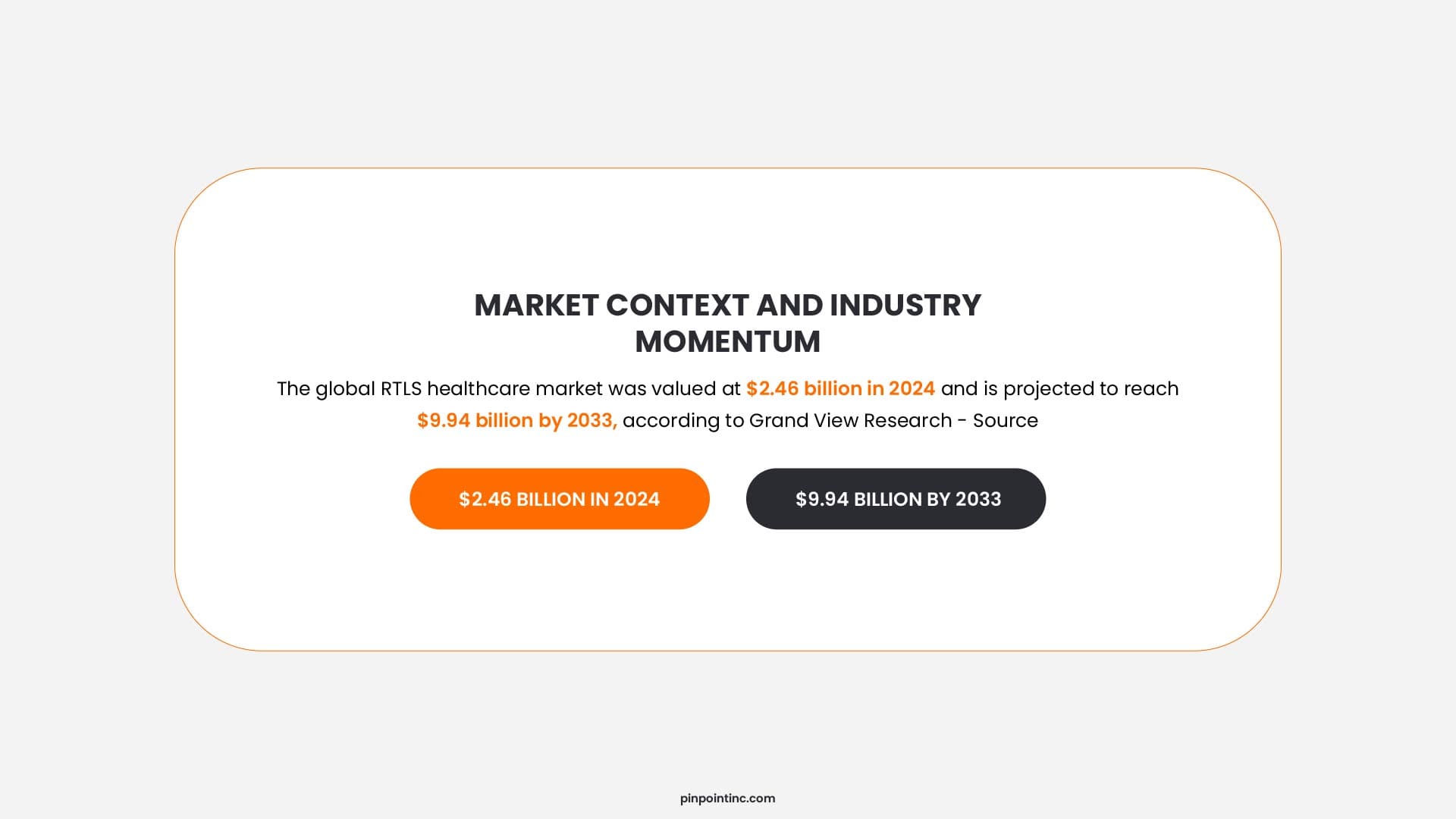
RTLS, is a technology infrastructure designed to continuously track the physical location of tagged objects such as staff badges, patient wristbands, and medical equipment. These systems use technologies like BLE, Wi-Fi, UWB, RFID, or infrared to provide real-time visibility across a healthcare facility.
Because of this, RTLS is widely used in healthcare for asset tracking, patient movement, workflow visibility, and compliance monitoring, it gives healthcare teams continuous insight into where people and equipment are at any given moment.
But this raises an important question.
If both non-tracking and RTLS healthcare systems can deliver the same core staff safety outcome, such as sending alerts and identifying where help is needed, why does RTLS remain the default choice in healthcare?
Because RTLS is already widely associated with tracking assets, patients, and workflows, it often becomes the first system considered during evaluation, even when staff safety does not require continuous visibility.
How Do Non-Tracking Staff Safety Systems Work in Healthcare?
Non-tracking staff duress systems, also called staff duress or panic alert systems, are designed to do one thing well: help staff call for assistance quickly when a situation becomes unsafe. Instead of continuously tracking movement, these systems activate only when a nurse or care worker presses a wearable panic button or fixed duress device.
When triggered, the system sends an immediate alert to responders, security teams, or supervisors. The alert identifies where help is needed, typically at room level, so response teams can act quickly without relying on continuous location history.
This is the key difference in how the two approaches operate. RTLS is built around continuous visibility across people, patients, and assets. Whereas, the non-tracking duress systems focus on the moment that matters: when a staff member needs help.
The underlying technology may use dedicated radio frequencies, supervised hardwired networks, or in-building receivers to deliver alerts without depending on hospital Wi-Fi. That independence reduces risk during network congestion or outages, which is critical in emergency situations.
Industry Insight
RTLS systems in healthcare are effective for tracking and operational visibility, but their real-world success depends heavily on change management, system complexity, and staff adoption. Source
Feature-by-Feature Comparison: Non-Tracking vs RTLS Healthcare Staff Safety
By “feature-by-feature,” we mean the practical factors healthcare buyers compare before choosing a staff safety system. This includes cost, infrastructure, Wi-Fi dependency, staff acceptance, compliance requirements, response performance, deployment timeline, maintenance, system supervision, and best-fit use cases.
The table below compares healthcare RTLS and privacy-first staff duress systems across the dimensions buyers consistently ask about. The “best fit” notes apply specifically to the staff duress use case, not broader asset tracking or patient monitoring scenarios where RTLS may be more appropriate.
Comparison Table
| Dimension | RTLS Systems | Non-Tracking Staff Safety Systems |
|---|---|---|
| Initial Cost (100-bed hospital) | $500,000 to $1M+ for hardware, software, and installation | $40,000 to $150,000 for devices and supervised network |
| Infrastructure Required | Dense BLE, Wi-Fi, or UWB reader network across the facility, often requiring ceiling-mounted hardware | Hardwired supervised network or mesh radio with significantly less infrastructure |
| Wi-Fi Dependency | Often dependent on stable hospital Wi-Fi or cloud connectivity | Operates independently of hospital Wi-Fi using dedicated or hardwired systems |
| Staff Acceptance | May face resistance due to continuous tracking and privacy concerns | Higher acceptance as staff activate alerts only when needed, without continuous tracking |
| HIPAA / Joint Commission Compliance | Higher complexity due to continuous location data and potential PHI exposure; requires careful evaluation | Easier alignment with HIPAA and Joint Commission requirements due to minimal data capture and event-based alerts |
| Response Time (Duress Alert) | Fast response supported by continuous location visibility | Fast response with room-level accuracy sufficient for effective intervention |
| Deployment Timeline | Typically 3 to 12 months depending on facility size, integrations, and change management | Typically 4 to 12 weeks with minimal infrastructure changes required |
| Maintenance Burden | Higher due to battery management across tags, software licensing, and IT oversight | Lower due to supervised systems that self-report faults and use durable infrastructure |
| System Supervision | Varies by vendor; not all systems proactively detect device or coverage failures | Active supervision with systems that alert administrators to faults before they become safety gaps |
| Best Use Case | Asset tracking, patient elopement monitoring, workflow visibility, and operational analytics | Staff duress response, nurse call integration, behavioral health safety, and emergency alerting |
What Does RTLS Actually Cost? The Numbers Vendors Don’t Always Highlight
RTLS pricing is rarely simple. It usually depends on how large your facility is, how much coverage you need, how many people or assets you want to track, and how many systems you want to connect.
That is why two hospitals can ask for RTLS in healthcare and receive very different quotes.
A basic deployment may focus on a smaller area or limited use case. A larger rollout may include facility-wide coverage, staff badges, patient tags, asset tracking, analytics, integrations, and ongoing software support. The more the system is expected to track and manage, the more the cost expands.
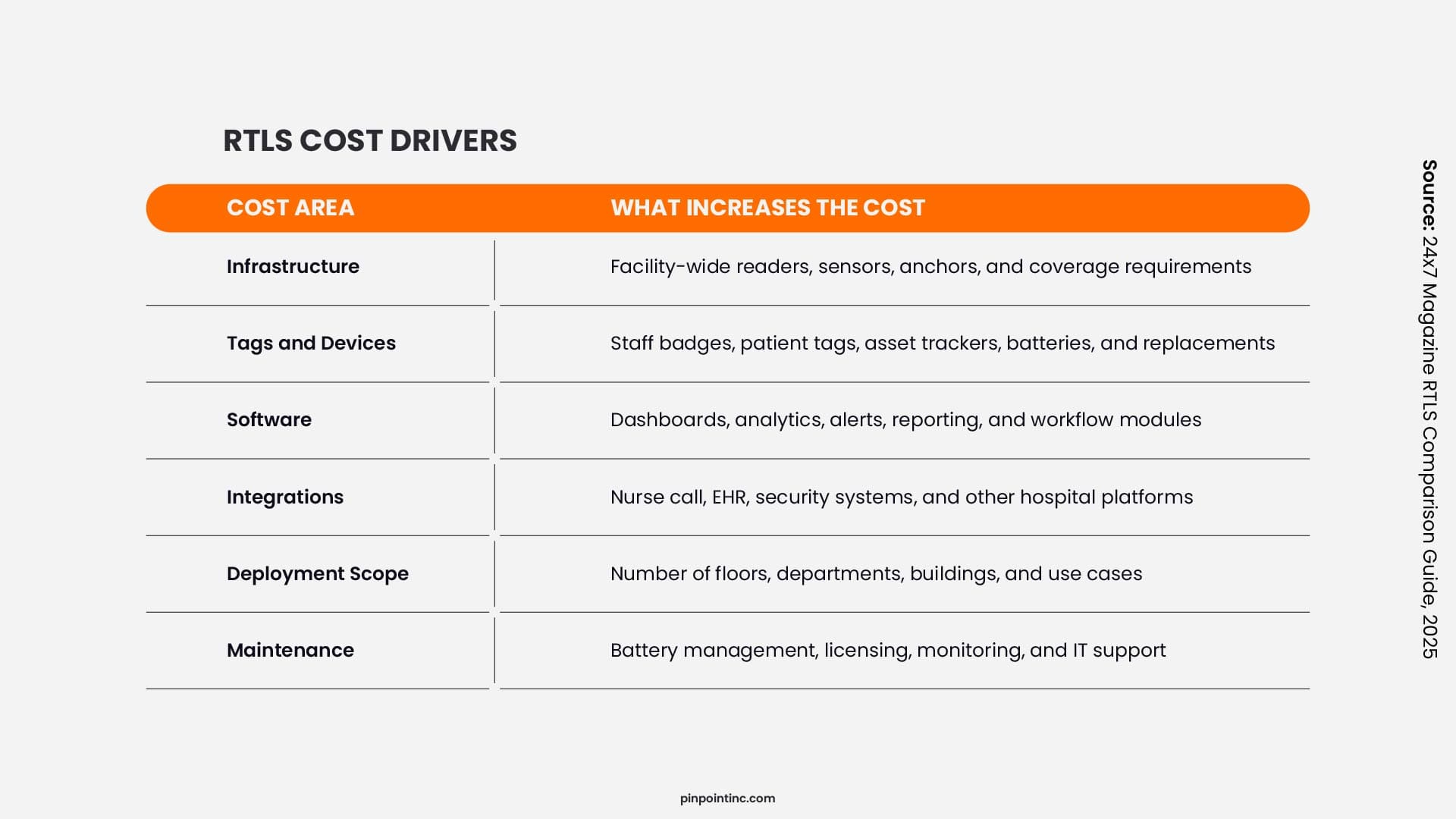
If your goal is full facility visibility, RTLS may make sense but if your goal is to help staff call for help quickly, identify the room, and get responders moving, you may not need the full cost structure of a continuous tracking platform. As the non-tracking staff safety system keeps the investment focused on the safety event itself: who needs help, where help is needed, and how quickly the right people can respond.
Why Staff Acceptance Is the Hidden Problem in RTLS Deployments
An RTLS system only protects staff who are willing to wear it, this may sounds simple, but adoption can become difficult when safety badges also collect continuous location data.
That concern becomes more serious in healthcare, where nurses and frontline staff may worry that location data collected for safety could later be used for timekeeping, productivity monitoring, or disciplinary review. Given the type of data RTLS systems can capture, those concerns are genuine and understandable.
This trust issue becomes even more sensitive in the context of workplace violence. In 2023, 81.6% of nurses reported experiencing at least one type of workplace violence, and 37.2% said violence made them consider leaving the profession. These nurses need to feel protected, not watched or tracked. A system that tracks movement throughout a shift can weaken the trust a safety program is supposed to create.
This is where non-tracking system takes a leverage, staff understand the duress button is only active when they wanted to. There is no continuous location log, no productivity implication, and less concern that safety data could be used outside the emergency context.
That simplicity matters because adoption directly affects protection, a system staff hesitate to wear or use cannot deliver its full safety value.
Did you know the financial impact?
Did You Know The Financial Impact?
Nurse turnover is not just a staffing issue, it carries a real financial impact for hospitals. The 2025 NSI National Health Care Retention Report estimates that replacing a single staff RN cost an average of $61,110 in 2024, and that number continues to rise year over year. In many cases, this adds up to millions in annual losses for a single facility.
HIPAA, OSHA, and Joint Commission: Does Real-Time Location Tracking Create Compliance Risk?
In March 2024, HHS updated its HIPAA guidance on tracking technologies, stating that regulated entities are not permitted to use tracking tools in ways that result in impermissible disclosure of protected health information (PHI).
While this guidance focuses on web-based tracking, it reinforces a broader principle. Data that can be linked to patient care activity, including location-based interactions, may fall under PHI depending on how it is collected, stored, and used.
In RTLS healthcare deployments, this creates an important consideration. When staff location data is recorded in patient care areas, it may be possible to associate that data with treatment events or patient presence. Whether that qualifies as PHI depends on system design and usage, but it introduces a layer of compliance review that healthcare organizations need to evaluate carefully.
This also connects to broader regulatory expectations. OSHA requires employers to provide a safe working environment, including protection from workplace violence, while The Joint Commission emphasizes staff safety, emergency response readiness, and clear incident documentation as part of accreditation standards.
That means the goal is not just to deploy a system, but to ensure it supports safety without introducing unnecessary complexity in compliance, documentation, or data governance.
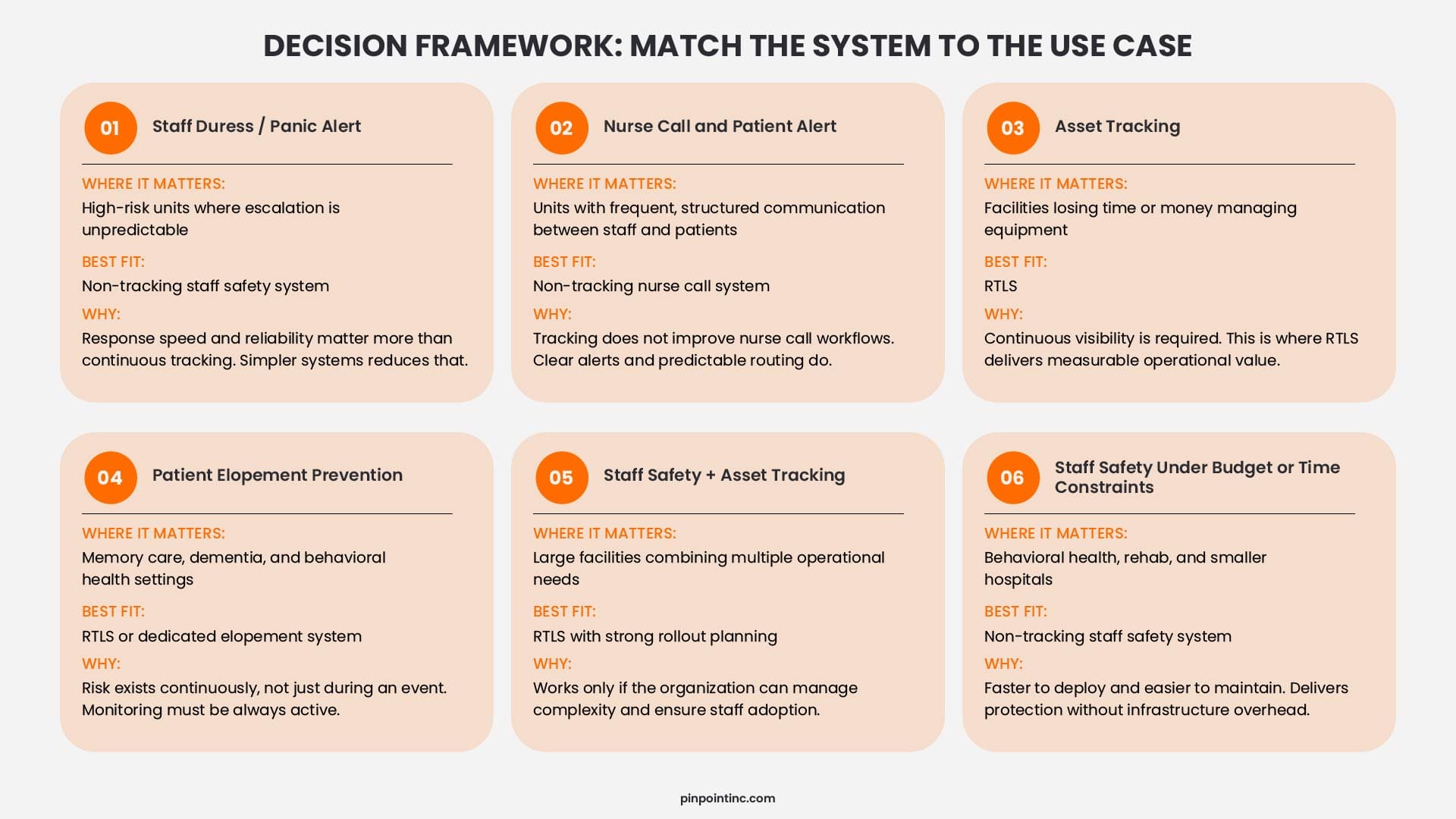
Which System Is Right for Your Facility? Non-Tracking or RTLS Healthcare System
By this point, the comparison is clear. RTLS and non-tracking staff duress systems are often grouped under the same “staff safety” category, but they are solving different problems in very different ways.
RTLS systems are often evaluated as a default because they can cover multiple use cases at once, but that breadth can blur the actual requirement. When the need is staff safety, the goal is not continuous visibility across a shift, it’s making sure a staff member can call for help instantly, the alert is delivered without delay, and responders know exactly where to go. Systems built specifically for that moment tend to perform more consistently because they remove unnecessary layers such as tracking infrastructure, data overhead, and adoption friction.
Closing Words
Workplace violence in healthcare continues to rise, with healthcare workers accounting for 73% of all nonfatal workplace violence injuries in the U.S. The issue is not a lack of technology. It is choosing systems that actually work in high-stress moments.
What we have covered so far is how facilities are trying to address this risk, and how different approaches like RTLS and non-tracking systems solve it in different ways. At this stage, it comes down to what actually fits your environment, your staff, and how response happens in real situations.
We built Pinpoint with that in mind. After working in healthcare environments for over 30 years, we understand the kind of situations staff face and what they need in that moment. Our non-tracking staff duress and panic button system is designed for fast, reliable response, without adding tracking, extra IT dependency, or unnecessary complexity. It is built to support privacy, align with compliance needs, and give facilities full control without relying on third-party systems.
Schedule A Demo To Evaluate Pinpoint For Your Facility
FAQ’s
What's the difference between Non-Tracking vs. RTLS in healthcare system?
RTLS continuously tracks the location of staff, patients, or assets using dense networks of ceiling-mounted readers and wearable tags. Non-tracking systems do not track continuously, they activate only when a staff member presses a button. This event-only approach eliminates continuous location data, reduces privacy concerns, and removes Wi-Fi dependency. Systems like Pinpoint use a supervised hardwired network to deliver room-level alerts with no dead zones. For staff duress specifically, privacy first system requires less infrastructure, costs significantly less, and typically achieves higher staff acceptance because the system stays silent until help is actually needed.
Is a non-tracking staff safety system less expensive than RTLS?
In most staff duress use cases, yes. A non-tracking system is usually less expensive because it does not require the same level of continuous tracking infrastructure, dense reader networks, advanced analytics modules, or broad system integrations.
Does Pinpoint create continuous staff location records?
No. Pinpoint is built around event-based alerting, not continuous tracking. Location is shared when staff activate the duress button. That means facilities get the information needed to respond, without creating a full movement history of staff throughout the shift, ensuring privacy, staff trust, and simpler data governance.
Why Continuous Tracking Creates Ethical and Clinical Tensions?
In behavioral health, continuous location tracking of staff (or patients) raises privacy and therapeutic concerns. Pinpoint’s event-only activation duress system respects patient dignity while giving every staff member a panic and duress option. No surveillance dynamic, just ensure help when needed.
Supervised vs. Unsupervised Staff Safety Systems: What’s the difference?
Most wireless RTLS systems do not self-diagnose. So what happens when a device fails silently? In an unsupervised system, you won’t know until someone presses an emergency button that never transmits. Pinpoint’s supervised hardwired network checks every device and receiver continuously, alerting IT before a coverage gap forms. Unsupervised systems may only fail during an emergency, which is exactly when failure is unacceptable.
What Is a Safety System Dead Zone, and How Does a Supervised Staff Safety System Help Prevent It?
Dead zones are areas where wireless tags lose connectivity, often discovered only after a missed alert. RTLS typically requires dense, costly ceiling-mounted readers to reduce dead zones, not eliminate them. Pinpoint’s supervised network uses dedicated frequencies and hardwired repeaters to deliver no dead zones, no silent failures, and continuous self-testing so every duress button press reaches responders every time.
Does RTLS create HIPAA risk?
Potentially the answer is, yes. When staff location data is recorded in patient care areas, it may be linkable to treatment events or patient presence, which could constitute protected health information (PHI) under HHS guidance. Non-RTLS systems avoid this risk entirely because they capture no continuous location data, only event-based alerts with no persistent tracking history.
- What Is RTLS in Healthcare, and Why Is It Often the Default Choice?
- How Do Non-Tracking Staff Safety Systems Work in Healthcare?
- Feature-by-Feature Comparison: Non-Tracking vs RTLS Healthcare Staff Safety
- What Does RTLS Actually Cost? The Numbers Vendors Don’t Always Highlight
- Why Staff Acceptance Is the Hidden Problem in RTLS Deployments
- Did you know the financial impact?
- HIPAA, OSHA, and Joint Commission: Does Real-Time Location Tracking Create Compliance Risk?
- Which System Is Right for Your Facility? Non-Tracking or RTLS Healthcare System
- Closing Words
- FAQ’s
Author:
Jordan Belous
Chief Marketing Officer of Pinpoint North America, where she leads marketing strategy, brand development, and digital growth initiatives. She earned a Bachelor of Science in Allied Health with a concentration in physical therapy sciences from the University of Tampa, bringing a unique interdisciplinary perspective that blends healthcare knowledge with modern marketing strategy.
Jordan writes about workplace violence prevention in healthcare, nurse safety, staff wellbeing, and emerging healthcare technologies that support frontline teams. Her work explores how hospitals and behavioral health facilities can build safer environments, reduce burnout and turnover, and implement safety systems that protect staff while preserving trust and dignity.
She is also the Chief Executive Officer of Whip Pediatric Cancer, a nonprofit dedicated to supporting children battling cancer and raising awareness and funds for pediatric cancer. Through her work with Whip, Jordan regularly visits pediatric cancer patients in hospitals and spends time alongside patients, families, and the clinicians who care for them. These experiences place her directly beside nurses and healthcare teams every day and reinforce her belief that the people providing care deserve to feel just as safe as the patients they serve.
Her experiences with Whip and her work at Pinpoint are closely connected, both driven by her deep respect for nurses and frontline healthcare workers. Seeing firsthand the compassion, resilience, and critical role nurses play has strengthened her commitment to advocating for safer healthcare environments and ensuring that those who dedicate their lives to caring for others have the protection and support they deserve.