
Wearable vs. Wall-Mounted Panic Buttons: Which Is Better for Your Facility?
Two systems can share the same badge and the same accuracy claim and still behave nothing alike the moment something goes wrong.
In 2025, the U.S. Department of Health and Human Services reported that approximately 192.7 million people were affected by the Change Healthcare breach, making it the largest healthcare hacking breach reported for 2024. The attack’s operational reach was just as striking: an American Hospital Association survey found that 74 percent of hospitals reported a direct impact on patient care. Separately, Microsoft has cited industry research estimating that healthcare organizations can lose up to $900,000 per day from ransomware-related downtime.
Those numbers raise a less obvious question: what do hospital network failures have to do with the panic button a nurse reaches for during an emergency? More than the device itself might suggest. The basic differences between wearable and fixed duress systems explain where each form factor fits, but that is only the visible part of the decision. Form factor tells you whether the button can be reached. It does not tell you what the alert depends on after it is pressed.
That is where the technology starts to look very different. Coverage, infrastructure dependency, location precision, tracking mode, supervision, and response workflow can separate two systems that appear almost identical on the surface. Understanding those layers reveals why choosing a panic button is really a question of how the entire safety architecture behaves when conditions are least predictable.
Key Takeaways
- Choosing between wearable and wall-mounted panic buttons is only the first decision. Coverage, infrastructure dependency, tracking mode, supervision, and response workflow decide whether the system actually works during an incident.
- A dedicated, hardwired alert network avoids sharing fate with the hospital’s general Wi-Fi, the same network exposed to the outages and disruptions documented in recent healthcare cyber incidents.
- Event-triggered location meets a responder’s real need. Continuous RTLS tracking solves a different problem and typically takes longer to deploy.
- Identifying the best panic button type for a given unit is a documented process now, not a preference. Joint Commission workplace violence requirements have expanded in stages since 2022 and apply broadly as of January 2026.
Where Can Panic Button Coverage Break Down?
Installed is not the same as reachable. A hospital can mount panic buttons in every corridor and still leave staff exposed, because coverage depends on where people are standing when something goes wrong, not on where the hardware was placed during construction.
A fixed button protects a location. The moment a staff member steps away from that spot, into a patient room, a supply closet, a stairwell, or a parking structure, the button stops being useful to them. Risk is also not distributed evenly. National Nurses United’s 2025–2026 survey found that 84.8 percent of nurses reported experiencing at least one type of workplace violence in the past year, and psychiatric aides continue to record the highest violence injury rate of any occupation the Bureau of Labor Statistics tracks. That kind of gap is exactly why the choice between wearable and wall-mounted panic buttons matters more in behavioral health units than at a reception desk.
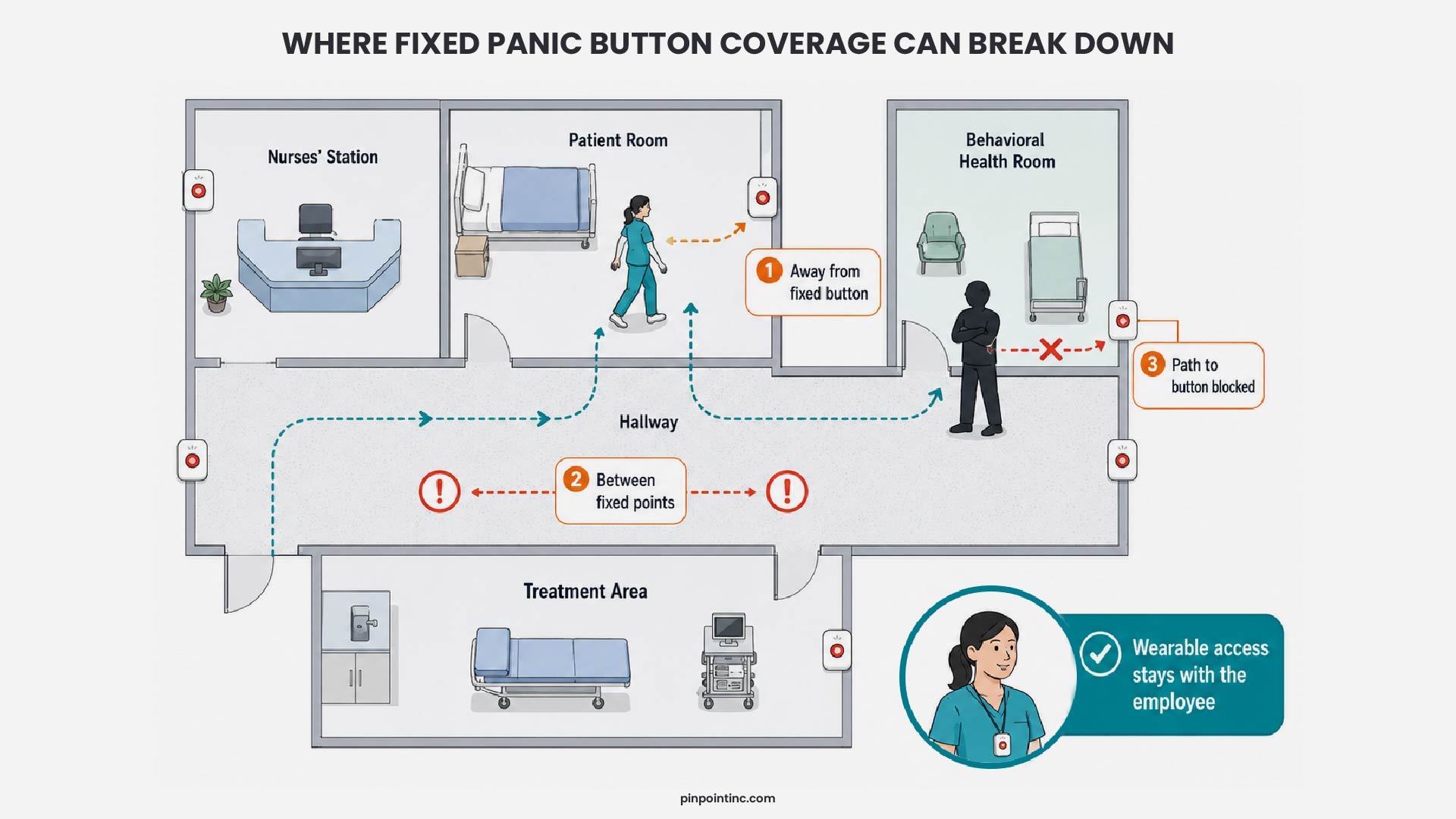
Coverage gaps tend to cluster in predictable places: patient rooms where staff work one-on-one with someone who is escalating, hallways and transition zones between units, treatment areas without a fixed console nearby, and behavioral health spaces where layout rules out mounting a device within easy reach. Access can also be blocked mid-incident. A staff member positioned between a patient and the door may not be able to reach a button a few feet away.
The useful test for coverage is not how many buttons were installed. It is whether staff can activate help everywhere risk can realistically occur, based on how they actually move through a shift.
When Do Fixed Buttons Work, and When Do Wearables Make More Sense?
That gap points toward an answer, but the right choice still depends on the role and how staff move through the facility. Different panic button types and use cases suit different risk patterns, from fixed protection around predictable work areas to wearable access for staff who move between rooms and departments. For this comparison, the key question is whether the alert remains within reach when risk moves with the employee.
Fixed buttons work well at predictable, stationary risk points: reception desks, security checkpoints, controlled entrances, medication dispensaries, and any location where the person facing risk is reliably at that desk or counter when trouble starts. Installation is straightforward, there is no device to charge or misplace, and staff do not need to remember to wear anything.
Wearables make more sense for mobile roles, which describes most clinical staff. Nurses, techs, and aides move between rooms and departments constantly, and the moment that calls for an alert rarely happens at a fixed console.
Fixed buttons protect locations. Wearables keep alert access with the employee.
Most hospitals do not choose one architecture exclusively. Reception and high-traffic entry points typically keep fixed buttons, while direct patient care roles are issued wearables. Deciding between wearable and wall-mounted panic buttons for a given role is not about declaring a single winner between the two form factors. It is about matching each role’s actual movement pattern to the device that can still be reached when it is needed.
Why Does the Infrastructure Behind a Panic Button Matter?
Pressing the button is the easy part. What happens next depends entirely on what carries that signal from the badge to a responder, and that is where most panic button evaluations stop looking too soon.
Many systems route alerts through the hospital’s general Wi-Fi or cellular network, the same infrastructure carrying clinical documentation, imaging traffic, guest devices, and dozens of other systems competing for bandwidth. That’s reasonable for most hospital technology, but riskier for a life-safety system, since duress alerts end up sharing fate with whatever else is happening on that network.
192.7M
People affected by the 2024 Change Healthcare ransomware attack, according to an HHS update reported in 2025. It became the largest healthcare data breach in U.S. history and showed how disruption to shared healthcare infrastructure can spread across the sector.
Reducing reliance on shared hospital IT infrastructure reduces the number of dependencies that could affect alert delivery at the exact moment it matters most. A dedicated, purpose-built safety network, hardwired receivers and alert infrastructure that exist specifically to carry duress signals, is not affected by what is happening on the clinical Wi-Fi and does not go down when a network switch fails or an IT team pushes a maintenance window. This doesn’t mean Wi-Fi-based systems are unsafe, or that a dedicated network eliminates every failure point. It means fewer shared dependencies for a hospital to account for when mapping its own risk.
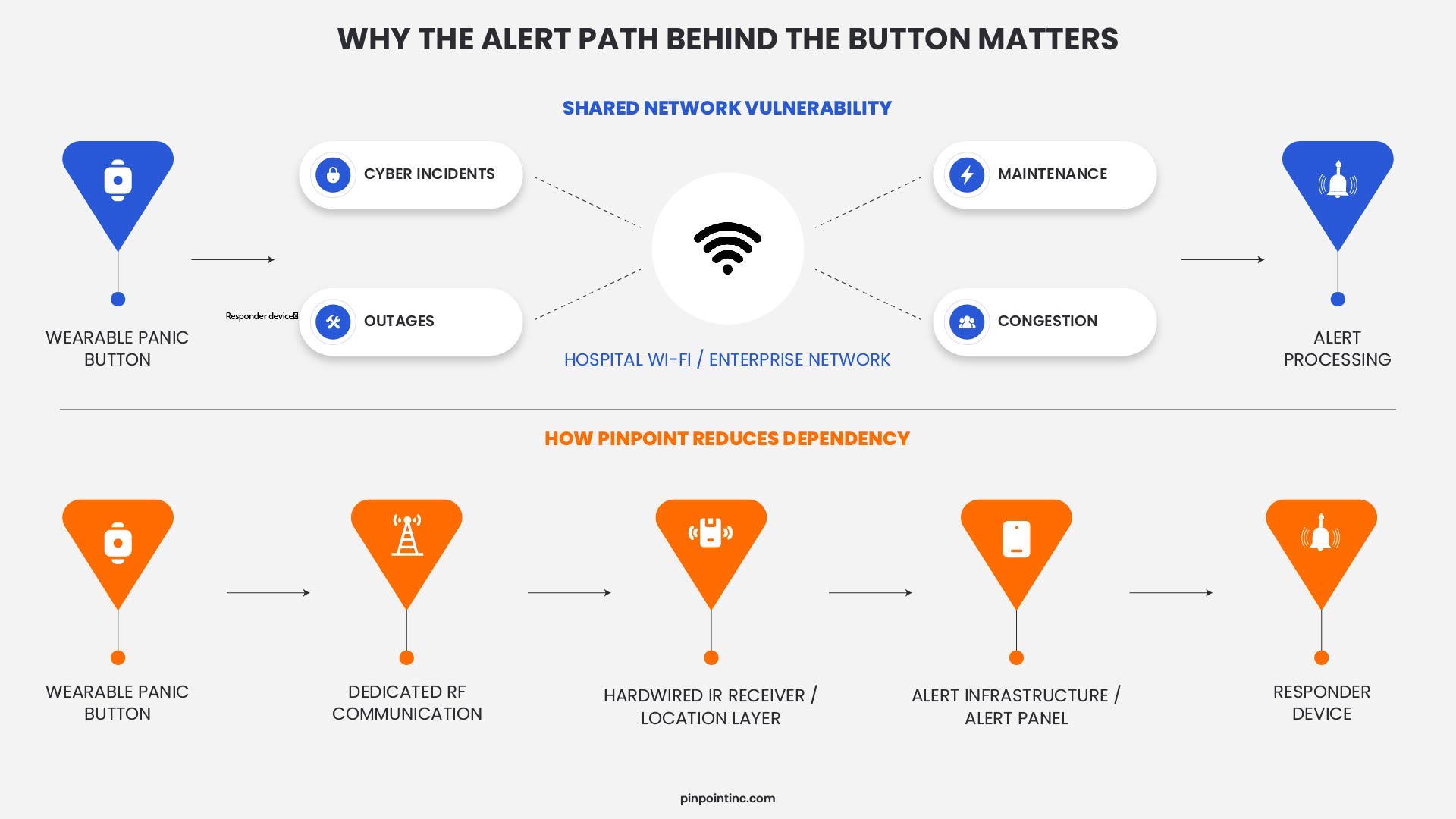
Coverage design follows the same logic. A dedicated safety network can be engineered around the building itself rather than layered onto existing Wi-Fi, then validated against the areas where staff actually face risk. The trade-offs become clearer when comparing RTLS alternatives for hospital staff safety, while those same infrastructure decisions also shape the cost of a healthcare panic button system over time.
Does Useful Location Require Continuous Staff Tracking?
Location matters once an alert fires. Whether it requires tracking someone throughout their entire shift to get there is a separate question, and the two get conflated more often than they should. Location precision is one more factor in identifying the best panic button type for a specific unit, alongside coverage and infrastructure.
What a responder actually needs is a single, actionable data point at the moment help is requested: which room, which bay, which hallway. That is generated by the act of pressing the button, not by a running record of everywhere the staff member has been since clocking in. An event-triggered system produces exactly that: no location data exists until an alert is activated.
Continuous movement history solves a different problem. Real-time location systems, or RTLS, track tagged staff, equipment, or patients constantly, which is genuinely useful for workflow analytics or patient-flow visibility. But “where has this employee been throughout the shift” is not the same project as “where does this employee need help right now,” and the more complex system built to answer the simpler question also tends to take longer to get live.
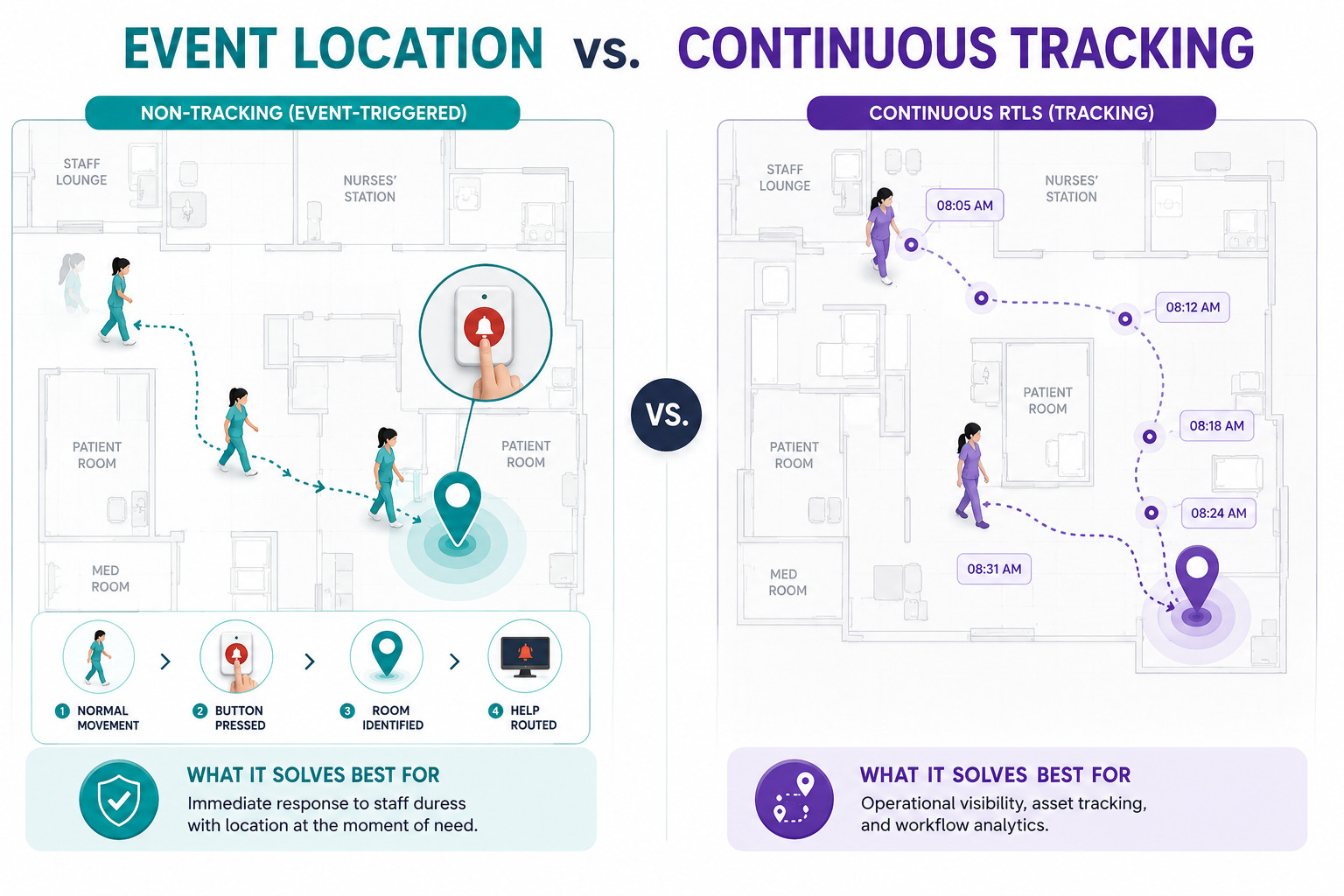
RTLS still earns its place where continuous visibility is the actual requirement, such as tracking high-value equipment across a campus. Staff duress solves a different problem: responders need to know where help is required when an alert is activated, not where someone has been throughout the shift. That distinction between RTLS and non-tracking staff safety systems helps clarify when each approach makes sense.
What Should Happen After Someone Presses the Button?
Activation is only the start of the response chain. Hospitals should also evaluate what happens between the button press and the moment help arrives.
A useful alert should tell responders two things quickly: where the incident is happening and how urgent it is. Systems with more than one alert level can distinguish an early request for assistance from a full panic event, giving staff a way to call for backup before a situation escalates further.
How that alert reaches responders matters too. Mobile notifications, desktop alerts, and on-site displays can provide multiple paths for the same event, reducing reliance on a single notification channel.
That response chain also depends on knowing the system is ready before an emergency occurs. A supervised system can monitor components such as badges, receivers, and display units for faults or connectivity issues, which is why supervision matters in life-safety systems. Reliability also affects the wider staff experience. In environments where employees already operate under persistent low-level pressure, understanding ambient stress in healthcare helps explain why confidence in the systems around them matters.
What Should You Compare Before Choosing the Best Panic Button Type?
Comparing panic button systems by form factor alone skips most of what determines whether a system performs during an actual incident. The table below sequences the questions this article has walked through into a single evaluation framework for identifying the best panic button type for any given role or zone, one a safety committee can work through with any vendor shortlist.
| Factor | Question to Ask |
|---|---|
| Reachability | Can staff activate it wherever risk occurs? |
| Form factor | Is the employee stationary or mobile? |
| Coverage | Are required areas protected? |
| Trigger | How is the alert activated? |
| Location precision | What does the responder know? |
| Signal infrastructure | What carries the alert? |
| IT dependency | Which shared systems must remain available? |
| Tracking mode | Event-triggered or continuous? |
| Supervision | Can system faults be identified? |
| Response workflow | Who receives the alert and what happens next? |
A hospital that works through these questions in order, reachability first, response workflow last, ends up choosing the best panic button type for how it performs during an incident, not for how it looks in a vendor demo.
There is also a compliance dimension to this timing. The Joint Commission’s workplace violence prevention requirements did not arrive all at once: coverage expanded from hospitals and critical access hospitals in January 2022, to behavioral health and human services organizations in mid-2024, to assisted living, nursing care, and office-based surgery in mid-2025, and now requires a documented program at all accredited hospitals under NPG.02.04.01 as of January 2026. None of these standards mandate a specific technology. All of them expect a documented, defensible evaluation process, which is exactly what the framework above is for.
How Does Pinpoint Address These Requirements?
Applying that framework to Pinpoint’s own architecture, and to the more than 30 years the company has spent building duress and de-escalation infrastructure for healthcare and behavioral health settings.
Pinpoint’s wearable badge gives staff deliberate, on-body access to two distinct alert levels, a de-escalation request and a panic alert, so the system reflects how situations actually escalate rather than forcing a binary choice. The badge functions alongside a staff member’s existing ID, requiring no new habit beyond what they already carry through a shift.
For hospitals still weighing wearable vs. wall-mounted panic buttons at all, Pinpoint’s architecture answers that question by pairing a wearable badge with hardwired detection, so mobility and infrastructure independence are not a tradeoff. When pressed, the badge communicates by infrared to hardwired receivers installed throughout the facility, which is what produces room-level event location: the system identifies which room the signal came from because of how the detection hardware works, not because it has been monitoring the staff member’s movement beforehand. Location data is generated only at the moment of activation. Outside of that moment, Pinpoint does not track where staff are, which is the distinction behind describing it as a non-tracking, event-triggered system rather than an RTLS platform.
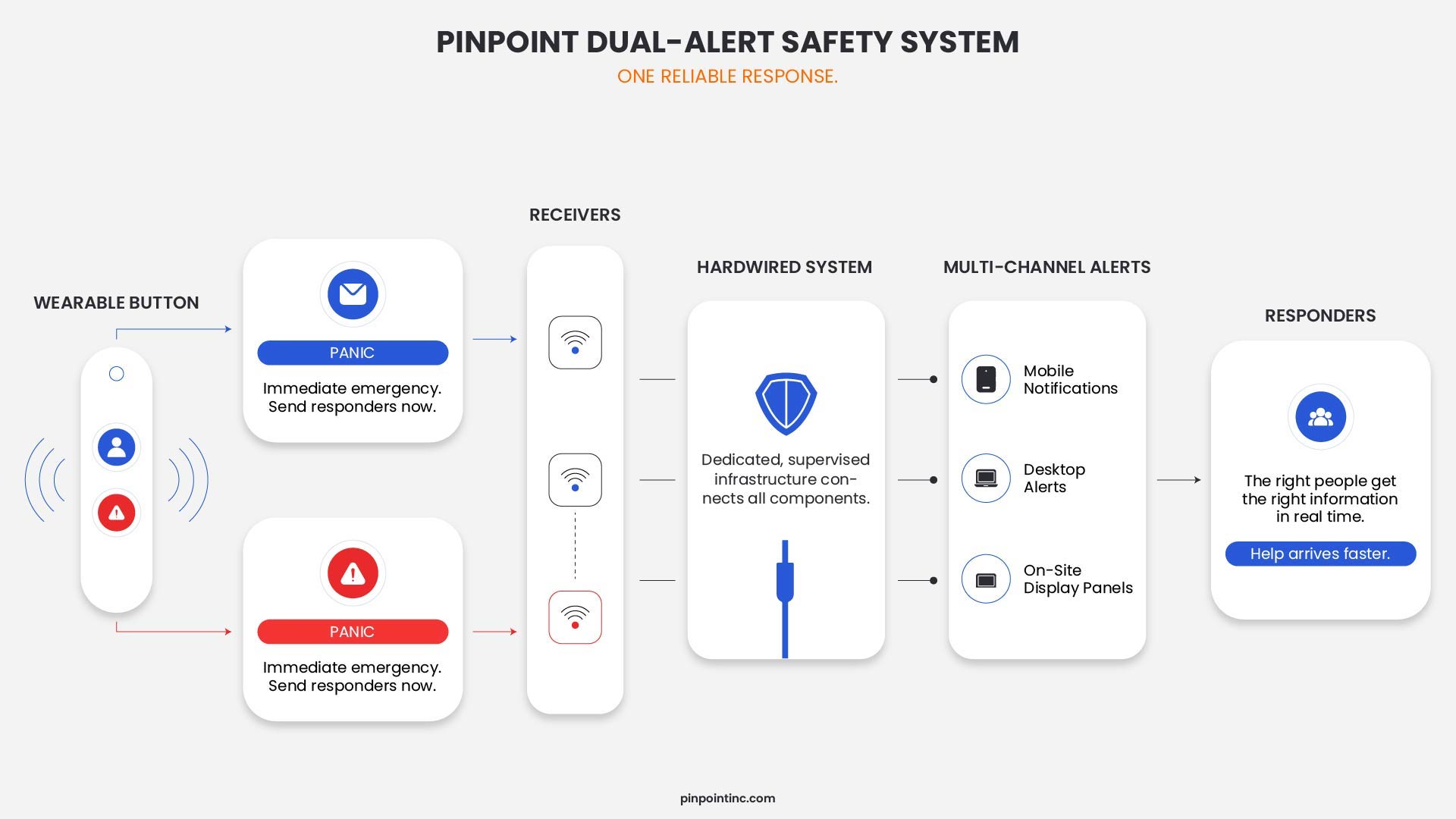
The infrastructure carrying that signal is dedicated to safety, not layered onto the hospital’s general Wi-Fi. Receivers and display panels run on Pinpoint’s own hardwired network, so a clinical network outage or a routine IT maintenance window does not interrupt the critical alert path. Once triggered, alerts reach responders through multiple channels at once, in under 85 milliseconds, giving security and clinical response teams the location and the alert level immediately.
The network is also supervised. Badges, receivers, and display units are continuously checked for connectivity and fault, so a failing component gets flagged to administrators before it becomes a coverage gap discovered mid-incident. Coverage itself is engineered around a facility’s actual floor plan and validated during deployment rather than assumed from a spec sheet. How this architecture supports a broader prevention program is covered in a wider look at workplace violence prevention in healthcare.
The Decision Comes Down to Architecture, Not Form Factor
The wearable-versus-wall-mounted question is a reasonable starting point, but it is not the decision that determines whether a panic button system holds up during a real incident. That comes down to whether coverage matches how staff actually move, whether the infrastructure survives a network problem, whether location data reaches responders without continuous tracking, whether the system flags a failed component, and whether the response workflow gets people to the room quickly. Buyers who treat this as a search for the best panic button type, not just a form-factor pick, end up with an architecture built for dependability.
Next Step
See the Architecture Against Your Own Floor Plan
Pinpoint has spent more than 30 years building staff-safety infrastructure for hospitals and behavioral health facilities.
See how the architecture holds up against your own floor plan, coverage gaps, and response workflow.
Walk your building and map where coverage actually needs to reach.
FAQ’s
What is the best panic button type for mobile healthcare staff?
A wearable badge, since coverage needs to follow the person rather than stay tied to a fixed location. Staff in direct patient care roles move between rooms constantly, and a device that has to be reached rather than worn will eventually be out of range when it matters.
Can a hospital panic button system work without Wi-Fi?
Yes. Systems built on dedicated, hardwired infrastructure do not depend on the hospital’s general Wi-Fi or cellular network to deliver an alert, which reduces exposure to the network outages, congestion, and maintenance windows that regularly affect hospital IT systems.
How do hospitals identify panic button coverage gaps?
By walking actual staff workflows rather than counting installed devices, mapping where incidents tend to occur, patient rooms, transition zones, behavioral health units, against where staff can currently activate an alert, and validating coverage against the real floor plan during deployment.
Do wearable panic buttons continuously track employees?
Not necessarily. Non-tracking, event-triggered systems generate location data only at the moment a button is pressed. Continuous tracking is a separate design choice associated with RTLS, built for a different use case than staff duress response.
Can wearable and wall-mounted panic buttons work together?
Yes. Many facilities layer wearable and wall-mounted panic buttons together, fixed devices at predictable, stationary risk points like reception desks or medication rooms, and wearable badges for mobile clinical staff, rather than choosing one architecture exclusively.
- Key Takeaways
- Where Can Panic Button Coverage Break Down?
- When Do Fixed Buttons Work, and When Do Wearables Make More Sense?
- Why Does the Infrastructure Behind a Panic Button Matter?
- Does Useful Location Require Continuous Staff Tracking?
- What Should Happen After Someone Presses the Button?
- What Should You Compare Before Choosing the Best Panic Button Type?
- How Does Pinpoint Address These Requirements?
- The Decision Comes Down to Architecture, Not Form Factor
- FAQ’s
Author:
Jordan Belous
Chief Marketing Officer of Pinpoint North America, where she leads marketing strategy, brand development, and digital growth initiatives. She earned a Bachelor of Science in Allied Health with a concentration in physical therapy sciences from the University of Tampa, bringing a unique interdisciplinary perspective that blends healthcare knowledge with modern marketing strategy.
Jordan writes about workplace violence prevention in healthcare, nurse safety, staff wellbeing, and emerging healthcare technologies that support frontline teams. Her work explores how hospitals and behavioral health facilities can build safer environments, reduce burnout and turnover, and implement safety systems that protect staff while preserving trust and dignity.
She is also the Chief Executive Officer of Whip Pediatric Cancer, a nonprofit dedicated to supporting children battling cancer and raising awareness and funds for pediatric cancer. Through her work with Whip, Jordan regularly visits pediatric cancer patients in hospitals and spends time alongside patients, families, and the clinicians who care for them. These experiences place her directly beside nurses and healthcare teams every day and reinforce her belief that the people providing care deserve to feel just as safe as the patients they serve.
Her experiences with Whip and her work at Pinpoint are closely connected, both driven by her deep respect for nurses and frontline healthcare workers. Seeing firsthand the compassion, resilience, and critical role nurses play has strengthened her commitment to advocating for safer healthcare environments and ensuring that those who dedicate their lives to caring for others have the protection and support they deserve.