
How Much Does a Healthcare Panic Button System Cost? A Complete Buyer’s Guide

For many healthcare leaders, staff safety used to sit inside broader facilities, security, or compliance planning. That has changed. As workplace violence becomes a more visible operational and workforce issue, the panic button system is no longer just a safety accessory. It is becoming part of a larger conversation around risk, retention, response time, and the true cost of protecting clinical teams.
The challenge for buyers is that pricing in this category is rarely published, and systems vary enormously in scope. A 50-bed clinic and a 600-bed hospital network are not buying the same thing, even if both call it a “panic button system.” This guide breaks down the real cost structure, what drives it up or down, and where hidden expenses tend to surface, using a practical equipment and installation breakdown alongside current market data.
Why Wearable Panic Button Systems Are Becoming a Healthcare Budget Priority
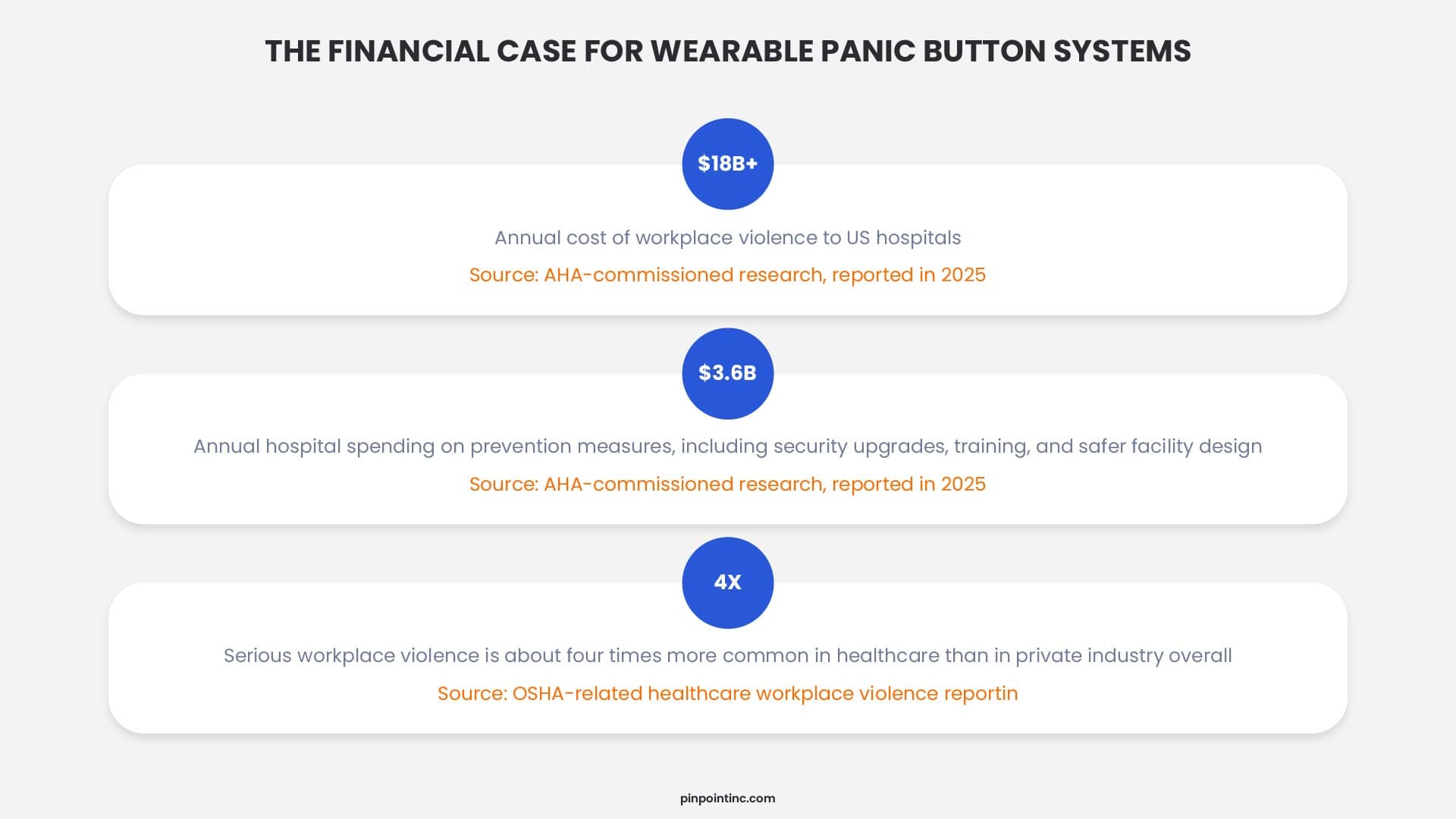
Workplace violence is no longer just a security concern for hospitals. It is a financial, compliance, and workforce safety issue. That is why many buyers are looking beyond fixed wall buttons and mobile apps toward wearable panic button systems that stay with staff during a shift. In patient rooms, hallways, behavioral health units, and emergency departments, staff may not be near a desk, wall button, or unlocked phone when a situation escalates.
The Three Cost Layers Behind a Healthcare Panic Button System
Pricing in this category is often discussed around hardware, but that only tells part of the story. For healthcare buyers, the real budget usually includes three layers: direct costs, indirect costs, and cultural costs. Each layer affects the total value of the system, especially when the goal is to protect staff across patient rooms, hallways, behavioral health units, and emergency departments.
Direct Costs
Direct costs are the visible expenses that usually appear on a quote. These may include wearable badges, room receivers, overdoor lights, sounders, displays, reset keys, core infrastructure, installation, cabling, and first-year setup or support.
Indirect Costs
Indirect costs are the operational expenses that show up after deployment. These may include maintenance time, battery management, IT support, troubleshooting, software updates, compliance reporting, disposal requirements, and future expansion.
Cultural Costs
Cultural costs are harder to measure but important in healthcare. They include staff trust, privacy concerns, adoption, morale, retention, and confidence in leadership. A system can look affordable on paper but lose value if staff do not wear it, trust it, or feel comfortable using it during a real incident.
Wearable Panic Button Direct Cost Breakdown
Direct costs are the visible expenses that usually appear first in a panic button system quote. For healthcare buyers, these typically include equipment, installation, cabling, setup, and initial support. In a smaller healthcare deployment covering roughly 10 rooms, first-year direct costs may fall in the range of $25,000 to $35,000, depending on room count, building layout, wiring access, infrastructure requirements, and system design.
What surprises many buyers is how the cost is distributed. The wearable badge may be the most visible part of the system, but it is rarely the largest budget item. In many small clinical deployments, equipment may account for roughly 40 to 45 percent of direct cost, installation around 30 to 35 percent, and cabling around 25 to 30 percent.
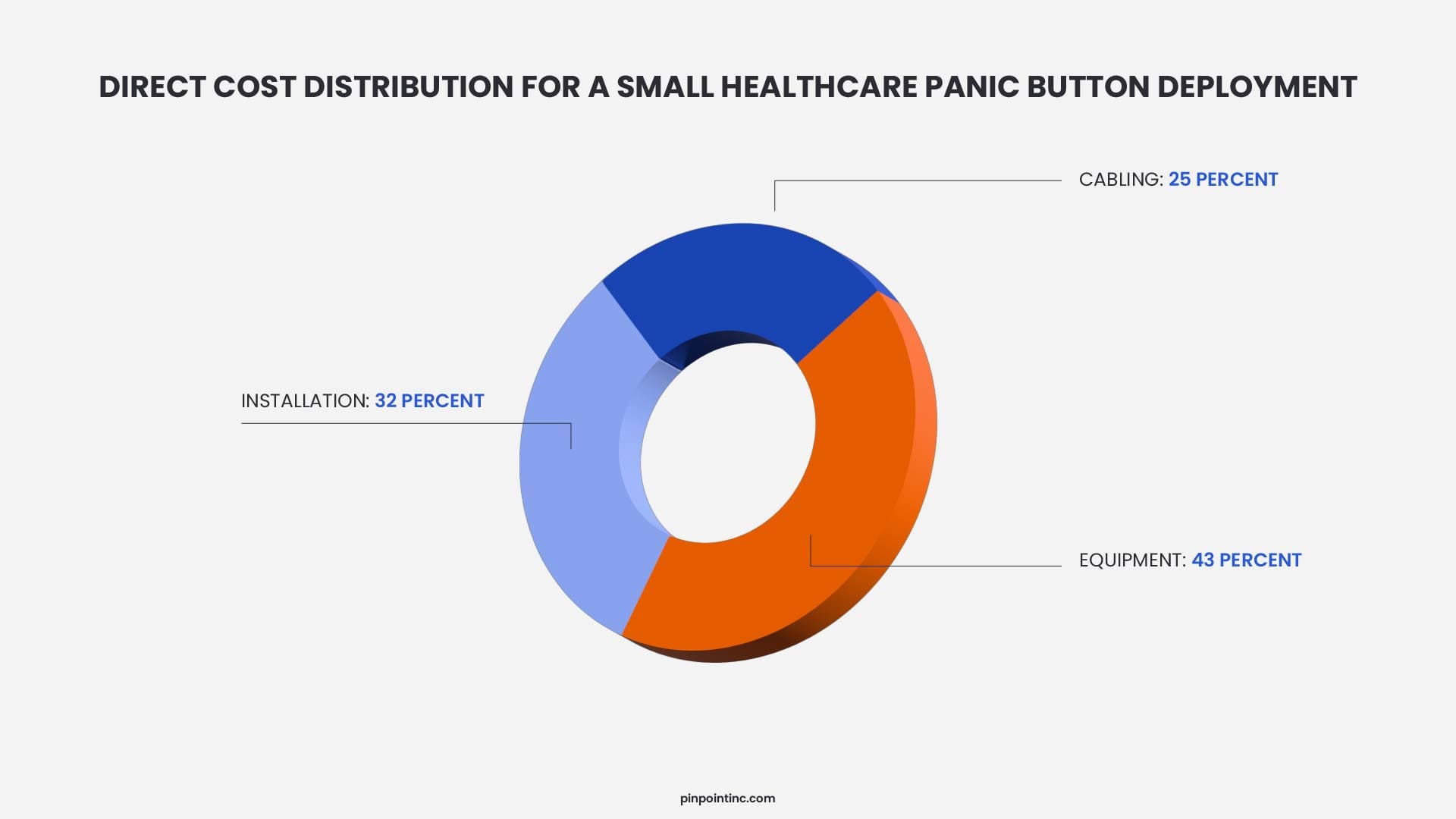
This should be framed as an illustrative healthcare deployment model, not an all-industry benchmark. Actual percentages can shift based on building age, ceiling access, conduit availability, room count, and whether the system is being installed in a new facility or retrofitted into an older clinical environment.
Equipment usually includes the physical components needed to trigger, receive, and display a duress alert. This may include wearable badges, room receivers, overdoor lights, sounders, a central display, reset hardware, and core infrastructure. For a smaller deployment, equipment alone may land around $11,000 to $16,000, with core infrastructure often representing the largest share because it supports the system beyond one room or one badge.
Installation and cabling are the next major cost areas. Installation covers mounting, wiring preparation, configuration, testing, and making sure alerts route correctly. Cabling covers the physical wiring needed to connect system components across covered areas. For a small deployment, installation may range from $8,000 to $12,000, while cabling may range from $6,500 to $10,000.
This is why buyers should be careful when comparing quotes. A lower-looking price may only include badges or software access, while another quote may include the infrastructure, room devices, installation, cabling, and first-year support required to make the system work from day one. The better comparison is not badge price alone. It is the complete direct-cost picture.
Indirect Costs: The Hidden Expenses Behind Staff Safety Technology
Indirect costs are the expenses that do not always appear clearly in the first quote, but they shape the long-term cost of a wearable panic button system. These costs usually come from maintenance workload, battery management, IT involvement, compliance exposure, legal risk, staff turnover, environmental disposal, reputation, and patient experience.
A lower upfront price can become more expensive over time if the system needs constant attention after installation. For example:
Maintenance
Some staff safety systems require ongoing maintenance personnel to keep devices active, charged, updated, and ready. That creates a recurring labor cost that may not be listed in the vendor quote.
A self-sustaining system can reduce this burden because it does not require the same level of daily oversight. For healthcare teams, this matters because facilities, security, and operations staff already have competing responsibilities. A system that needs frequent manual checks may add hidden workload every week.
Battery Management
Battery management is one of the easiest indirect costs to underestimate. Some wearable devices use batteries that run constantly, need daily charging, or require frequent replacement. That means someone must collect devices, charge them, track missing badges, replace batteries, and confirm readiness before each shift.
Long-life batteries reduce this operational drag. If batteries last several years and activate only when the badge is pressed, the facility spends less time managing device readiness. Self-testing also helps staff confirm functionality without depending on a maintenance team for every check.
This matters because an uncharged or untested badge is not only a maintenance issue. It can become a safety risk during an actual incident.
IT Overhead
IT overhead can become a major hidden cost when a system depends heavily on Wi-Fi, mobile apps, software updates, network troubleshooting, or complex integrations.
In a hospital, IT teams are already responsible for clinical systems, security infrastructure, user access, connectivity, cybersecurity, and compliance-related systems. A panic button solution that creates regular IT tickets can become costly even if the vendor quote looks affordable. Systems with minimal IT involvement free internal teams to focus on higher-priority technology work.
Weighing hardwired vs. wireless?
See how reliability, IT burden, and long-term cost compare between hardwired and wireless panic buttons for hospitals.
Non-Compliance Fines
Compliance risk is another indirect cost. Hospitals and healthcare facilities are under increasing pressure to document workplace violence prevention efforts, incident response processes, and staff safety controls.
A system that supports compliance documentation can reduce administrative burden and help leadership show OSHA and The Joint Commission that safety risks are being addressed. Limited documentation, inconsistent records, or unclear reporting can create more work during audits, reviews, or post-incident investigations.
The risk is not only the possibility of a fine. It is the time, paperwork, corrective action, legal review, and leadership attention that can follow when documentation is incomplete.
Lawsuits
Legal exposure is not always easy to price, but it belongs in the cost discussion. If a staff member experiences violence and the facility cannot show reasonable prevention measures, reliable response tools, or clear incident records, the organization may face higher risk.
A panic button system does not eliminate lawsuits by itself. But a reliable system with proactive safety measures, clear alert routing, and event documentation can reduce gaps that become costly later.
Buyers should look closely at whether alerts are logged, whether response activity can be reviewed, and whether the system helps leadership understand what happened after an incident.
Nurse Turnover
Staff safety directly affects retention. Nurses and frontline workers are less likely to stay in an environment where they feel unsupported, unsafe, or ignored. Turnover creates financial pressure through recruiting, onboarding, temporary staffing, overtime coverage, lost productivity, and the loss of experienced clinical judgment.
The value is not only the alert itself. It is the confidence staff feel knowing they have a direct way to call for help. For leadership teams building the business case, it is useful to estimate what nurse turnover is already costing the facility before comparing safety technology options. Even a modest improvement in retention can change how the investment looks over a three- to five-year period.
E-Waste
Device and battery disposal can also create indirect costs. Some systems rely on battery types that require special disposal under state or local guidelines. Over time, especially across hundreds of staff devices, disposal can become an operational and compliance task.
Battery design matters here. Safer, longer-life battery options can reduce both replacement frequency and disposal complexity. This is usually not the largest cost in the buying decision, but it is still worth asking about. Buyers should understand what happens when batteries or devices reach the end of their life.
Reputation
Workplace violence also affects reputation. A facility known for poor staff safety may struggle with recruitment, retention, employee trust, and public perception. Safety failures can also influence how staff talk about leadership, whether candidates want to join, and how confident patients and families feel inside the facility.
Investing in reliable de-escalation and duress technology can support a stronger safety culture and show that leadership is taking staff concerns seriously.
Patient Satisfaction
Staff safety and patient experience are connected. When staff do not have a safe way to call for help during escalation, teams may rely on more disruptive interventions or respond later than ideal.
A safer staff environment can also create a calmer patient environment. When teams feel supported, they are better positioned to focus on care, communication, and de-escalation.
Cultural Costs: Privacy, Trust, Morale, and Staff Adoption
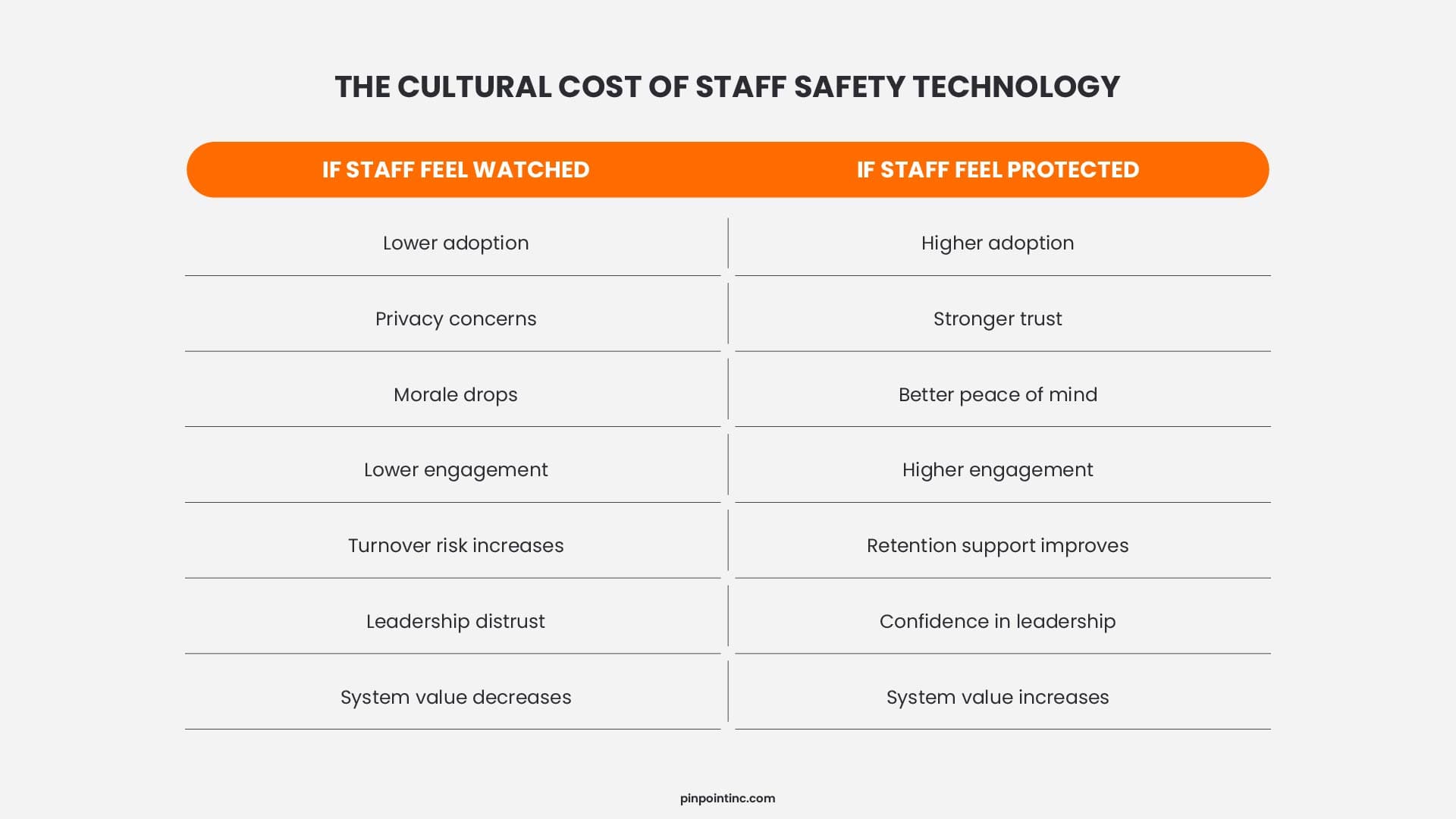
Cultural costs are the human factors that determine whether a wearable panic button system actually gets used. A system can be technically strong, but if staff feel tracked, watched, or unsure whether it will work, adoption drops.
The biggest cultural concern is privacy. Systems that rely on continuous staff location tracking can create a “Big Brother” feeling among nurses and frontline teams. That can affect morale, trust in leadership, engagement, and even turnover risk if staff feel safety technology is being used to monitor productivity, breaks, or movement patterns.
A stronger cultural fit is a system that gives staff a fast way to call for help while preserving autonomy. When staff feel protected without feeling watched, the system can support peace of mind, better morale, stronger engagement, higher adoption, and more confidence in leadership’s commitment to safety.
Cost by System Type: Wearable vs Fixed vs RTLS
Not every facility needs the same architecture, and the cost differences between system types are substantial enough to shape the entire budget conversation. Before comparing vendors, it helps to understand what a panic button system actually includes depending on use case, since a behavioral health unit and a standalone outpatient clinic have very different requirements.
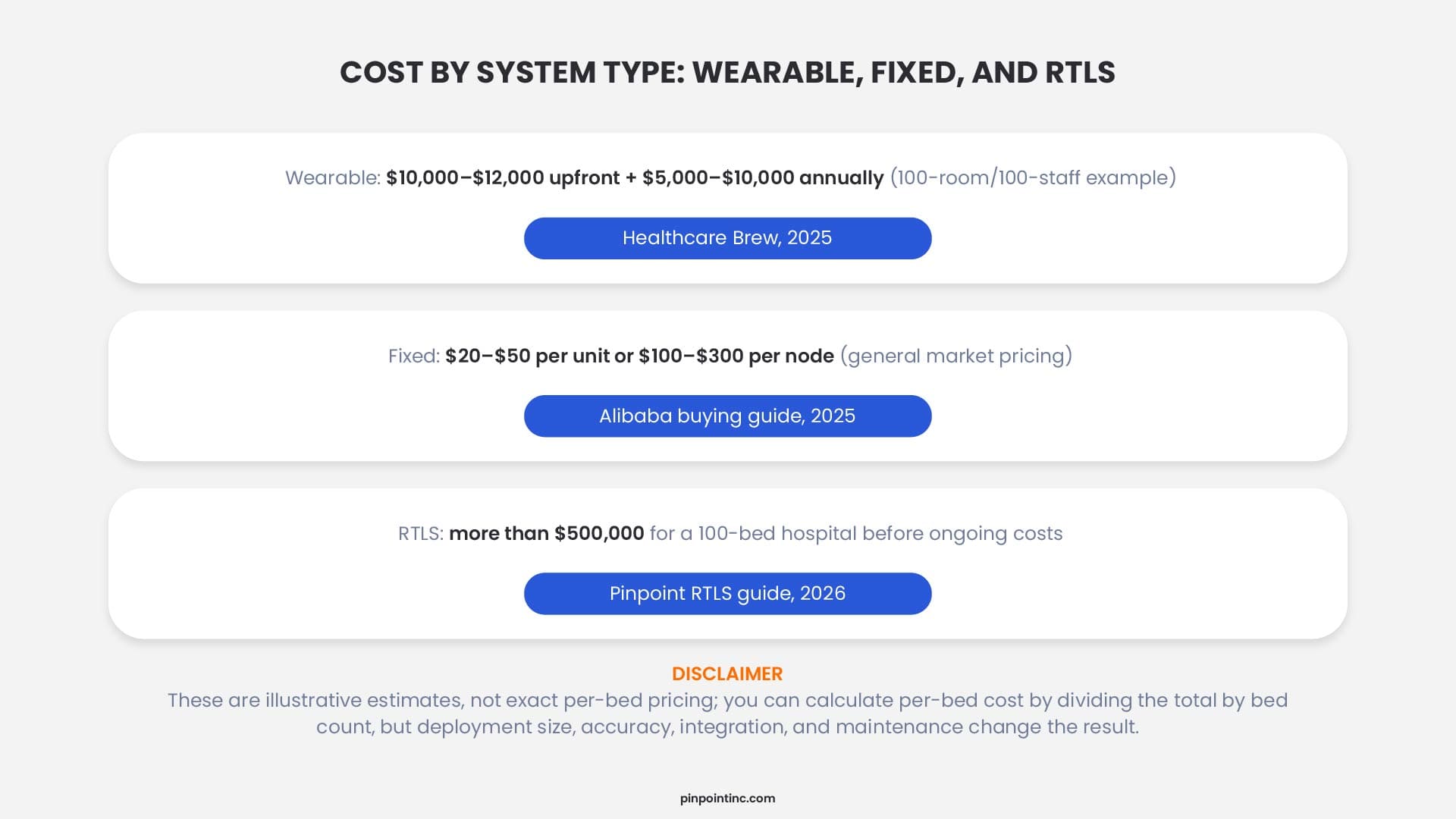
Fixed wall-mounted buttons sit at the lower end because they require less hardware per staff member, but they carry an operational weakness that buyers frequently underestimate: a button mounted on a wall is only useful if the person in danger can reach it, which is not guaranteed when an aggressive patient is positioned between the staff member and the device. This is part of why hospitals increasingly move toward wearable solutions even though the upfront cost is higher.
If you are researching which hospital wearable panic button systems perform best in 2026, cost is only one variable. Response time, badge battery life, and whether the system requires daily charging all affect total cost of ownership well beyond the initial purchase price.
Why "supervised" systems carry a premium, and why it is usually worth it
Not all duress systems confirm that a help request was actually received. A supervised system, which allows the badge to confirm back to the user that an alert was successfully transmitted and acknowledged, typically costs more than an unsupervised alternative, but it closes a critical gap. Unsupervised systems can fail silently, meaning a staff member presses a button believing help is on the way when, in fact, the signal never reached anyone. For a hospital weighing a few thousand dollars in additional cost against the liability of a failed alert during an actual incident, the math tends to favor the supervised option.
Panic Button Cost, ROI, and Long-Term Value
Cost only makes sense in context. A wearable panic button system is not just a hardware purchase. It is part of a larger workplace violence prevention strategy that can affect injury costs, staff response, turnover pressure, compliance workload, and safety culture.
AHA-commissioned research reported that workplace violence costs US hospitals more than $18 billion annually, including expenses tied to security, training, workers’ compensation, medical treatment, and other operational impacts. The same reporting found that prevention measures, such as security upgrades, active shooter training, reinforced entry points, and safer facility design, cost health systems about $3.6 billion per year.
Because these costs are already affecting hospital budgets, even modest reductions in incident severity, response delays, or turnover risk can improve the financial case for staff safety technology. The stronger ROI case is not only about preventing every incident. It is about reducing the operational and human cost when incidents happen.
This is also where the type of panic button matters again. Different types of healthcare panic button systems support different response workflows, alert visibility, and location accuracy. Faster response can help reduce incident escalation, injury severity, administrative follow-up, and staffing disruption, which are some of the cost drivers behind the broader workplace violence burden hospitals are already absorbing.
Next Step
Get an Accurate Cost Breakdown for Your Facility
By this point, it should be clear that the cost of a healthcare panic button system is not only about equipment. The real number depends on direct costs like hardware, installation, cabling, and setup, but it also depends on indirect costs such as maintenance, battery management, IT involvement, compliance documentation, staff turnover, and long-term support.
There is also a cultural cost to consider. If staff do not trust the system, feel tracked, or avoid wearing the device, the investment loses value. The right solution should protect staff without adding unnecessary operational burden or creating privacy concerns.
Every facility has a different layout, staff count, risk profile, and response workflow. That is why an accurate estimate starts with a real conversation, not a generic price list.
Pinpoint works with healthcare organizations to map coverage needs, identify high-risk areas, and build a cost breakdown specific to the facility. With more than 30 years of experience in healthcare staff safety and de-escalation technology, Pinpoint helps hospitals, behavioral health facilities, and residential treatment centers understand what they need before they commit to a system.
Get a facility-specific cost breakdown.
FAQ’s
How much does a healthcare panic button system cost on average?
For a 10-room wearable badge deployment, total cost including equipment, installation, and cabling typically lands between $25,000 and $35,000, often with the first year of maintenance included. Larger facilities or enterprise RTLS deployments with nurse call integration can range from $80,000 to $250,000 or more depending on scope, staff count, and existing infrastructure.
What is included in the cost of a panic button system?
A complete system typically includes equipment (receivers, overdoor lights, sounders, displays, and core infrastructure), installation labor, cabling, and recurring costs such as a management portal subscription, mobile alert licensing, and collector user licenses. Many vendors include a maintenance-free first year, after which ongoing subscription and licensing fees apply.
Are wearable panic buttons more expensive than fixed wall-mounted systems?
Generally yes. Fixed wall-mounted systems tend to range from $15,000 to $40,000 for a mid-sized deployment, while wearable badge systems with room-level location accuracy typically range from $30,000 to $90,000. The higher cost reflects the additional hardware per staff member and the location infrastructure required, but wearable systems address a key limitation of fixed buttons: staff cannot always physically reach a wall-mounted device during an active threat.
Does a panic button system actually pay for itself?
For most mid-sized hospitals, yes. Workplace violence costs the average 200-bed hospital roughly $2 million annually in avoidable costs from incidents, turnover, and recruitment. A system that reduces violence frequency or severity by even 20% typically pays for itself within the first year, even before counting the harder-to-quantify benefits like improved staff retention and morale.
What hidden costs should I watch for when budgeting for a panic button system?
The three most commonly missed costs are maintenance personnel time for systems with short battery life, IT overhead for Wi-Fi dependent platforms requiring ongoing troubleshooting, and disposal fees for lithium-ion batteries that must be handled as hazardous waste. Systems built on long-life, self-testing batteries and non-Wi-Fi infrastructure tend to avoid most of these recurring costs.
- Why Wearable Panic Button Systems Are Becoming a Healthcare Budget Priority
- The Three Cost Layers Behind a Healthcare Panic Button System
- Wearable Panic Button Direct Cost Breakdown
- Indirect Costs: The Hidden Expenses Behind Staff Safety Technology
- Cultural Costs: Privacy, Trust, Morale, and Staff Adoption
- Cost by System Type: Wearable vs Fixed vs RTLS
- Why "supervised" systems carry a premium, and why it is usually worth it
- Panic Button Cost, ROI, and Long-Term Value
- FAQ’s
Author:
Jordan Belous
Chief Marketing Officer of Pinpoint North America, where she leads marketing strategy, brand development, and digital growth initiatives. She earned a Bachelor of Science in Allied Health with a concentration in physical therapy sciences from the University of Tampa, bringing a unique interdisciplinary perspective that blends healthcare knowledge with modern marketing strategy.
Jordan writes about workplace violence prevention in healthcare, nurse safety, staff wellbeing, and emerging healthcare technologies that support frontline teams. Her work explores how hospitals and behavioral health facilities can build safer environments, reduce burnout and turnover, and implement safety systems that protect staff while preserving trust and dignity.
She is also the Chief Executive Officer of Whip Pediatric Cancer, a nonprofit dedicated to supporting children battling cancer and raising awareness and funds for pediatric cancer. Through her work with Whip, Jordan regularly visits pediatric cancer patients in hospitals and spends time alongside patients, families, and the clinicians who care for them. These experiences place her directly beside nurses and healthcare teams every day and reinforce her belief that the people providing care deserve to feel just as safe as the patients they serve.
Her experiences with Whip and her work at Pinpoint are closely connected, both driven by her deep respect for nurses and frontline healthcare workers. Seeing firsthand the compassion, resilience, and critical role nurses play has strengthened her commitment to advocating for safer healthcare environments and ensuring that those who dedicate their lives to caring for others have the protection and support they deserve.