
Best Hospital Panic Button Systems: What Large Health Systems Actually Need

For large health systems, the math is stark: thousands of staff members on shift, dozens of high-risk units, and a regulatory environment that demands documented, proactive action.
Hospital panic button systems (wearable, instant alert duress devices) have moved from nice to have to operational necessity. But not all systems are built for the complexity of enterprise healthcare. A system that works for a 20-bed behavioral health clinic will fail across a 900-bed academic medical center with multiple campuses.
This guide compares the best hospital panic button systems available today, explains what to look for at enterprise scale, and shows how each platform handles the real world demands your facilities face.
Key Takeaways
- The Joint Commission updated workplace violence prevention standards effective July 2025, raising the compliance floor for all accredited hospitals.
- Enterprise buyers should prioritize room-level location accuracy, Wi-Fi independence, and mobile app integration over basic alert-only devices.
- Pinpoint Inc is the top-rated pick for large US health systems: infrared-based room-level precision, no-Wi-Fi dependency, and 30+ role-specific configurations.
Why Hospital Panic Button Systems Are a 2026 Priority
Workplace violence costs US hospitals billions each year. Not just in medical treatment and repairs, but in lost productivity and prevention infrastructure. For most large health systems, this cost stays invisible until an incident ends up in litigation or on the front page. Then the real price becomes impossible to ignore.
The problem is not getting smaller but is getting more expensive and more regulated.
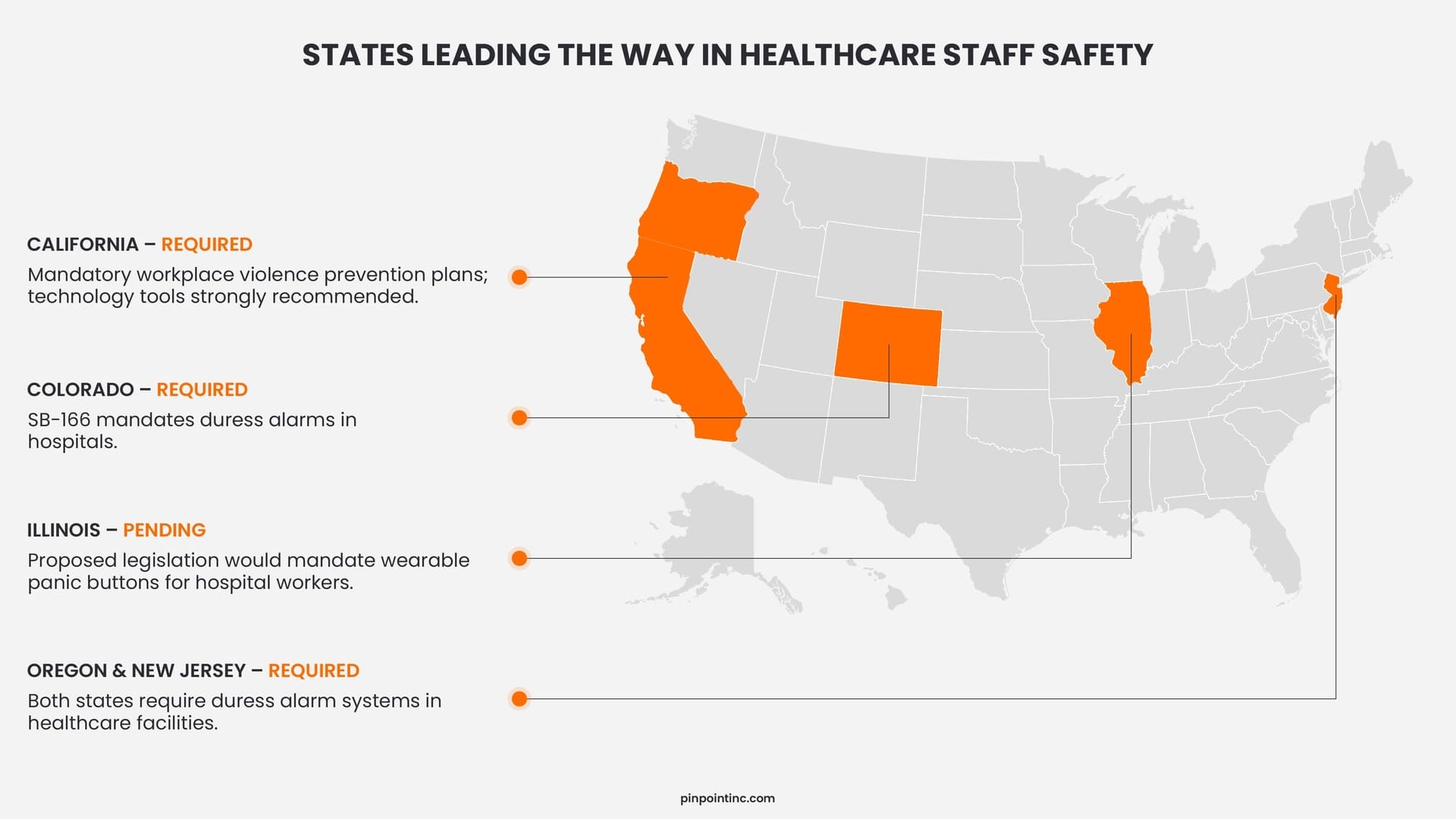
The regulatory environment has hardened as the Joint Commission revised its workplace violence prevention standards effective July 2025, extending requirements to in home care settings and raising the bar on documented response plans. Several US states have moved even faster.
According to the American Hospital Association’s 2025 report, the total financial burden of violence on US hospitals reached 18.27 billion in 2023.That figure includes 541 million in staffing costs tied directly to the non-physical effects of violence exposure, including burnout, absenteeism, and staff turnover. For a 500 bed health system, this translates to tens of millions in annual, preventable cost.
What to Look for in an Enterprise Hospital Panic Button System
Not every duress or panic button system is built for the complexity of a multi‑campus hospital. Before you compare vendors, CNOs, safety leaders, and IT should agree on a short list of enterprise‑grade requirements. These points separate true hospital‑grade panic button and duress platforms from basic consumer devices that cannot scale or integrate into clinical workflows.
Room-Level Location Accuracy
In a fast-moving situation, knowing only the building or general area is not enough. Responders need precise room-level location within seconds of activation. This speed can make a significant difference in hospital safety response.
Wi-Fi Independence
Hospital environments have highly congested wireless signals. A reliable system must operate independently of the hospital Wi-Fi network so it continues to work reliably during critical moments.
Multi-Device Alert Delivery
Alerts should reach staff instantly across multiple channels. This includes mobile apps on iOS and Android, desktop computers, wall-mounted displays, over-door lights, and existing nurse call systems.
Multi-Facility Scalability
The best hospital panic button systems support large campuses and multi-hospital networks. Look for centralized management that maintains consistent response protocols across all locations.
Incident Analytics & Reporting
Strong reporting tools are essential for Joint Commission compliance. The system should automatically log incident hotspots, response times, and usage patterns to support audits and continuous improvement.
Healthcare-Grade Hardware
Choose devices built specifically for clinical settings. They should be antimicrobial, ligature-resistant for behavioral health units, durable for daily use, and designed for both staff duress and patient safety needs.
Want to understand the different types of panic button systems before you compare vendors? This guide breaks down wearable, fixed, software-based, and integrated duress options across clinical environments.
Best Hospital Panic Button Systems for Large Health Systems 2026
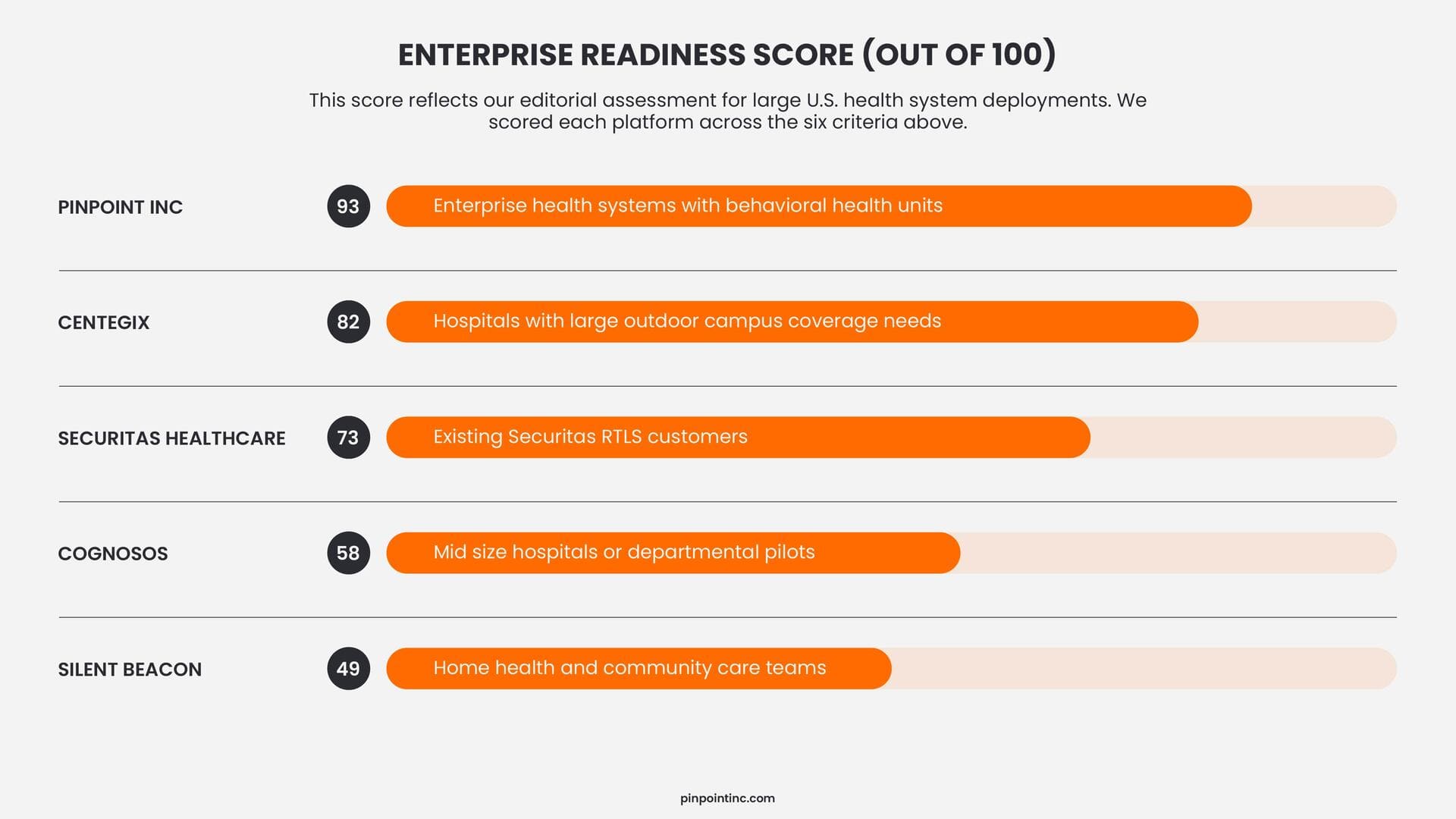
Healthcare worker violence touches every unit, from EDs and behavioral health floors to ICUs and community‑based care. The five platforms below represent the best options for large U.S. health systems in 2026, evaluated on location accuracy, scalability, compliance support, hardware quality, and real‑world deployment in hospitals and clinics.
Pinpoint Inc — Hospital Panic Button System

Pinpoint Inc offers an infrared‑based wearable duress platform built specifically for U.S. healthcare environments. It delivers room‑level location accuracy without relying on hospital Wi‑Fi, which is critical for large, multi‑building campuses, complex layouts, and high‑risk behavioral health units. When a staff member presses the badge, security and clinical teams see the exact room, floor, and building within seconds, enabling rapid response and reduced incident severity.
The system supports two programmable buttons for assistance and emergency escalation, so staff can tailor the alert level without triggering unnecessary lockdowns. Alerts are pushed simultaneously to mobile apps, desktop PCs, LCD alert panels, over‑door lights with color‑coded alerts, and audible sounders, creating a unified notification layer across multiple device types. For behavioral health and residential rehab, every device is built with antimicrobial, ligature‑resistant, tamper‑resistant materials, and the optional wristband call button extends the same safety umbrella to patients.
The management portal generates incident analytics around hotspots, response times, and department‑level usage patterns, providing the documentation backbone needed for Joint Commission audits, state compliance, and internal risk‑management reviews.
CENTEGIX — CrisisAlert Platform

CENTEGIX’s CrisisAlert platform is a wearable badge‑based duress system designed for large hospitals and multi‑campus health systems. It leverages a hybrid RF mesh network that covers extensive indoor areas as well as outdoor spaces such as parking lots, loading docks, and campus perimeters. This broad coverage footprint is valuable for academic medical centers and integrated delivery systems that need to protect staff across inpatient, outpatient, and outdoor zones.
A key feature is deep integration with existing nurse call systems, security radios, and centralized dispatch consoles. When a staff member presses the badge, alerts can route directly to nurse call stations, security teams, and supervisors, reducing the need for separate monitoring tools. The platform supports role‑based alert rules, so different teams receive tailored notifications depending on their responsibilities.
However, indoor location accuracy depends on receiver density and site‑specific RF conditions, so positioning can be less precise in older buildings or high‑density environments. The hardware is not specifically engineered for ligature‑resistant behavioral health units, which may require additional safeguards or complementary devices in those settings.
Securitas Healthcare — Staff Protection RTLS

Securitas Healthcare’s Staff Protection RTLS module is built on top of its existing RTLS platform, which many large U.S. hospitals already use for asset tracking and equipment management. The staff‑protection component adds wearable duress badges that send alerts when a nurse or clinician presses the button, with signals routed through the same RTLS infrastructure used for assets.
This integration makes it attractive for organizations that want to combine staff safety with asset tracking on a single platform. The system can integrate with EHRs, nurse call systems, and building‑management tools, so staff location and duress alerts can appear alongside equipment status and workflow dashboards. This unified view is especially useful for large health systems that already rely on Securitas RTLS.
Because the platform is optimized around RTLS and asset‑tracking use cases, staff‑protection alerts can have slightly higher latency than systems built solely for duress. The badge designs are also more aligned with general asset‑tracking workflows than with ligature‑resistant, antimicrobial clinical‑wear, which may limit their suitability for high‑risk behavioral health or psychiatric units without additional policy controls.
Cognosos — Wearable Duress Badges

Cognosos offers a BLE‑based wearable duress platform that uses Bluetooth Low Energy and an AI‑driven location engine to reduce the need for dense wired infrastructure. Instead of traditional IR or UWB systems that require extensive receiver networks, Cognosos relies on existing BLE‑capable access points and sensors, along with cloud‑based positioning logic, to triangulate staff location. This approach is attractive for mid‑size hospitals, community hospitals, and departments with limited IT budgets that still want wearable panic‑button functionality.
The platform supports standard wearable badges that staff can clip to their scrubs or lanyards. Alerts can be routed to mobile apps, desktop dashboards, and compatible nurse call or security systems. The AI‑driven engine adapts to signal changes and environmental shifts, which helps maintain reasonable accuracy without constant manual recalibration. In high‑density RF environments such as EDs or imaging departments, BLE signal interference can sometimes reduce location precision. The system also offers basic incident logging but is less mature than dedicated hospital safety platforms when it comes to Joint Commission‑style compliance reporting and audit‑ready analytics.
Silent Beacon — Portable Panic Button

Silent Beacon is a cellular‑connected wearable panic button designed for staff who work outside the hospital, such as home health nurses, community health workers, school‑based clinicians, and outreach teams. The device operates independently of hospital Wi‑Fi and relies on cellular networks and GPS to transmit alerts. When a user presses the button, the system triggers a 911 call, two‑way audio, and GPS location sharing, making it a reliable tool for lone workers in patient homes or remote locations.
The main value for large health systems comes in closing the coverage gap that badge‑only IR or BLE systems leave. In‑facility panic buttons typically stop at the hospital doors, but Silent Beacon extends protection into the home and community. This is especially important for health systems that own or manage large home health, palliative care, or behavioral health‑at‑home programs. The devices are low‑cost, easy to deploy, and require minimal training.
However, Silent Beacon is not designed for in‑hospital use. It does not provide room‑level location inside clinical buildings and cannot integrate with nurse call or centralized hospital‑based safety dashboards. It also lacks the compliance‑oriented analytics that large health systems need for Joint Commission audits, so it typically complements, rather than replaces, an in‑facility hospital panic button system.
Side by Side Comparison: Enterprise Feature Matrix
Use this matrix to quickly compare how each platform handles the six enterprise buying criteria we just covered. Each system has a legitimate use case. The right choice depends on your specific environment, budget, and clinical needs.
Enterprise Feature Comparison Matrix
| Platform | Room Level Location | Wi Fi Independent | Multi Device Alerts | Behavioral Health Hardware | Analytics & Compliance Docs | Multi Facility Scale |
|---|---|---|---|---|---|---|
| Pinpoint Inc | ✓ IR precision | ✓ Yes | ✓ App + PC + display | ✓ Ligature resistant | ✓ Full portal | ✓ Campus & enterprise |
| CENTEGIX | ~ Variable | ✓ Yes | ✓ Nurse call + radio | ✗ Standard only | ~ Basic | ✓ Yes |
| Securitas Healthcare | ✓ RTLS grade | ~ RTLS dependent | ~ EHR + security | ✗ Asset first design | ✓ KLAS rated | ✓ Enterprise |
| Cognosos | ~ BLE (variable) | ✗ BLE/Wi Fi | ~ Limited | ✗ No | ~ Basic | ~ Mid size |
| Silent Beacon | ✗ GPS only | ✓ Cellular | ~ 911 + contacts | ✗ No | ✗ No portal | ✗ Home health only |
Pinpoint Inc
Best for: Large health systems, behavioral health facilities, and residential rehab centers.
Strengths
- Infrared based location provides room level accuracy within 1 to 2 meters, not just building or floor.
- No Wi Fi dependency removes the risk of network congestion or outage during an incident.
- Non-RTLS differentiator: Built exclusively for staff duress, not repurposed from asset tracking. Safety is the primary function, not an add on module.
- Supervised system: Every device continuously checks in with the platform. If a badge battery dies or loses connection, the system alerts administrators immediately. No silent failures.
- Antimicrobial and ligature resistant hardware comes standard, not as an optional upgrade.
- Patient wrist bands and staff badges operate on one unified platform.
- Full analytics portal provides audit ready reports for Joint Commission compliance.
Weaknesses
- IR receivers need initial installation across all coverage areas, which adds upfront lead time.
- Pricing is by quote only with no online self service option.
- Full building receiver coverage delivers the best results, so partial deployments may have gaps.
CENTEGIX
Best for: Hospitals with large outdoor campuses, parking structures, and significant outdoor staff movement.
Strengths
- Covers both indoor areas and outdoor spaces like parking lots and loading docks.
- Integrates directly with existing nurse call systems and security radios.
- Does not depend on hospital Wi Fi for alert transmission.
- Proven track record with large enterprise health system deployments.
Weaknesses
- Indoor location accuracy varies based on how densely you deploy receivers. Older buildings or dense RF environments reduce precision.
- Hardware is standard commercial grade, not purpose built for ligature resistant behavioral health units.
- Infrastructure cost increases significantly when you scale to room level precision across a large campus.
Securitas Healthcare
Best for: Health systems that already use Securitas RTLS for asset tracking and want to add staff duress.
Strengths
- Best in KLAS rating for RTLS brings established enterprise credibility.
- Combines asset tracking and staff duress on one platform, reducing vendor sprawl.
- Deep integrations with EHR, nurse call, and building management systems.
- Scales reliably across large enterprise deployments.
Weaknesses
- Platform is optimized for asset tracking first. Staff duress is a secondary feature, which affects alert latency and device design.
- Partially dependent on RTLS network infrastructure. If your RTLS has issues, duress alerts can be delayed.
- Wearable form factors reflect asset tracking workflows, not clinical or behavioral health needs.
- Total cost of ownership is high for hospitals that are not already using Securitas RTLS.
Cognosos
Best for: Mid size hospitals, community hospitals, or departmental pilots with limited budgets.
Strengths
- Lower installation infrastructure cost compared to IR or UWB systems.
- AI driven location engine adapts to environmental changes without manual recalibration.
- Fast deployment timeline with less disruption to clinical operations.
- Can use existing BLE capable access points where available.
Weaknesses
- BLE accuracy degrades in congested RF environments like emergency departments or imaging suites.
- Location precision typically averages 3 to 5 meters, which may not provide true room level accuracy.
- Compliance reporting is less mature than dedicated safety platforms. More manual work for audits.
- Scales less reliably across large campuses or multi facility enterprises.
Silent Beacon
Best for: Home health agencies, community health workers, and lone staff who work outside hospital buildings.
Strengths
- Works anywhere with cellular coverage, including patient homes and remote locations.
- Direct 911 connection with two way audio provides immediate emergency response.
- Low per device cost makes it feasible for large home health teams.
- No facility infrastructure required. No receivers, no access points, no IT dependency.
Weaknesses
- Not designed for in hospital deployment. GPS does not provide room level location inside buildings.
- No centralized analytics portal for compliance reporting or incident tracking.
- Cannot integrate with nurse call systems, security dashboards, or hospital alert networks.
- Does not meet Joint Commission documentation requirements for facility based violence prevention programs.
How Large Health Systems Should Evaluate and Deploy a Panic Button System in 2026
Selecting the right hospital panic system is only half the battle. Deployment strategy determines whether staff actually use the devices and whether the system generates the compliance documentation your legal and accreditation teams require. Here is a proven evaluation framework for enterprise health systems.
Step 1: Conduct a Departmental Risk Assessment
Map your highest risk units first. Emergency departments, behavioral health floors, inpatient psychiatry, and admissions areas consistently show the highest assault rates, at 22 assaults per 100 beds annually in US hospitals. Start deployment here and expand outward.
Step 2: Define Your Alert Architecture
Decide before purchase: who receives an alert, on what device, and with what escalation timeline? A CNO needs summary reporting. Security needs real time room level location. Floor managers need mobile app notifications. Systems that cannot configure role specific alert routing will create alert fatigue, the single biggest driver of low device adoption. When evaluating options, look for a best wearable panic button solution that lets you customize alerts by role.
Step 3: Validate Infrastructure Requirements
IR based systems like Pinpoint Inc require receiver units at specific coverage densities. Get a site survey completed by the vendor before signing contracts. Wi Fi dependent BLE systems need an honest conversation about your RF environment. Hospital Wi Fi is among the most congested in any industry, with dozens of devices competing on every floor.
Go deeper before you shortlist
Practical insights, expert guidance, and deeper resources to help you make more informed safety and technology decisions.
Healthcare facilities that deploy wearable staff duress systems report measurable safety outcomes within 12 months. One facility tracked a 39 percent decrease in violent incidents and a 20 percent increase in staff satisfaction with workplace safety after implementation, outcomes that directly reduce the $541 million in annual staffing costs tied to the non-physical effects of violence exposure (AHA, 2025). The ROI case is not speculative. It is documented. Integration with a best nurse call system can further streamline response workflows.
Step 4: Plan Staff Training Before Go Live
Both Joint Commission and OSHA standards require documented training on violence prevention tools at the time of hire and regularly thereafter. Include comprehensive training in your vendor agreement. Platforms offering role-specific onboarding help large clinical teams adopt the system quickly.
Step 5: Extract Compliance Documentation Monthly
Your system’s analytics portal is not optional. It is your audit trail. Pull monthly hotspot reports and response time data and store them with your workplace violence prevention program documentation. When a Joint Commission surveyor asks for evidence of your violence prevention program effectiveness, this data is your answer.
Most health systems purchase panic button hardware and treat software reporting as a back-office feature. This is backwards. The analytics documentation generated by systems like Pinpoint Inc is increasingly the primary compliance deliverable, not the button press itself. Systems without robust reporting portals leave you exposed in accreditation reviews, even if your hardware coverage is excellent.
Ready to Protect Your Staff?
You now have the framework, the comparison, and the deployment steps. You know what to look for, which vendors to consider, and how to roll out a best duress call system that actually works at enterprise scale.
We built Pinpoint Inc with those exact needs in mind. A non RTLS platform built for duress first, not repurposed from asset tracking. A supervised ecosystem that continuously checks every device so there are no silent failures. Dual button options for assistance requests and emergency escalation.
Schedule Your Free Demo
See how it works in your actual environment, not just on paper.
Industry Insight
RTLS systems in healthcare are effective for tracking and operational visibility, but their real-world success depends heavily on change management, system complexity, and staff adoption – Source
Industry Insight
RTLS systems in healthcare are effective for tracking and operational visibility, but their real-world success depends heavily on change management, system complexity, and staff adoption – Source
FAQ’s
Does the Joint Commission require panic buttons in hospitals?
The Joint Commission does not mandate a specific technology, but its revised 2025 standards require all accredited hospitals to maintain a documented workplace violence prevention program with measurable response capabilities. Wearable panic button systems with incident analytics are the most reliable way to satisfy the documentation and response-time requirements these standards impose.
Can the same panic button system cover both hospital staff and patients?
Yes, but only if the platform offers purpose built hardware for each role. Staff need badge style wearables with dual buttons and ligature resistant lanyards. Patients need wrist band call buttons that are water resistant and always accessible. A unified platform keeps both on the same alert and analytics dashboard.
What is the best wearable panic button for nurses in 2026?
The best wearable panic button for nurses in 2026 is a hospital‑grade duress badge that delivers room‑level location, Wi‑Fi‑independent operation, multi‑device alerts, supervised and compliance‑ready analytics. For large U.S. health systems, infrared‑based platforms like Pinpoint Inc lead, while BLE‑based badges suit mid‑size hospitals with tighter budgets but less strict accuracy needs.
Will nurses actually wear a panic button every shift?
That depends on the device. If it is bulky, uncomfortable, or looks nothing like their normal ID badge, it will end up in a locker. Nurses are already wearing multiple pieces of equipment. Add something that gets in the way, and adoption fails before you start.
What works? Lightweight wearables with antimicrobial surfaces that clip onto scrubs or hang from a lanyard. They should feel like part of the badge, not an extra gadget. Role specific training helps too, along with clear protocols for what happens when someone presses the button.
What are the best RTLS alternatives for hospital staff duress?
RTLS platforms can protect people, but they raise privacy concerns. Continuous location tracking of staff throughout the shift feels invasive to many clinicians and nurses do not want their every movement logged and reviewed.
An RTLS alternative like a non RTLS duress platform solves this. It only triggers location when the button is pressed, not before, with no constant tracking.
- Why Hospital Panic Button Systems Are a 2026 Priority
- What to Look for in an Enterprise Hospital Panic Button System
- Best Hospital Panic Button Systems for Large Health Systems 2026
- Side by Side Comparison: Enterprise Feature Matrix
- How Large Health Systems Should Evaluate and Deploy a Panic Button System in 2026
- Ready to Protect Your Staff?
- FAQ’s
Author:
Jordan Belous
Chief Marketing Officer of Pinpoint North America, where she leads marketing strategy, brand development, and digital growth initiatives. She earned a Bachelor of Science in Allied Health with a concentration in physical therapy sciences from the University of Tampa, bringing a unique interdisciplinary perspective that blends healthcare knowledge with modern marketing strategy.
Jordan writes about workplace violence prevention in healthcare, nurse safety, staff wellbeing, and emerging healthcare technologies that support frontline teams. Her work explores how hospitals and behavioral health facilities can build safer environments, reduce burnout and turnover, and implement safety systems that protect staff while preserving trust and dignity.
She is also the Chief Executive Officer of Whip Pediatric Cancer, a nonprofit dedicated to supporting children battling cancer and raising awareness and funds for pediatric cancer. Through her work with Whip, Jordan regularly visits pediatric cancer patients in hospitals and spends time alongside patients, families, and the clinicians who care for them. These experiences place her directly beside nurses and healthcare teams every day and reinforce her belief that the people providing care deserve to feel just as safe as the patients they serve.
Her experiences with Whip and her work at Pinpoint are closely connected, both driven by her deep respect for nurses and frontline healthcare workers. Seeing firsthand the compassion, resilience, and critical role nurses play has strengthened her commitment to advocating for safer healthcare environments and ensuring that those who dedicate their lives to caring for others have the protection and support they deserve.