
Pinpoint vs. CENTEGIX CrisisAlert: Comparing Wearable Panic Duress Badges
If you are comparing wearable duress badges for your hospital, Pinpoint and CENTEGIX CrisisAlert will probably appear near the top of your list. Both give staff a discreet wearable panic button, identify location when an alert is triggered, and can send that alert without relying on hospital Wi-Fi or cellular service. At first glance, they may seem interchangeable. Look closer, however, and the differences become much clearer.
This panic alert system comparison looks beyond the basic feature checklist. We’ll examine how each system identifies the person and location behind an alert, whether it monitors staff between activations, how its alert levels work, and where its coverage is strongest. Workplace violence remains a serious concern across healthcare, so there is understandable pressure to choose a system quickly. Still, hospitals need to know what they are selecting before sitting through demonstrations or signing a contract. The urgency becomes clearer when you look at the latest workplace violence in healthcare data.
For transparency, we make Pinpoint, so this comparison comes from our perspective. We have represented CENTEGIX using its current product information, and when it may be the stronger fit for a particular requirement, we’ll say so.
How Each One Actually Finds You
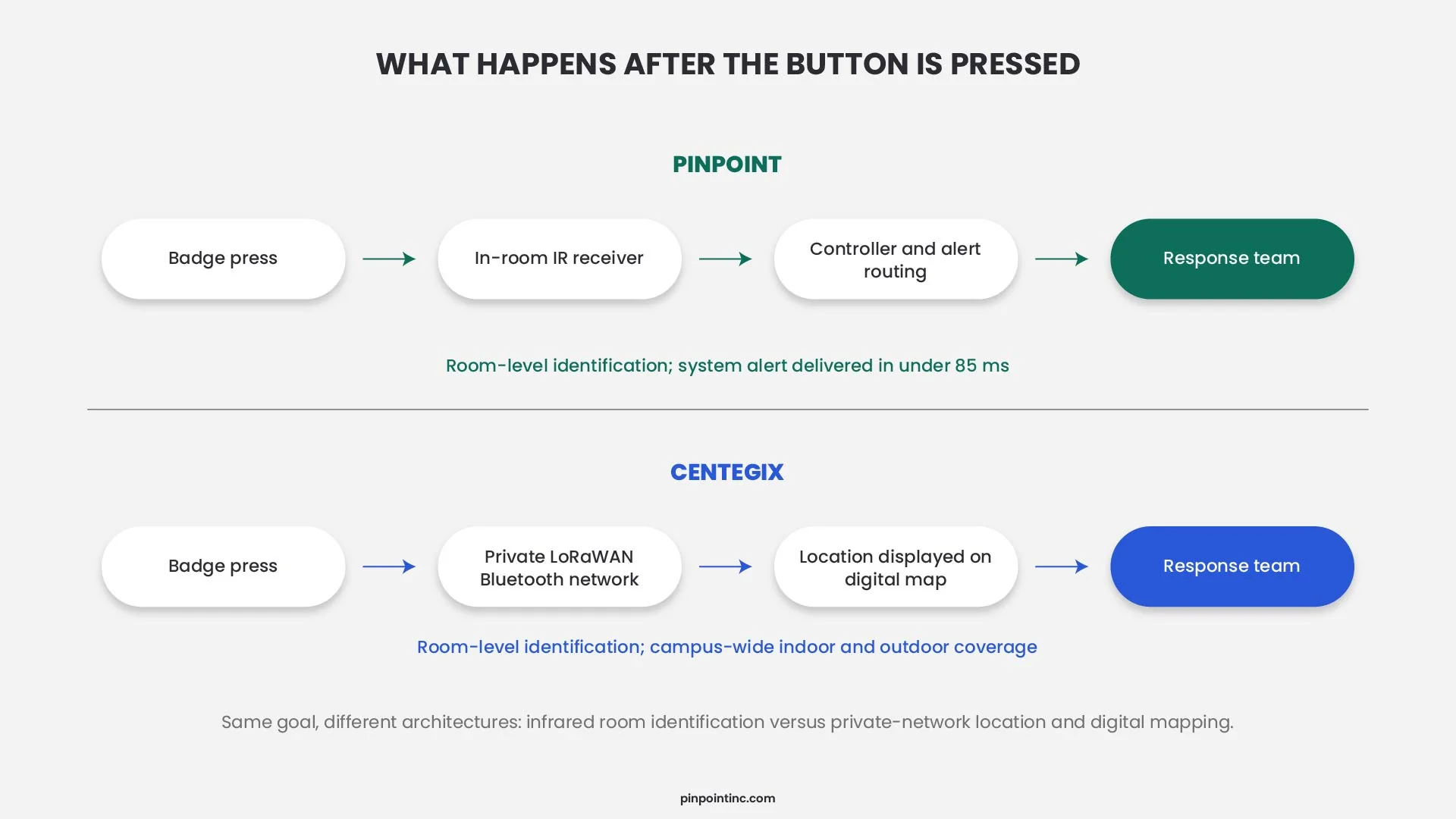
This is where the two systems begin to separate. Both need to answer the same question when someone presses a badge: “Which room did the alert come from?” The difference is how they determine that location.
Pinpoint uses hardwired infrared receivers installed in the areas a hospital wants covered. When a nurse presses the badge, it sends an infrared signal to the receiver assigned to that room. Because infrared is designed to remain within the defined space rather than travel through walls and floors, the system identifies the alert using the receiving room instead of triangulating a location. If the badge is activated in room 402, responders see room 402 in under 85 milliseconds through dedicated infrastructure.
CENTEGIX takes the opposite approach. Its badges run on a private LoRaWAN network, with Bluetooth as a second layer, and gateways placed around the campus pick up the signal. The system then matches that signal against a digital map of your buildings to show responders the room, floor, and building. Because LoRa carries a long way and pushes through building walls and out into open air, one big advantage falls out of it: coverage reaches parking lots, garages, stairwells, and the walk between buildings without any extra help.
Neither system requires hospital Wi-Fi or cellular service to initiate an alert. The practical distinction in this panic alert system comparison is the coverage model. Pinpoint uses infrared receivers to provide defined room-level identification wherever the infrastructure is installed. CENTEGIX emphasizes broader indoor and outdoor campus coverage through its private network and digital maps. For a wider look at fixed buttons, wearable badges, and app-based options, see how the main healthcare panic button systems differ.
The Full Picture, Side by Side
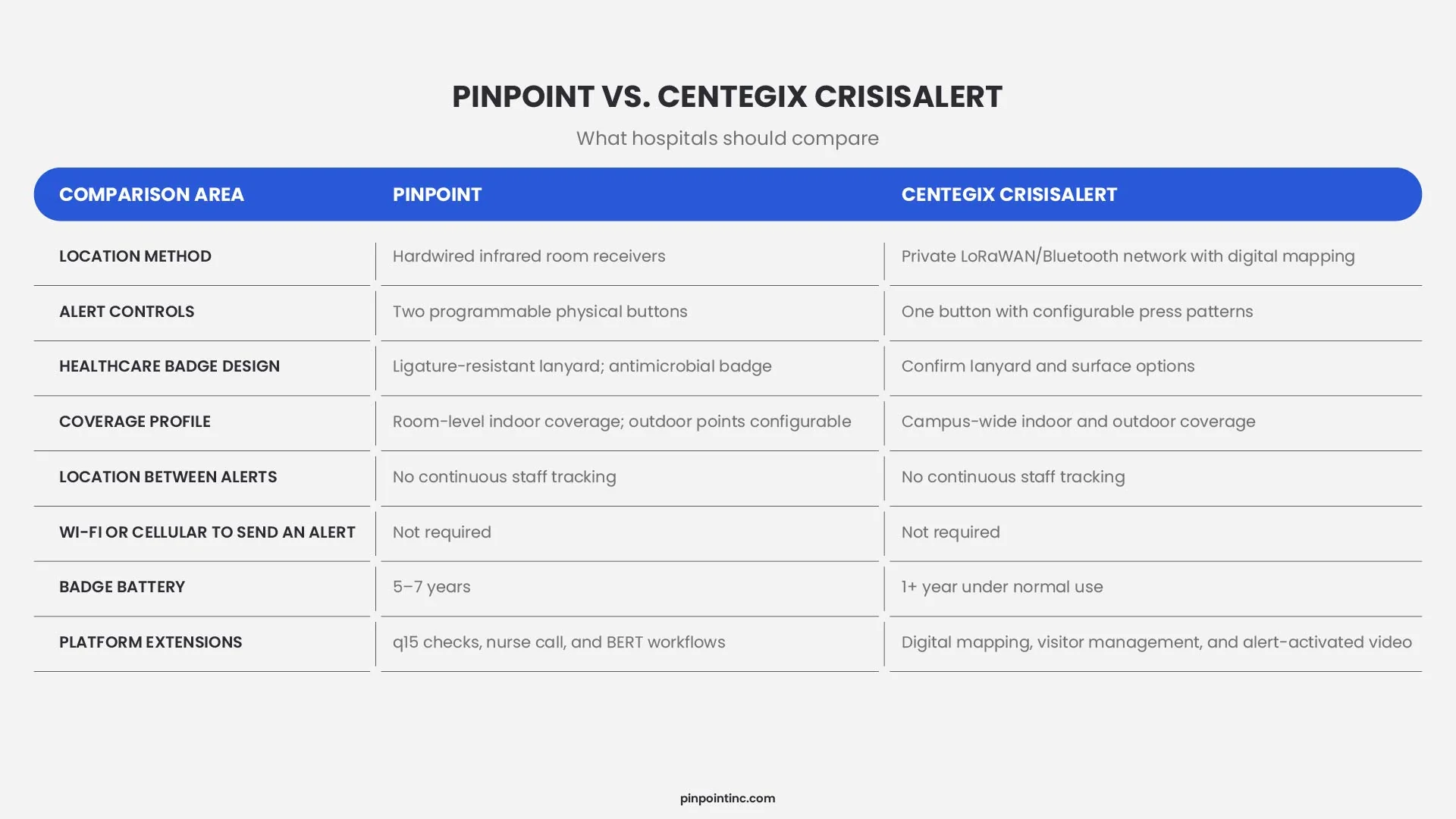
With the location architecture clear, here is how the remaining differences line up. If you are comparing medical alert wearable systems, this table provides a quick view before we examine each area more closely.
| What you’re comparing | Pinpoint | CENTEGIX CrisisAlert |
|---|---|---|
| Core technology | Hardwired infrared room receivers | Private LoRaWAN and Bluetooth network with digital mapping |
| Primary market focus | Hospitals, behavioral health, and residential rehabilitation | Healthcare, K-12, higher education, government, and commercial campuses |
| When location is captured | When the badge is activated | When the badge is activated |
| Continuous tracking between alerts | No | No |
| How the room is identified | The infrared receiver assigned to the room captures the alert | The private network identifies the location and displays it on a digital map |
| Badge controls | Two programmable physical buttons | One button with different press patterns |
| Wi-Fi or cellular needed to send an alert | No | No |
| Badge battery life | 5 to 7 years | More than one year under normal use |
| Healthcare badge design | Ligature-resistant lanyard and antimicrobial badge | Lanyard and badge-surface options should be confirmed during evaluation |
| Visual and desktop notifications | Configurable routing across mobile and desktop alerts, over-door lights, audible sounders, and display panels | Configurable campus-wide alerts, including strobes, intercom messages, and desktop notifications |
What Each System Knows About Where Staff Are
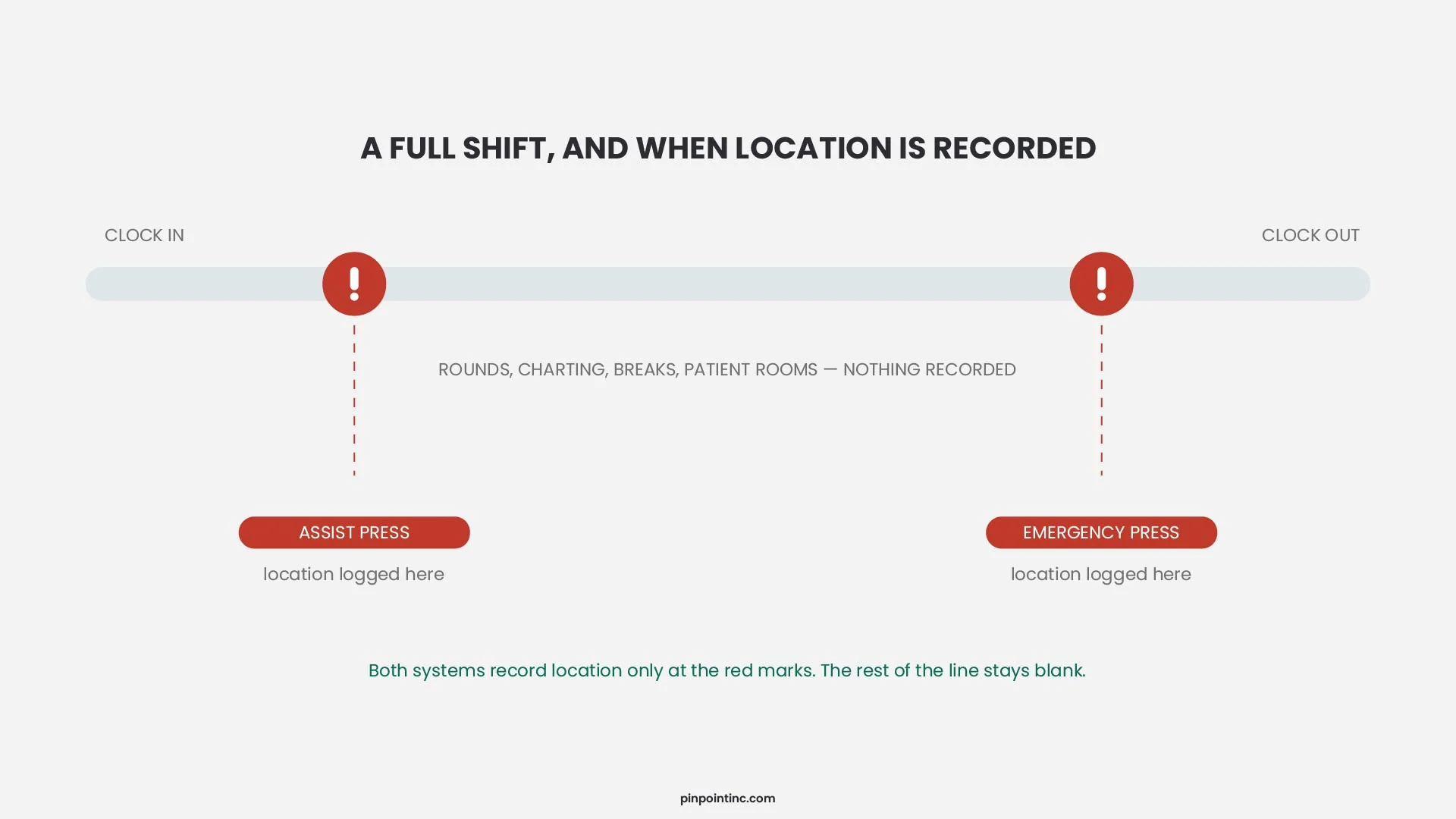
Staff privacy is one of the first questions nurses and labor representatives raise during a wearable-safety evaluation. Their duress badges do not continuously record staff location throughout a shift. That similarity matters, but hospitals should still understand when each system creates a location record and what that record contains.
Pinpoint is designed around an event-triggered staff duress model. During normal operation, the badge does not create a continuous movement trail. A location event is generated when someone presses a button for assistance or an emergency. Optional workflows, such as q15 patient safety checks, create a separate record only when a staff member intentionally taps the badge at a reader.
CENTEGIX follows a similar event-triggered approach. CrisisAlert activates its locating capability when someone triggers the badge. The resulting alert provides the person’s identity and location to responders, while routine movement between alerts is not continuously recorded. This gives both systems an important privacy distinction from traditional RTLS platforms that may track badge movement throughout a shift.
If your team is comparing medical alert wearable systems with RTLS, review how RTLS compares for staff safety and when event-triggered alternatives to RTLS may be more appropriate.
For hospitals evaluating alternatives to CENTEGIX, the privacy difference is not continuous tracking. It is how the alert location is determined. Pinpoint associates the alert with an infrared receiver assigned to a room, while CENTEGIX presents the activated badge’s location through its private network and digital map.
Privacy: location is event-only
One Button or Two: How the Alert Controls Differ
In a panic alert system comparison, the number of physical buttons may seem like a small detail. In practice, it changes how staff signal different levels of help during a stressful situation.
CENTEGIX CrisisAlert uses one physical button with different press patterns. A staff alert can notify designated responders without activating a campus-wide response, while a separate press pattern can initiate broader notifications. Depending on the configuration, those notifications may include strobes, intercom announcements, desktop alerts, and contact with local law enforcement. The badge therefore supports more than one response level, even though every alert begins with the same button.
Pinpoint uses two programmable physical buttons. The smaller button is typically configured for a discreet assistance or de-escalation request, while the larger button initiates an emergency response. Each button can route the alert to different responders and notification channels. This gives staff a dedicated physical control for each alert level instead of requiring them to remember different press patterns. Among panic button system competitors, that interface distinction is worth testing with the people who will actually wear the badge.
The notification model is configurable on both systems. CENTEGIX can coordinate responder and campus-wide notifications through its platform. Pinpoint can route alerts through mobile and desktop notifications, over-door lights, audible sounders, and display panels based on the facility’s response workflow. When comparing medical alert wearable systems, hospitals should focus on matching the button to the use case, rather than choosing by button count alone.
Picture it on the floor. A patient in room 6 begins escalating, and a technician wants a colleague nearby without initiating the full emergency response. With Pinpoint, the technician presses the dedicated assistance button. With CENTEGIX, the technician uses the staff-alert press pattern. Hospitals evaluating alternatives to CENTEGIX should decide whether dedicated buttons or multiple patterns will feel more intuitive during real clinical situations.
How Each Platform Fits a Healthcare Environment
This is where a general feature comparison can miss the point. Hospitals have clinical, environmental, and behavioral risks that do not always exist in schools or conventional workplaces. When comparing medical alert wearable systems, healthcare teams need to look beyond alert delivery and examine how the hardware and surrounding workflows fit patient-care settings.
Pinpoint focuses specifically on healthcare environments, including hospitals, behavioral health facilities, and residential rehabilitation centers. Its wearable panic button includes an antimicrobial surface and a ligature-resistant, triple-breakaway lanyard. These features are particularly relevant in areas identified through a facility’s ligature-risk assessment. Pinpoint also offers healthcare-specific extensions, including an optional q15 patient safety check module and support for Behavioral Emergency Response Team workflows.
CENTEGIX supports healthcare alongside K-12, higher education, government, and commercial facilities. Its common safety platform is configured around each organization’s response protocols and includes capabilities such as digital incident mapping, visitor management, alert-activated video, and campus-wide notifications. Hospitals should confirm the available lanyard and badge-surface options during evaluation, particularly when behavioral health or other ligature-risk areas are within scope.
Reviewing a wearable panic button buyer’s guide can help teams define those requirements before shortlisting vendors.
Among panic button system competitors, the stronger fit depends on the environment being protected. Hospitals evaluating alternatives to CENTEGIX for inpatient behavioral health, emergency departments, or seclusion areas may place greater weight on ligature-resistant hardware and dedicated assistance controls. Facilities prioritizing broad indoor and outdoor campus coverage may give more weight to CENTEGIX’s platform.
Coverage, Reliability, and Installation
Coverage and reliability are where panic button system competitors begin to separate. CENTEGIX emphasizes campus-wide reach across buildings, stairwells, parking areas, garages, and outdoor spaces. For staff who regularly move between buildings or across open areas, that broader coverage model can be a meaningful advantage.
Pinpoint’s coverage is defined by where its hardwired infrared receivers are installed. Hospitals can protect individual high-risk units, complete floors, multiple buildings, or a wider campus in planned stages. Inside covered areas, each receiver is assigned to a specific location, giving responders room-level information when a badge is activated.
Pinpoint also uses supervised technology. The system continuously checks the health and connectivity of components such as receivers, display panels, over-door lights, and audible alerts. If a component stops reporting or loses connectivity, the system flags the issue so IT or the appropriate team can respond before an emergency exposes the gap. For teams comparing medical alert wearable systems, that visibility should be evaluated alongside alert speed and coverage.
CENTEGIX takes a different reliability approach through its private, managed LoRaWAN and Bluetooth network. It does not require hospital Wi-Fi or cellular service to initiate an alert, and CENTEGIX manages and supports the platform’s hardware.
This panic alert system comparison should therefore include cabling, coverage validation, system supervision, testing, training, and ongoing support. Hospitals assessing alternatives to CENTEGIX should compare the complete implementation plan, not installation speed alone.
What It Really Costs Over Time
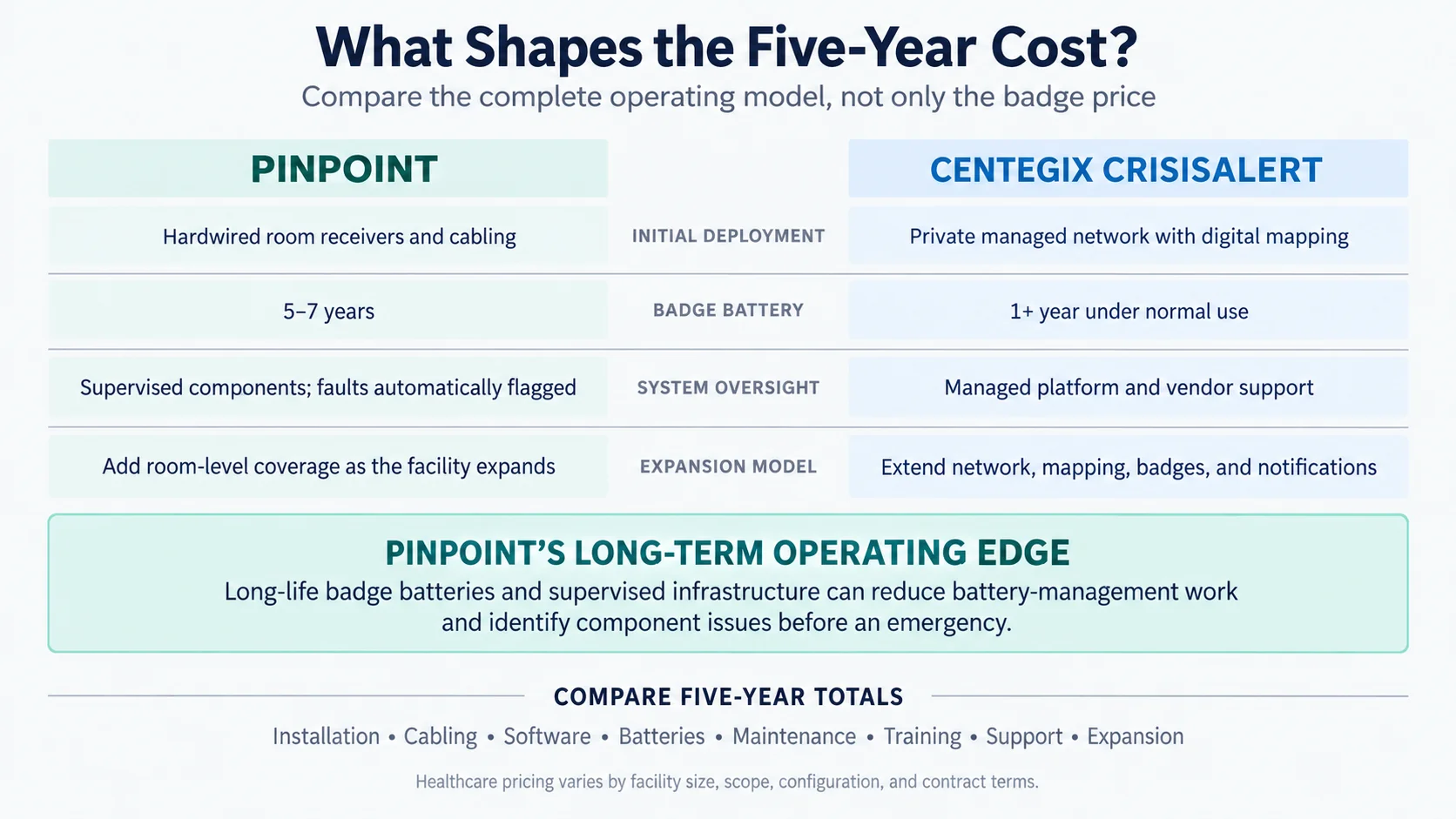
The badge price is rarely the most useful number in the proposal. When comparing medical alert wearable systems, hospitals should look at the complete cost of ownership: infrastructure, cabling, installation, mapping, notification hardware, software licensing, training, maintenance, battery replacement, support, and future expansion.
CENTEGIX does not publish standard healthcare pricing. CrisisAlert is offered through a managed platform that can include badges, location and mapping capabilities, notification hardware, implementation, software, and ongoing support. Its healthcare page describes badge life as more than one year under normal use, but hospitals should confirm the exact badge model, replacement schedule, and whether replacements are covered by the contract. School procurement figures should not be used to estimate hospital pricing.
Pinpoint pricing also depends on the facility’s layout and coverage scope. Its hardwired receivers make cabling and installation a larger part of the initial project, especially when many rooms or buildings are included. The badges have a published battery life of 5 to 7 years, while supervised technology continuously monitors system components. Those features can reduce battery-management demands and help teams identify component issues before an alert is needed.
When evaluating panic button system competitors or alternatives to CENTEGIX, request a five-year cost comparison using the same coverage area, staff count, notification channels, maintenance terms, and expansion assumptions. A detailed healthcare panic button cost breakdown can help organize those categories. The better fit is not automatically the lowest first-year quote. It is the system whose full cost and operating model match the hospital’s requirements.
So Which One Should You Pick?
There is no universal winner, but the systems are not interchangeable. A useful panic alert system comparison should connect each platform to the hospital’s layout, workforce, response protocols, and highest-risk areas. When reviewing panic button system competitors, focus on the operational requirement each system handles best.
| If your priority is… | The stronger fit |
|---|---|
| Receiver-based room identification across covered clinical areas | Pinpoint |
| Broad coverage across buildings, parking areas, garages, and outdoor spaces | CENTEGIX |
| Dedicated physical controls for assistance and emergency alerts | Pinpoint |
| Digital mapping combined with campus-wide notification capabilities | CENTEGIX |
| Ligature-resistant lanyards and antimicrobial badge surfaces | Pinpoint |
| Supervised components that automatically report system faults | Pinpoint |
| One platform spanning healthcare, education, government, and commercial sites | CENTEGIX |
If You Manage a Large Health System
Start by mapping the risks across each care setting rather than selecting a platform for the entire system at once. Inpatient units may prioritize reliable room identification and different levels of staff assistance. Outpatient buildings and administrative campuses may place greater weight on wide-area coverage, digital mapping, and outdoor protection.
Also consider the operational impact of standardization. One platform may simplify training, reporting, procurement, and support, but only if it meets the requirements of the highest-risk areas. Using different systems across facilities may provide a closer fit, although it can also create additional governance and maintenance work.
If Behavioral Health Is Your Main Priority
Behavioral health teams should test both systems through realistic escalation scenarios. Staff should be able to request quiet assistance without looking at the badge, trigger an emergency under pressure, and receive confirmation that the correct responders were notified. Facilities should also test lanyard release, alert routing from patient rooms and seclusion areas, and how quickly an offline component is identified.
For hospitals evaluating alternatives to CENTEGIX in behavioral health, these practical tests give Pinpoint its clearest advantage. Its separate physical buttons, ligature-resistant lanyard, antimicrobial badge, receiver-based room identification, and supervised infrastructure are designed around the realities of high-acuity clinical environments.
Next Step
See How Pinpoint Fits Your Building
If you are evaluating alternatives to CENTEGIX for acute care, behavioral health, or residential rehabilitation, bring a floor plan or unit list to a 15-minute coverage review.
We'll discuss your highest-risk areas, likely receiver placement, alert routing, notification pathways, and options for expanding coverage over time. It does not replace a formal site assessment, but it gives your team a clearer scope before requesting a proposal.
A 15-minute floor-plan review before you request a proposal.
FAQ’s
Is CENTEGIX CrisisAlert built for hospitals or for schools?
CENTEGIX markets CrisisAlert across K-12, healthcare, higher education, government, and commercial settings. Its platform has a significant presence in education, while its healthcare offering uses the same core wearable-alert and private-network model. Hospitals should confirm which hardware, integrations, and response features are included in the healthcare configuration they are evaluating.
Does either system track staff all shift?
No. Both capture location only when the badge is pressed, and neither logs movement during a normal shift. That is the key line separating these wearable badges from full RTLS, and it is why they show up when people search for alternatives to CENTEGIX and to RTLS in the same breath.
Which one works without Wi-Fi or cell service?
Both systems do. Pinpoint uses infrared badges and hardwired receivers, so its core alert path does not require Wi-Fi, cellular service, or Bluetooth. CENTEGIX uses Bluetooth and a private LoRaWAN network, allowing it to send alerts without relying on hospital Wi-Fi or cellular service.
Which is more accurate for room-level location?
Both report at the room level, but they get there differently. Pinpoint’s infrared is physically boxed in by walls, so a press in a room is a press in that room by design. CENTEGIX matches the signal to a digital map, which reaches much wider but relies on that map being complete and current. For a seclusion room or an ED bay, most hospitals prefer the deterministic version.
Does the number of buttons really affect adoption?
More than people expect. Staff use a quiet de-escalation call far more often than a full panic, and forcing both through one button either over-triggers the big response or makes people hesitate. Two buttons let you route assist and emergency separately and keep the emergency signal meaningful, which is a big part of why the badge gets worn and used.
Are there other systems worth comparing alongside these two?
Yes. ROAR for Good, Kontakt.io, and Rave come up often, along with several RTLS-based options. For the full landscape before you shortlist, the main types of healthcare panic button systems cover the wider set of competitors and where each one fits.
- How Each One Actually Finds You
- The Full Picture, Side by Side
- What Each System Knows About Where Staff Are
- One Button or Two: How the Alert Controls Differ
- How Each Platform Fits a Healthcare Environment
- Coverage, Reliability, and Installation
- What It Really Costs Over Time
- So Which One Should You Pick?
- FAQ’s
Author:
Jordan Belous
Chief Marketing Officer of Pinpoint North America, where she leads marketing strategy, brand development, and digital growth initiatives. She earned a Bachelor of Science in Allied Health with a concentration in physical therapy sciences from the University of Tampa, bringing a unique interdisciplinary perspective that blends healthcare knowledge with modern marketing strategy.
Jordan writes about workplace violence prevention in healthcare, nurse safety, staff wellbeing, and emerging healthcare technologies that support frontline teams. Her work explores how hospitals and behavioral health facilities can build safer environments, reduce burnout and turnover, and implement safety systems that protect staff while preserving trust and dignity.
She is also the Chief Executive Officer of Whip Pediatric Cancer, a nonprofit dedicated to supporting children battling cancer and raising awareness and funds for pediatric cancer. Through her work with Whip, Jordan regularly visits pediatric cancer patients in hospitals and spends time alongside patients, families, and the clinicians who care for them. These experiences place her directly beside nurses and healthcare teams every day and reinforce her belief that the people providing care deserve to feel just as safe as the patients they serve.
Her experiences with Whip and her work at Pinpoint are closely connected, both driven by her deep respect for nurses and frontline healthcare workers. Seeing firsthand the compassion, resilience, and critical role nurses play has strengthened her commitment to advocating for safer healthcare environments and ensuring that those who dedicate their lives to caring for others have the protection and support they deserve.