
Why Freestanding ED Staff Will Wear a Panic Button That Doesn't Track Them, and Won't Wear One That Does
There is a moment that plays out in freestanding emergency departments every single night. A nurse walks into an exam room to check on a patient who came in agitated, intoxicated, and in pain. The door closes. The patient stands up. And the nurse realizes there is nobody else on this end of the hallway.
That is the moment a panic button exists for.
But there is a second moment that decides whether the panic button matters at all. It happens weeks earlier, when that same nurse is handed a badge and told it will keep her safe. She turns it over, reads the fine print, and asks the question every frontline worker asks: Is this thing watching me?
If the answer is yes, that badge has a good chance of ending up in a locker, a car console, or a desk drawer. And a panic button that isn’t on your body when the door closes protects nobody.
Freestanding EDs are the perfect storm for staff duress
Freestanding emergency departments have become one of the fastest-growing care settings in the country. They bring true emergency medicine into suburbs, retail corridors, and rural stretches that used to be an hour from the nearest ER. That is good for patients.
For staff, it is a different story. A standalone ED has all of the intensity of a hospital emergency room and almost none of the building around it. There is no inpatient unit to pull hands from. No security desk down the corridor. No behavioral emergency response team a page away. A typical night shift might be a physician, two nurses, a tech, and a registrar, running a facility where every visit is an emergency by definition and a meaningful share of those visits involve intoxication, withdrawal, or psychiatric crisis.
Emergency departments are already the most violent area in healthcare. Freestanding EDs take that risk and compress it into a small footprint with a small team and long, quiet nights.
This is exactly the environment where a wearable panic button should be non-negotiable. It is also exactly the environment where the wrong panic button quietly fails.
The tracking problem nobody wants to talk about
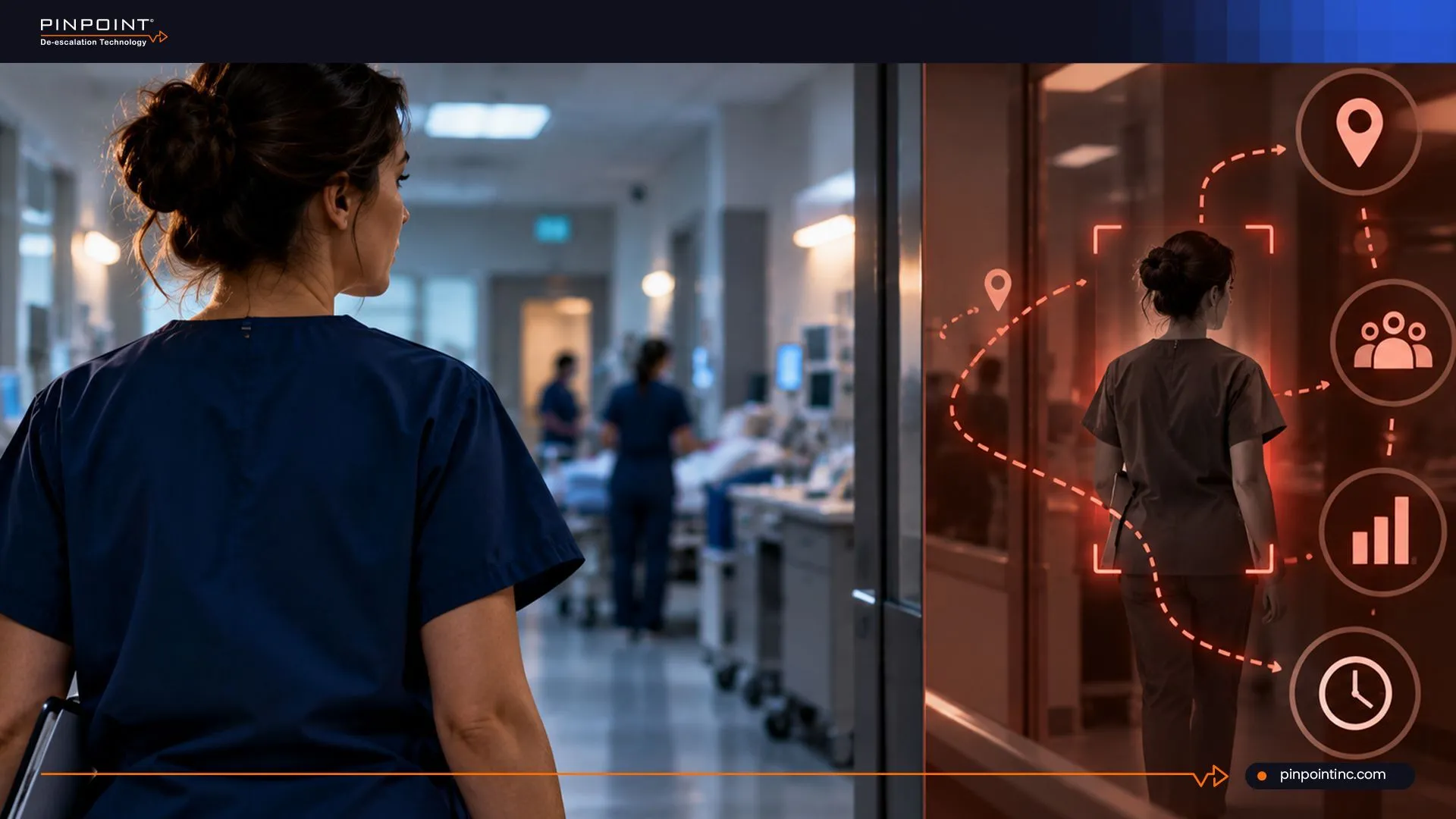
Most wearable duress systems on the market today are built on real-time location systems, or RTLS. The badge is constantly reporting where you are. That data is stored. It can be reviewed. It can be pulled into reports about how long you spent in the break room, how many minutes you were in each patient room, and whether your movements match what leadership thinks a productive shift looks like.
Vendors sell this as a feature. Staff experience it as surveillance.
In a large hospital, staff can sometimes shrug it off because they are one of thousands. In a freestanding ED with five people on shift, there is no anonymity. Every data point traces back to one person. A charge nurse who gets pulled into a meeting about “time in room” metrics does not need to guess whose badge generated the report.
The result is predictable. Staff stop wearing the badge. Or they wear it but resent it. Or they wear it and quietly change how they work, spending less time with the patients who need them most because the clock is running. None of those outcomes make anyone safer.
Pinpoint has spent years listening to nurses on this issue, and the message is consistent: they want protection, not a leash.
What a non-tracking panic button actually means
Pinpoint is the only wearable non-tracking panic button built specifically for healthcare, and the distinction is not marketing language. It describes how the system works.
During a normal shift, the Pinpoint badge is silent. It is not reporting location. It is not logging movement. There is no record of where a staff member has been, how long they were there, or what they did. The system has no idea where anyone is, and it does not need to.
The only time Pinpoint knows where a staff member is standing is the moment they press the button. At that instant, the badge signals its exact room location to the facility’s hardwired infrastructure and the alert goes out to responders in under 85 milliseconds. Responders see the room. They go. The location was captured for one purpose and used for one purpose: getting help to a person who asked for it.
That is a fundamentally different contract with your staff. It says: We are not interested in where you are. We are interested in whether you are safe.
Why this matters more in a standalone ED than anywhere else
In a hospital, a panic button typically summons security. In a freestanding ED, a panic button summons everyone, because everyone is the response team. That makes two things true at once.
First, adoption has to be near-total. If the physician in Room 4 is the closest responder to a nurse in Room 2, the physician has to be wearing a badge. So does the tech. So does the registrar at the front desk who is often the first person an angry visitor encounters. A system that half the team refuses to wear because it tracks them is a system with holes in it, and in a small facility every hole is a big one.
Second, trust has to be high. Small teams run on trust. Introducing a device that management can use to monitor movement changes the culture of a five-person night shift in a way it does not change the culture of a 600-bed hospital. Pinpoint’s non-tracking design protects that culture. The badge is on the staff member’s side, full stop.
Privacy is becoming a legal question, not just a cultural one
There is a practical dimension here too. Courts and regulators have grown steadily more skeptical of continuous location tracking of individuals. Data that is collected can be subpoenaed, breached, or misused. A facility that stores months of staff movement history is holding a liability it may not have thought about.
Pinpoint sidesteps the problem by never generating the data in the first place. There is no movement history to protect, disclose, or explain. The only records the system keeps are alert events: when the button was pressed, where, who responded, and how it was resolved. That is precisely the documentation OSHA, The Joint Commission, and state workplace violence prevention laws expect, and nothing more.
The badge that stays on
The measure of a panic button is not what it can do in a product demo. It is whether it is clipped to a nurse’s scrubs at 2:47 a.m. when a door closes and a situation turns.
Pinpoint earns that spot because staff trust it. It does not watch them. It does not report on them. It waits, silently, for the one moment it is needed, and then it works instantly.
For a freestanding emergency department, where the team is small, the nights are long, and every visit is an emergency, that trust is the difference between a safety program on paper and a safety program on the floor.
Adoption is only half the question. The other half is whether the system keeps working on its own: why a freestanding ED’s panic button shouldn’t need an IT department, and why only a supervised system can promise it works at 3 a.m.
Next Step
See How Pinpoint Fits Your Freestanding ED
A panic button only protects your team if every person on shift is willing to wear it, from the physician in Room 4 to the registrar at the front desk.
Our healthcare safety team can walk your facility, map the rooms where staff end up alone, and show how a non-tracking badge shares its room location only at the moment the button is pressed.
See a panic button your staff will actually wear.
Author:
Jordan Belous
Chief Marketing Officer of Pinpoint North America, where she leads marketing strategy, brand development, and digital growth initiatives. She earned a Bachelor of Science in Allied Health with a concentration in physical therapy sciences from the University of Tampa, bringing a unique interdisciplinary perspective that blends healthcare knowledge with modern marketing strategy.
Jordan writes about workplace violence prevention in healthcare, nurse safety, staff wellbeing, and emerging healthcare technologies that support frontline teams. Her work explores how hospitals and behavioral health facilities can build safer environments, reduce burnout and turnover, and implement safety systems that protect staff while preserving trust and dignity.
She is also the Chief Executive Officer of Whip Pediatric Cancer, a nonprofit dedicated to supporting children battling cancer and raising awareness and funds for pediatric cancer. Through her work with Whip, Jordan regularly visits pediatric cancer patients in hospitals and spends time alongside patients, families, and the clinicians who care for them. These experiences place her directly beside nurses and healthcare teams every day and reinforce her belief that the people providing care deserve to feel just as safe as the patients they serve.
Her experiences with Whip and her work at Pinpoint are closely connected, both driven by her deep respect for nurses and frontline healthcare workers. Seeing firsthand the compassion, resilience, and critical role nurses play has strengthened her commitment to advocating for safer healthcare environments and ensuring that those who dedicate their lives to caring for others have the protection and support they deserve.